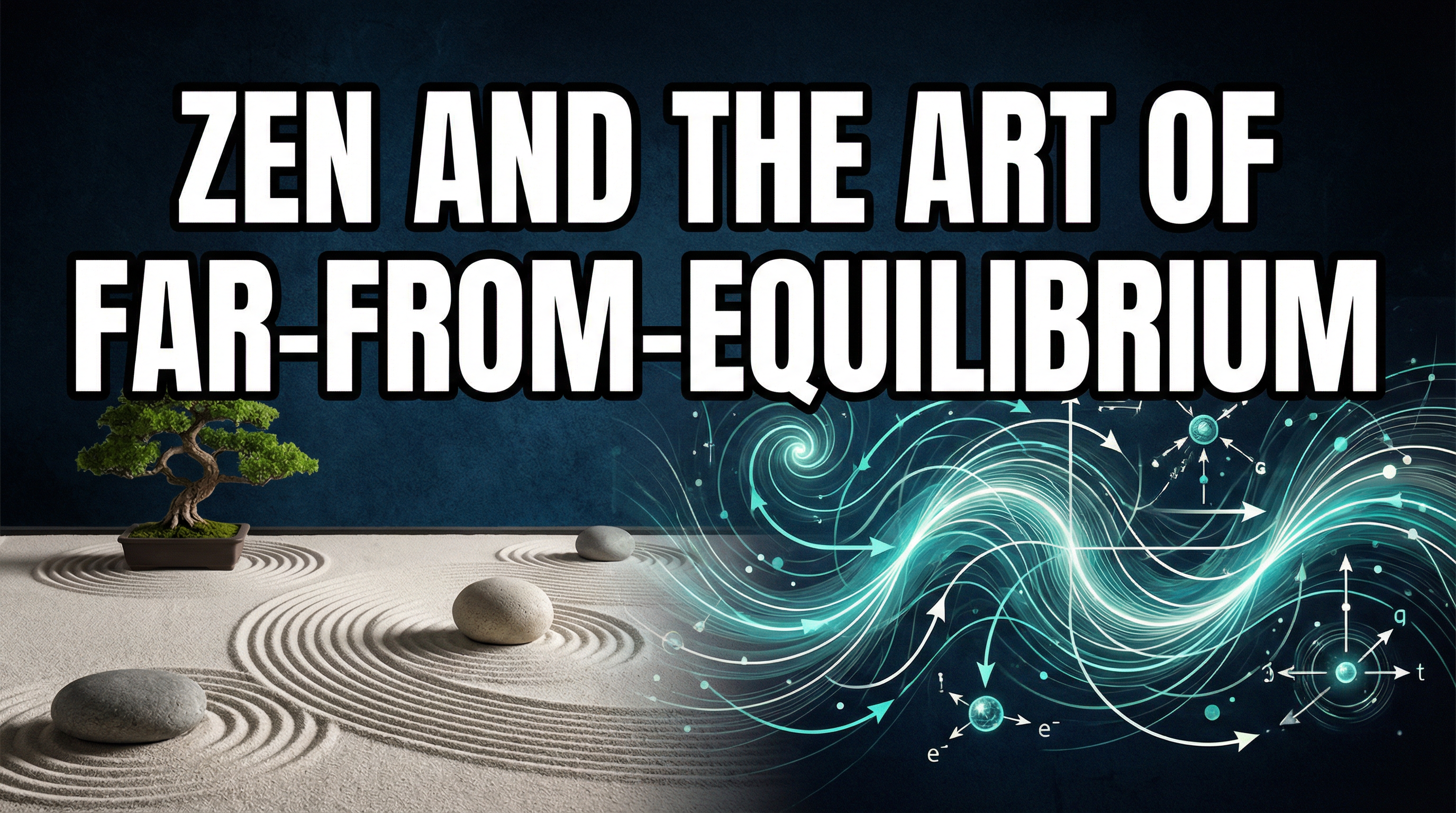
Zen and the Art of Far-From-Equilibrium
Zen koans break your rational mind to access flow. Dr. Bob's work explains why this works. The neuroscience of enlightenment.

Full Article
Zen and the Art of Far-From-Equilibrium
Your Brain is a Liar
Let me ask you something. Do you believe your thoughts? Do you trust that little voice in your head that narrates your life, judges your every move, and constantly tries to make sense of the world? Most people do. We spend our lives tethered to our rational minds, believing that logic and reason are the ultimate tools for navigating reality.
What if I told you that this belief is not only wrong, but it's the very thing holding you back from a life of effortless action and profound insight? What if the key to unlocking your true potential lies not in thinking harder, but in learning to shut your damn brain up?
This isn’t some new-age mumbo jumbo. This is the core teaching of Zen Buddhism, a practice that has been around for centuries. And now, thanks to the work of scientists like the legendary Dr. Bob Melamede, we can finally understand the hard science behind why it works. It all comes down to a concept called far-from-equilibrium thermodynamics. It’s time to break your rational mind to access flow.
The Trap of "Knowing"
We’re obsessed with knowing. From the moment we’re born, we’re taught to label, categorize, and understand everything. We build complex mental models of the world, and we cling to them like life rafts in a sea of uncertainty. The problem is, these models are bullshit. They’re simplified, distorted, and ultimately, they’re a prison for your mind.
This is where Zen koans come in. A koan is a riddle that your rational mind can’t solve. It’s a paradox, a contradiction, a slap in the face to your precious logic. Here’s a classic one: “What is the sound of one hand clapping?”
Go ahead, try to figure it out. Your mind will spin in circles, desperately searching for a logical answer. But there isn’t one. The koan is designed to break your rational mind, to force you to abandon your need for a neat and tidy explanation. It’s a tool for short-circuiting the analytical part of your brain and accessing a deeper, more intuitive way of knowing.
The koan blows holes in the rational thought to get access to a deeper truth, liberating, insightful and sometimes enlightening.
When you stop trying to “figure it out” and simply sit with the question, something amazing happens. Your mind gets quiet. The constant chatter fades away, and you’re left with a sense of pure awareness. This is the gateway to flow, that elusive state of peak performance where you’re completely absorbed in the present moment, and action happens effortlessly.
Ditching the Rear-View Mirror: FLPs vs. BLPs
Dr. Bob had this great concept of Forward-Looking People (FLPs) and Backward-Looking People (BLPs). BLPs are stuck in the past. They’re the ones clinging to their outdated mental models, resisting change, and trying to force the world to conform to their expectations. They’re living in a state of high stress and chronic inflammation, and they’re slowly but surely being crushed by the relentless forward march of time.
FLPs, on the other hand, have embraced the far-from-equilibrium nature of reality. They understand that the past is gone, and the future is unwritten. They’re adaptable, resilient, and constantly learning. They’ve learned to quiet their minds, trust their intuition, and ride the wave of change. They are, in essence, living in a state of flow.
So, how do you become an FLP? You start by recognizing that your rational mind is not your friend. It’s a tool, and a limited one at that. You learn to question your thoughts, to challenge your assumptions, and to embrace uncertainty. You start a meditation practice. You spend time in nature. You do things that scare you. You learn to listen to your body and your intuition.
And you practice with koans. You sit with the paradox, you embrace the confusion, and you allow your rational mind to break. It’s not about finding the “right” answer. It’s about the process of letting go of the need for an answer. It’s about surrendering to the mystery of the present moment.
The Takeaway: Your Action Items for a Life of Flow
This all sounds great in theory, but how do you actually apply it to your life? Here are a few practical steps you can take to start living in a more far-from-equilibrium way:
- Question Everything: The next time you have a strong opinion or a deeply held belief, ask yourself: “Is this really true?” Be willing to entertain the possibility that you might be wrong.
- Embrace the “Don’t Know” Mind: The next time you’re faced with a difficult problem, resist the urge to immediately jump to a solution. Instead, sit with the question. Allow yourself to be in a state of not knowing. This is where true creativity and insight come from.
- Practice Mindfulness: Start a daily meditation practice, even if it’s just for five minutes. The goal is not to stop your thoughts, but to become aware of them without judgment. This will help you to create a space between you and your thoughts, and to realize that you are not your thoughts.
- Get Out of Your Comfort Zone: Do something that scares you every day. This could be anything from striking up a conversation with a stranger to learning a new skill. The more you expose yourself to novelty and uncertainty, the more you’ll train your brain to be adaptable and resilient.
Closing
Look, the world is not a neat and tidy place. It’s a chaotic, unpredictable, and constantly changing mess. You can either fight against this reality, or you can learn to dance with it. The choice is yours. But if you want to live a life of purpose, passion, and peak performance, you need to let go of your need for control and embrace the beautiful, terrifying, and ultimately liberating truth of far-from-equilibrium thermodynamics.
It’s time to stop thinking and start living. It’s time to break your rational mind and access the flow that is your birthright. The path isn’t easy, but it’s the only one that leads to true freedom.
Comments
Related Articles
The Tortoise Strategy
The State is Entropy
Why Some People Can't Handle Change

The FLP Advantage in the AI Age
Stop Trying to Convince BLPs
Want More?
Subscribe to The Forward Look on YouTube to get notified when new episodes drop.
Subscribe