Why Some People Can't Handle Change
It's not stubbornness. It's biology. The neuroscience of why some brains are wired for novelty and others for safety. And what to do about it.
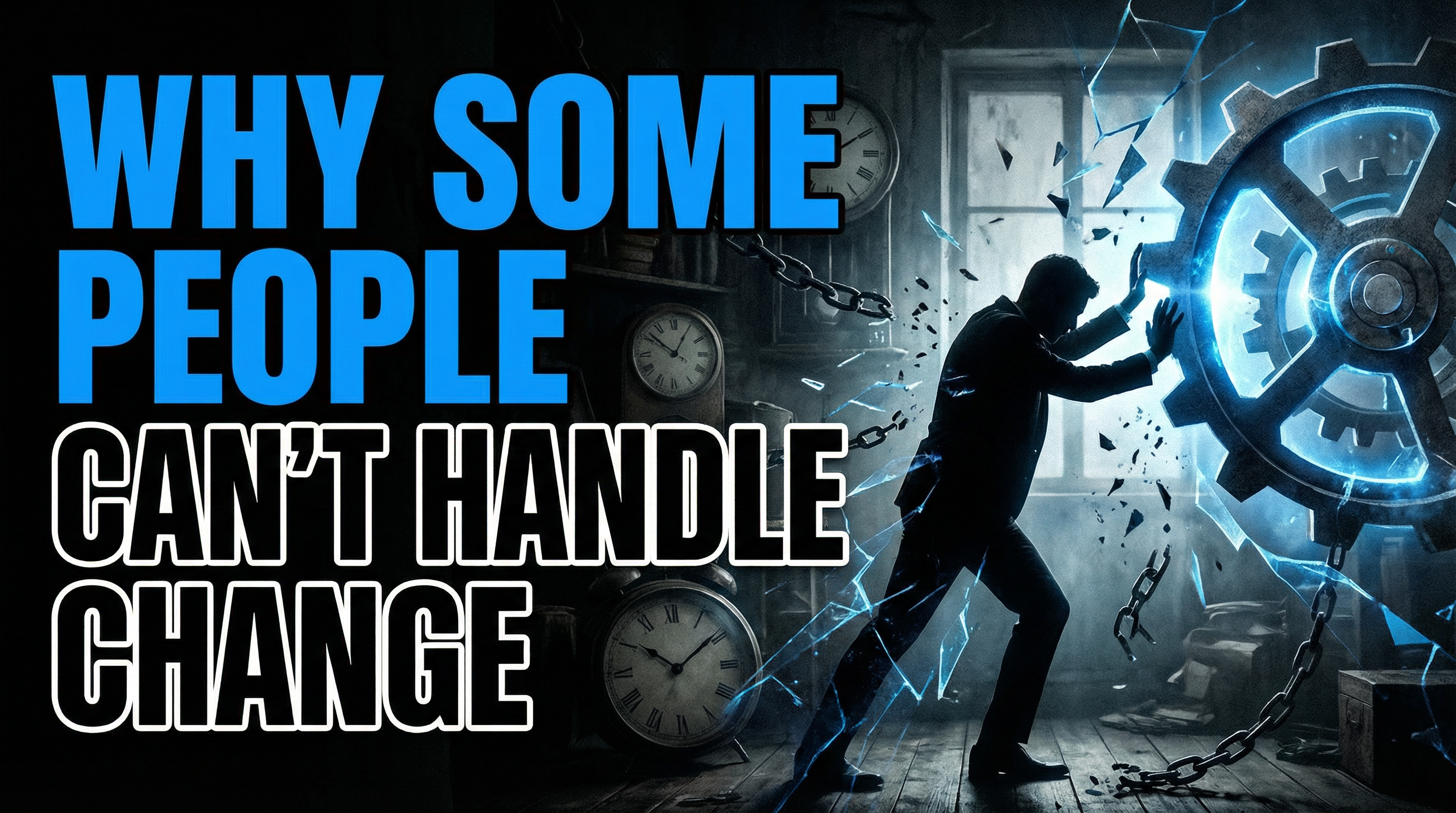

Full Article
Why Some People Can't Handle Change
Let's cut the bullshit. You know someone who digs their heels in at the slightest hint of change. Maybe it's your uncle who still thinks the internet is a fad, your boss who insists on using a fax machine, or maybe, just maybe, it's you. You see them as stubborn, rigid, maybe even a little bit dumb. You think if they just "opened their mind," they'd see the light.
You're wrong.
It’s not a character flaw. It’s not a choice. It’s biology, pure and simple. Their brains are wired differently. And understanding that difference is the key to everything.
The Problem: Chasing a Ghost
We live in a world that worships at the altar of "balance." We're told to seek equilibrium in our lives, our diets, our work. It's a comforting thought. It's also a complete and utter fantasy. The universe isn't about balance; it's about a relentless, chaotic, and beautiful dance away from it.
Life doesn't happen in a state of perfect, boring equilibrium. Life happens at the edge of chaos.
This is the fundamental truth that my mentor, the legendary Dr. Bob Melamede, a stoned-out hippie with a PhD in biochemistry, dedicated his life to understanding. He saw that the universe is governed by the Second Law of Thermodynamics. Entropy. Disorder. It always increases. Time only moves forward. You can't go back.
And here's the kicker: your body knows this. Your very cells are in a constant state of flux, a dynamic, far-from-equilibrium state. To be alive is to be in a state of managed chaos.
So what happens when your brain is wired to resist this fundamental truth? You get what I call a Backward-Looking Person, or a BLP. They are fighting a losing battle against the arrow of time. They are trying to hold onto a past that doesn't exist, seeking a stability that is an illusion. And it's making them, and everyone around them, miserable.
The Application: Are You a FLP or a BLP?
So, how does this play out in the real world? Look at the business world. Blockbuster Video was a classic BLP organization. They had a winning formula, and they clung to it for dear life, even as a little FLP company called Netflix was rewriting the entire damn rulebook. Blockbuster's collective corporate brain was wired for safety, for the familiar. They couldn't handle the change, and it drove them straight into the grave. Contrast this with a company like Amazon. From its origins as an online bookstore, it has relentlessly evolved, expanding into cloud computing, streaming media, and artificial intelligence. Amazon is a quintessential FLP organization, constantly dancing at the edge of chaos, embracing disruption, and reinventing itself. It's a living testament to the power of a forward-looking mindset.
Think about your own life. Where are you being a BLP? Are you staying in a job you hate because it's familiar? Are you refusing to learn a new skill because it feels too hard? Are you clinging to a relationship that's draining the life out of you because the alternative is too scary? That's your amygdala talking. That's your inner BLP fighting against the arrow of time.
Reflecting on my own journey, I realize how often I resisted change and clung to familiar patterns, even when they no longer served me. I made decisions driven more by fear and the desire to protect my ego than by what was truly best for my growth. Recognizing this helped me understand the deeper reasons why change can feel so difficult and intimidating.
It makes me laugh to reflect upon some of the choices I've made in my former life. Man was I a fucking idiot! I used to resist change; I used to hold on to things that were not; I made horrendous decisions every day, all in the effort to preserve my ego and resist change.
The Takeaway: How to Rewire Your Brain
You can't change your fundamental wiring overnight. But you can train your brain to be more adaptable. You can learn to be a FLP.
- Starve the Fear, Feed the Curiosity: The next time you feel that knee-jerk resistance to change, pause. Acknowledge the fear. Thank your amygdala for trying to keep you safe. And then, deliberately, choose to be curious. Ask, "What if?" What if this change is an opportunity? What if this new thing is better than the old thing? You are not your fear. This is a cognitive reframing technique. By consciously choosing curiosity over fear, you are activating your prefrontal cortex and calming your amygdala. You are telling your brain that you are in control, not your primal instincts.
- Embrace Small Disruptions: Start small. Take a different route to work. Try a new food. Read a book on a topic you know nothing about. Each time you step out of your comfort zone, you are creating new neural pathways. You are teaching your brain that novelty is not a threat. This process, known as neuroplasticity, is the brain's remarkable ability to reorganize itself by forming new neural connections. Every small act of courage, every step into the unknown, physically rewires your brain to be more open and adaptable.
- Study the Masters of Chaos: Read about complex systems. Learn about entropy and the arrow of time. Dive into Dr. Bob Melamede's work. The more you understand the fundamental principles of the universe, the less you will fear them. You'll start to see the beauty in the chaos. You'll begin to understand that the universe is not a machine, but a living, breathing organism, and you are a part of it. You'll see that the path forward is not a straight line, but a meandering, unpredictable, and ultimately beautiful journey.
This isn't about becoming a reckless adrenaline junkie. It's about becoming more resilient, more adaptable, and ultimately, more alive. It's about recognizing that the only constant in life is change, and the only way to thrive is to embrace it.

Comments
Related Articles

The Future is Decentralized

The Plant That Evolved With Us

Why Comfort is Killing You

IKE: The World Is What You Think It Is

Why Modern Medicine is Failing (And What You Can Do About It)
Want More?
Subscribe to The Forward Look on YouTube to get notified when new episodes drop.
Subscribe