Buddhism and the Arrow of Time
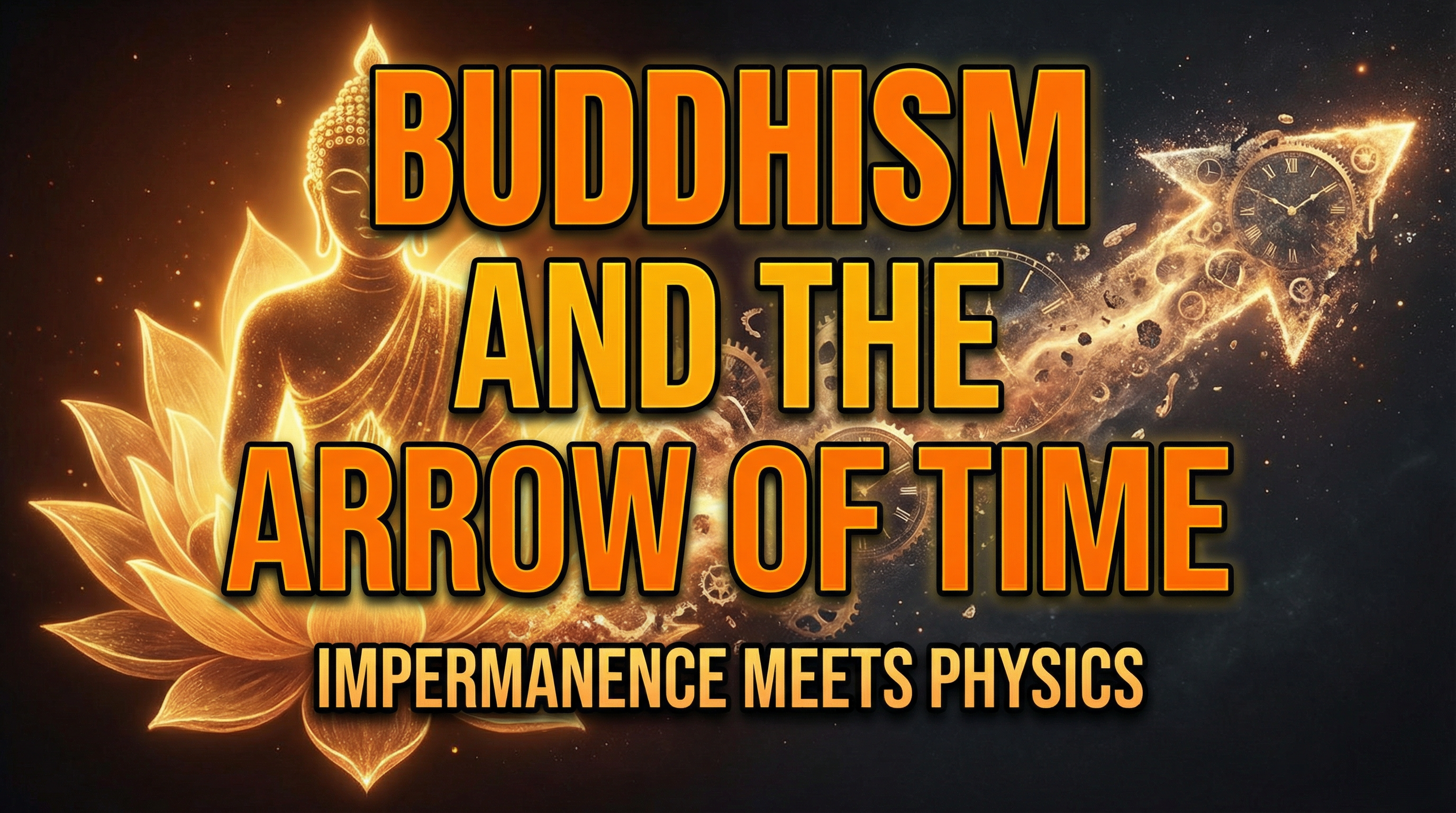
Impermanence. Non-attachment. The Buddha understood entropy. Buddhist philosophy as a practical guide to living with thermodynamic reality.
Full Article
Buddhism and the Arrow of Time
You Think You're In Control? Bullshit.
You think you're in control? That's cute. You meticulously plan your life, your career, your 401k, as if you're the master architect of your own destiny. You cling to your possessions, your relationships, your youth, your very identity, like a drowning man clutching a fistful of water. Let me tell you something, my friend: you're not in control. The universe is a runaway freight train thundering down a one-way track, and you're just a passenger along for the ride. But what if I told you the secret isn't to frantically claw for the emergency brake, but to learn how to dance in the dining car?
What if I told you that a 2,500-year-old philosophy from the East and one of the most fundamental laws of modern physics are singing the exact same tune? It’s the song of impermanence, the anthem of change. The Buddha and the second law of thermodynamics are about to have a conversation, and you're invited to listen in. It might just change the way you see everything.
The Problem: Our Bullshit Battle Against Time
Let's be honest. You spend most of your life fighting a war you can't win. You fight to keep your body young, your car new, your relationships exactly as they were in that one perfect moment. You are a Backward-Looking Person (BLP), trying to swim up a waterfall. You're obsessed with the past, a place that doesn't even exist anymore, and you're terrified of the future, the only place you can actually go. The BLP is the person who laments that music was better in their day, who refuses to learn new technology, who defines themselves by a job they lost five years ago. They are living in a museum of their own memory, dusting off relics while life is happening, vibrant and chaotic, right outside their door.
This clinging, this desperate, white-knuckled attachment to things that are fundamentally transient, is the root of all your suffering. The Buddha had a word for it: upadana. It’s the source of dukkha, the deep, pervasive dissatisfaction that gnaws at you even when things are going your way. Why? Because deep down, you know it can't last. You're trying to build a house of cards in a hurricane. It's a rigged game, and the house always wins. Every moment of pleasure is tinged with the fear of its ending. Every success is shadowed by the anxiety of its eventual decline. You're not living; you're preserving. And it's exhausting.
The Application: The Buddha Was a Thermodynamicist
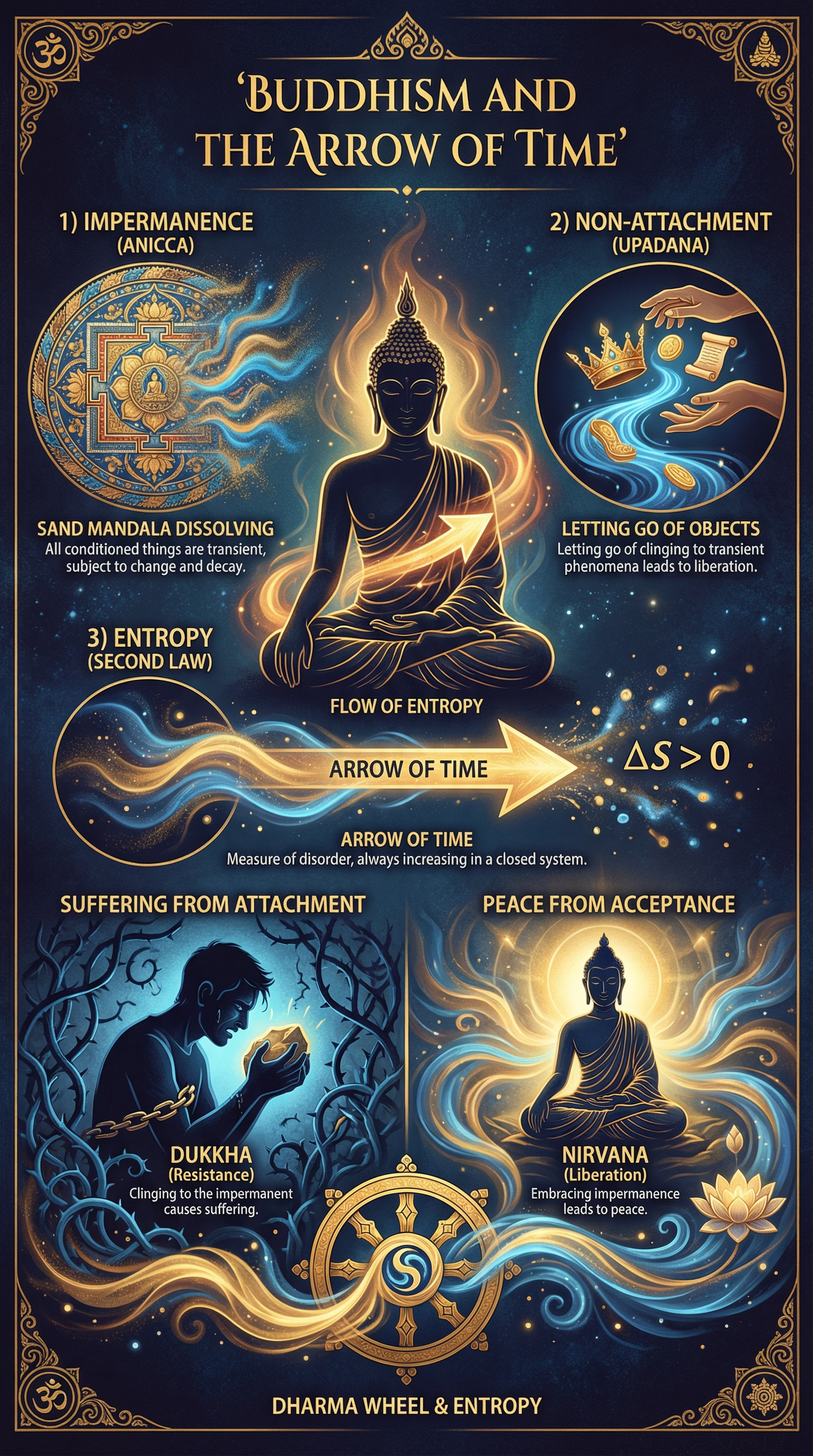
The Buddha didn't have a PhD in physics, but he didn't need one. He saw the second law of thermodynamics playing out all around him. He saw it in sickness, old age, and death. He called it anicca, or impermanence. It's the first of the three marks of existence. Everything that arises, passes away. No exceptions. Your thoughts, your feelings, your body, your relationships, your possessions, your achievements – all of it is in a constant state of flux. To the Buddha, this wasn't a depressing thought; it was a liberating one.
"The only thing that is constant is change. Your suffering comes from expecting anything else. That's the cosmic joke, and you're the punchline."
If everything is impermanent, then non-attachment isn't some passive, nihilistic philosophy for doormats. It's the ultimate survival strategy. It's the martial art of the mind. It's about letting go of the rope and learning to flow with the current. This is the path of the Forward-Looking Person (FLP). The FLP understands that security is an illusion and that the only real safety is in adaptability. They don't fear the future; they engage with it. They don't mourn the past; they learn from it. They see change not as a threat, but as an opportunity.
Reflecting on my own journey, I realize how often I clung to illusions of permanence, resisting the inevitable changes around me. In those moments, I made choices driven by attachment and fear, striving to preserve a fixed sense of self rather than embracing the flow of life. Recognizing this pattern was a crucial step toward understanding non-attachment not just as a concept, but as a lived practice.
The Takeaway: How to Surf the Arrow of Time
So how do you stop being a BLP and start surfing the arrow of time? It's not about chanting in a cave (unless that's your thing). It's about a radical shift in perspective and practice.
- Practice 'Entropy Meditation': You don't need a cushion for this. Just open your damn eyes. Actively observe impermanence everywhere. Watch the steam rise from your coffee and disappear. Watch the clouds morph and dissolve. Feel the ache in your muscles after a workout – that's the breakdown of tissue that leads to growth. Acknowledge the decay, the change, the flow. Don't judge it. Don't resist it. Just see it. This is reality. Make it a daily practice to notice five things that have changed since yesterday. The new weed in your garden, the crack in the sidewalk, the different expression on your partner's face. This trains your brain to see the world as it is: a process, not a static picture.
- Conduct a 'Clinging Audit': Get out a piece of paper and be brutally honest with yourself. What are you white-knuckling in your life? Your job title? Your political tribe? Your story about your past? Your idea of who you are? Make a list. Now, for each item, ask yourself: "What am I so afraid would happen if I just... loosened my grip?" The fear is the lock. Awareness is the key. Go deeper. What belief about yourself is tied to this clinging? That you're only valuable if you're successful? That you're only lovable if you're perfect? Challenge those bullshit beliefs.
- Feed Your ECS: Your body already knows how to do this. It wants to adapt and flow. Help it out. Move your body in ways that feel good. Get some sunshine on your skin. Eat real food, not processed crap. Laugh your ass off, even at the absurdity of it all. Reduce chronic, unnecessary stress by recognizing what's actually a threat and what's just your mind telling you stories. You don't need to be a biohacker. Just be a human being. Your endocannabinoid system will thank you by keeping you balanced on the surfboard, ready for the next wave.
Closing
The universe is not against you. It's just indifferent. It has one simple rule: everything changes. You can spend your life fighting this rule, and you will be miserable. Or, you can accept it, embrace it, and learn to dance with it. The Buddha pointed the way. Modern physics drew the map. The choice, as always, is yours.
Stop trying to build a dam. Learn to build a surfboard.
Related Reading
- Metabolism Drives Evolution — How energy flow shapes life
- The Belousov-Zhabotinsky Reaction — Chemistry that defies intuition

References
- [The Wisdom of Nature: Honoring Dr. Bob - A Pioneer in Cannabis Science](https://cashom.substack.com/p/the-wisdom-of-nature-honoring-dr)
- [Second Law Of Thermodynamics Is Part Of Anicca! - Pure Dhamma](https://puredhamma.net/dhamma-and-science/second-law-of-thermodynamics-is-part-of-anicca/)
Comments
Related Articles

The Universe Doesn't Care About Your Feelings
Why the Old Institutions Are Failing

The Plant That Evolved With Us
The Consciousness Question Nobody's Asking
Sleep is Non-Negotiable
Want More?
Subscribe to The Forward Look on YouTube to get notified when new episodes drop.
Subscribe