Your Body's Operating System
If your body were a computer, the ECS would be the operating system. It's managing everything in the background. Here's how it works.

Full Article
Your Body's Operating System
You think you're in control? That's cute. You think that little voice in your head, the one that's reading these words right now, is the one calling the shots? Bullshit. You're not the CEO of your body; you're more like the intern who gets coffee and occasionally gets to sit in on the big meetings. The real boss, the one running the entire show from behind the scenes, is a system you've probably never even heard of: the Endocannabinoid System (ECS).
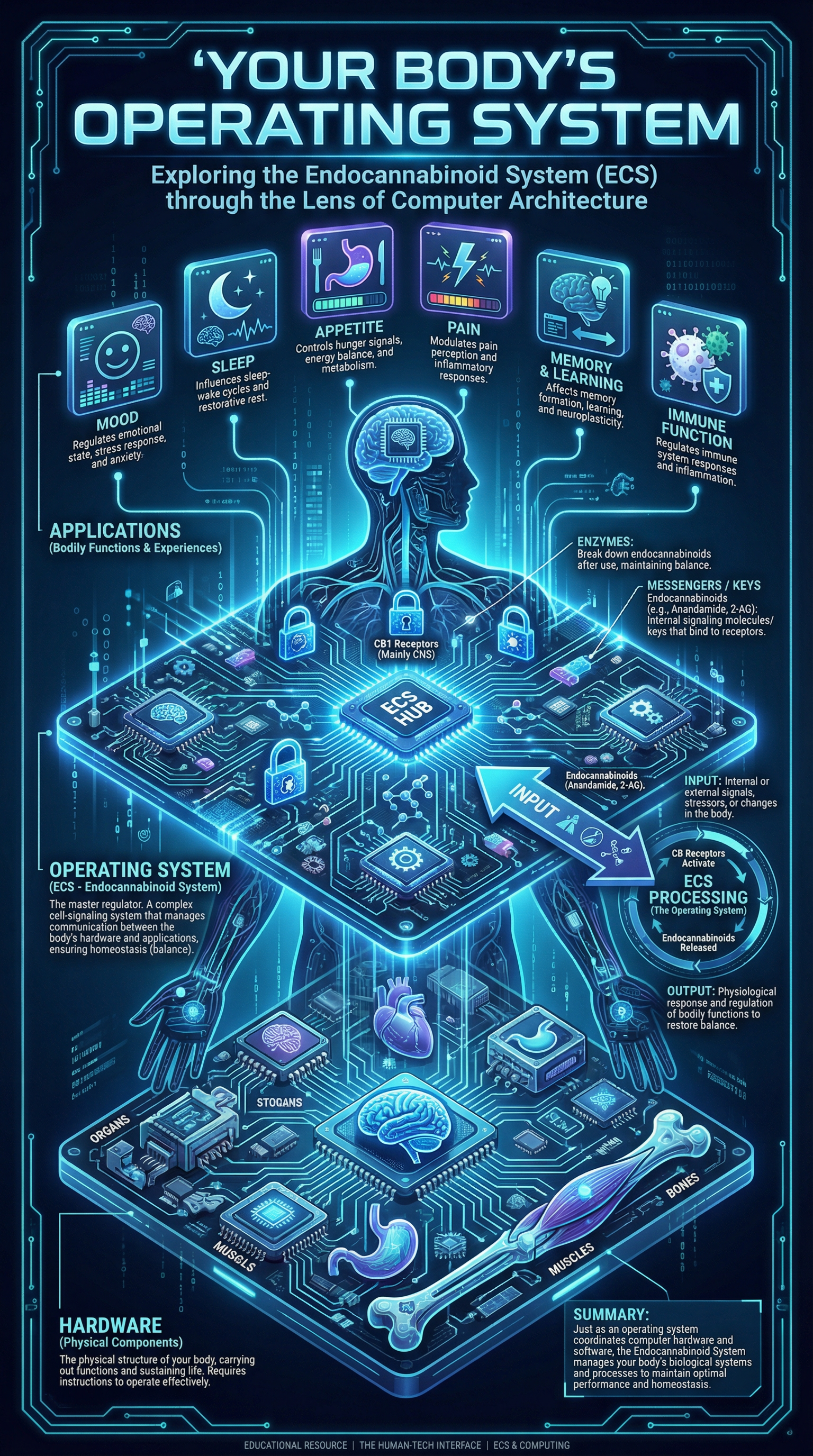
If your body were a computer, the ECS would be its operating system. It’s the silent, tireless manager making sure all the other programs are running smoothly, talking to each other, and not crashing the whole damn machine. It’s the master regulator, the conductor of the symphony of life, and you’ve been blissfully unaware of its existence. Until now. This isn't some fringe, woo-woo concept; it's one of the most important physiological systems in the human body, and understanding it is the key to unlocking a new level of health and performance.
The Problem: We’re All Looking in the Wrong Direction
For decades, we’ve been obsessed with treating symptoms. Got a headache? Pop a pill. Feeling anxious? Here’s a prescription. We’re constantly playing a game of whack-a-mole with our health, chasing after individual problems without ever asking why they’re happening in the first place. It’s a backward-looking approach, a relic of a bygone era of medicine that sees the body as a collection of separate parts rather than a unified, interconnected whole.
This is where my mentor, the legendary Dr. Bob Melamede, would lean back, a twinkle in his eye, and tell you that you’re missing the forest for the trees. Dr. Bob, the "stoned-out hippie with a PhD," was a visionary who saw the bigger picture. He understood that life isn’t about maintaining a static, boring equilibrium. It’s about existing in a state of far-from-equilibrium thermodynamics, constantly adapting and evolving at the edge of chaos. And the ECS is the key to navigating that chaos.
"The past doesn't exist. The future is uncertain. The only thing that's real is the present moment, and your ability to adapt to it."
We’ve been so focused on the individual applications—the software—that we’ve completely ignored the operating system. We’re trying to fix a software bug by smashing the monitor. It’s time to stop being Backward-Looking People (BLPs) and start being Forward-Looking People (FLPs). It’s time to understand the system that’s actually in charge. The BLP sees a symptom and wants to suppress it. The FLP sees a symptom and asks, "What is my body trying to tell me? What is the underlying imbalance that needs to be addressed?" This is the fundamental shift in perspective that can change everything.
The Application: So What Does This Mean for You?
Understanding the ECS isn’t just some abstract scientific exercise. It has profound implications for how you live your life. When your ECS is running smoothly, you’re more resilient to stress, you have a stronger immune system, and you’re better able to adapt to the challenges that life throws your way. You’re a Forward-Looking Person, flowing with the current of time instead of fighting against it.
But what happens when your ECS is out of whack? When it’s not producing enough endocannabinoids, or when your receptors aren’t functioning properly? That’s when you start to see problems. Chronic pain, anxiety, inflammation, autoimmune disorders—these are all signs of a dysfunctional ECS. You’re stuck in a backward-looking loop, unable to adapt, and your health suffers as a result.
Understanding the impact of a dysfunctional ECS made me reflect on my own experiences with resistance to change and poor decision-making. Like many, I struggled to adapt, often holding onto habits and beliefs that no longer served me. This personal journey eventually led me to encounter a group of people whose approach to cannabis challenged my previous assumptions.
Looking back, I realize how much my resistance to change was tied to fear and misconceptions, especially around things I didn’t fully understand. For example, I once found myself in the company of people casually using cannabis—not the stereotypes I had imagined, but professionals who were grounded, healthy, and focused. This experience challenged my long-held beliefs and showed me that my fears were largely unfounded. It was a small but meaningful step in becoming more open and adaptable, which ultimately ties into how we can better support our body's internal systems, like the endocannabinoid system, to foster resilience and growth.
The Takeaway: How to Upgrade Your OS
You don’t have to be a "stoned-out hippie" to benefit from this knowledge. There are plenty of ways to support your ECS and become a more forward-looking, adaptable human being. Here are a few to get you started:
- Eat a healthy diet: Your body needs the right raw materials to produce endocannabinoids. That means plenty of omega-3 fatty acids, which are found in foods like fish, flaxseeds, and walnuts. It also means cutting down on processed foods and sugar, which can cause inflammation and disrupt the delicate balance of your ECS.
- Exercise regularly: Physical activity has been shown to boost endocannabinoid levels, which is one of the reasons why you feel so good after a workout. That "runner's high" you've heard about? That's not just endorphins; it's your ECS at work.
- Reduce stress: Chronic stress is a major drain on your ECS. Find healthy ways to manage your stress, whether it’s through meditation, yoga, or spending time in nature. Even just taking a few deep breaths can help to activate your vagus nerve and stimulate your ECS.
- Consider cannabis: If you’re struggling with a chronic health issue, or if you just feel like your system needs a boost, cannabis can be a powerful ally. Talk to a knowledgeable doctor or cannabis consultant to find the right product and dosage for you. And don't be afraid to experiment. Everyone's ECS is different, so what works for one person may not work for another.
It’s time to stop being a passive passenger in your own body. It’s time to take the wheel. By understanding and supporting your ECS, you can upgrade your body’s operating system and unlock your full potential for health, happiness, and resilience. You can become the architect of your own evolution.

Comments
Related Articles

Why Your Parents Don't Get It

How to Think About AI (Without Panicking)

Why I'm a Thermodynamic Libertarian

Why Cannabis Works (The Real Science)

Dr. Bob's Flow vs. The Tao
Want More?
Subscribe to The Forward Look on YouTube to get notified when new episodes drop.
Subscribe