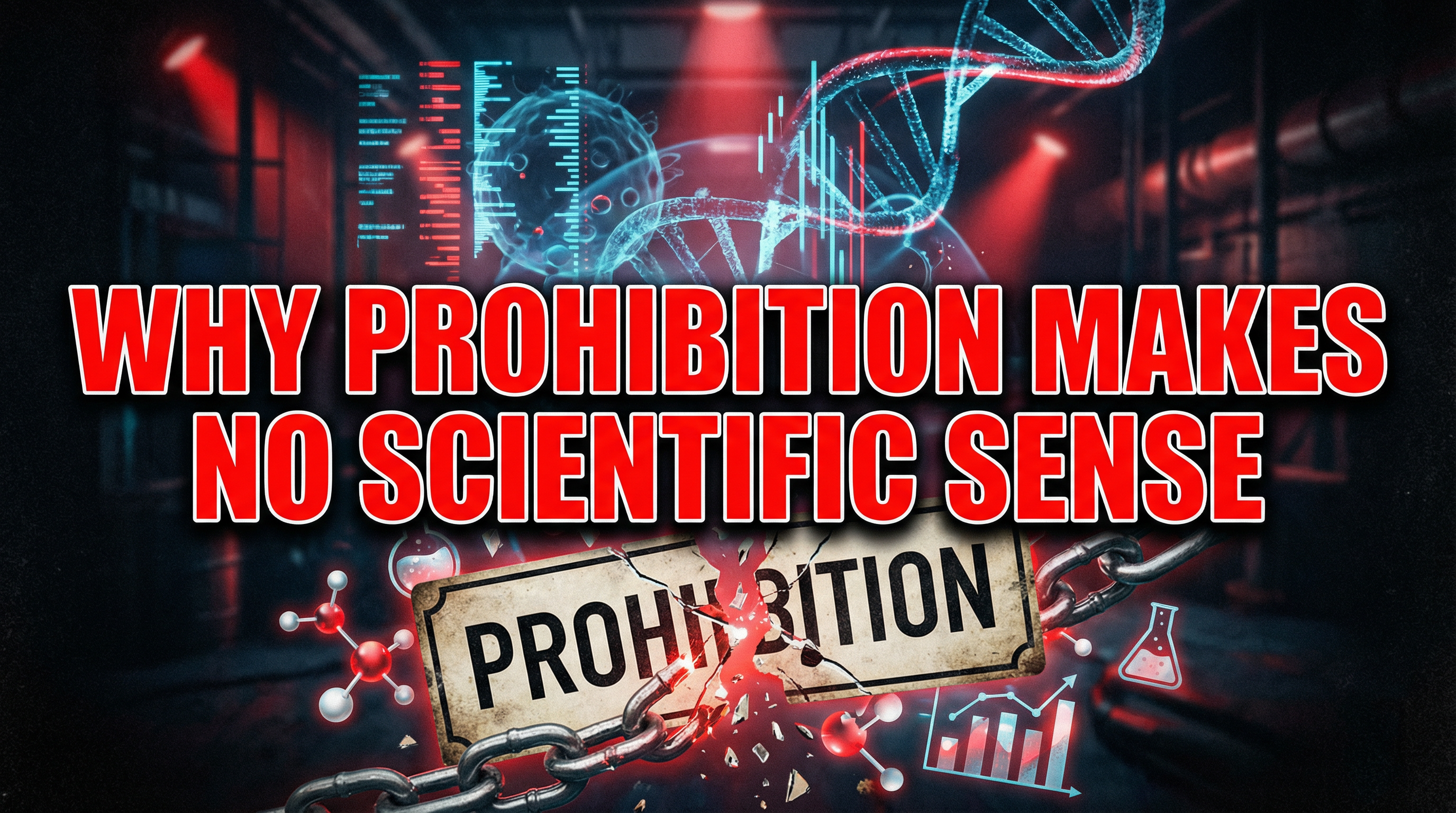
Why Prohibition Makes No Scientific Sense
The Schedule I classification of cannabis is scientifically indefensible. A 4:20 breakdown of why the law is 50 years behind the science.
Full Article
Why Prohibition Makes No Scientific Sense
Let me ask you a question, and I want you to be brutally honest with yourself. Why does the United States government, in its infinite wisdom, classify cannabis as one of the most dangerous substances on Earth? I’m not kidding. They have it listed as a Schedule I drug, right alongside heroin. That means it has “no currently accepted medical use and a high potential for abuse.”
Meanwhile, drugs like cocaine, methamphetamine, and fentanyl—substances that are actively destroying lives and communities—are all listed on Schedule II. The government’s official position is that meth has more medical value than a plant that has been used by humans for thousands of years. If that doesn’t set off your bullshit detector, you need to get it recalibrated. This isn’t just a dumb policy; it’s a 50-year-old lie that is scientifically indefensible. The prohibition of cannabis is a political decision, a relic of a bygone era that flies in the face of everything we know about thermodynamics, biology, and the very nature of life itself.
The Problem: A 50-Year-Old Lie
To understand how we got here, you have to go back to 1970 and the Controlled Substances Act. This was the legal framework for the “war on drugs,” and it gave the federal government the power to categorize substances based on their perceived risk. The decision to place cannabis on Schedule I was made against the advice of the government’s own commission. The National Commission on Marihuana and Drug Abuse, also known as the Shafer Commission, was appointed by President Nixon himself. After two years of exhaustive research, they concluded that cannabis should be decriminalized. Nixon, of course, ignored them. He wanted a weapon to use against the anti-war left and black people, and cannabis was the perfect tool.
It’s a political decision, not a scientific one. And it’s created a system riddled with hypocrisy. You can get a prescription for Desoxyn, which is literally pharmaceutical-grade methamphetamine, but a cancer patient can’t legally use a plant to manage their nausea. It’s insane. The entire classification system is a house of cards built on a foundation of political expediency and cultural prejudice. It has nothing to do with science or public health. It’s bullshit.
The Application: FLPs vs. BLPs in the War on Drugs
Dr. Bob used to talk about two kinds of people: Forward-Looking People (FLPs) and Backward-Looking People (BLPs). BLPs are stuck in the past. They resist change, they fear the unknown, and they are constantly trying to impose a rigid, static order on a world that is inherently dynamic. They are the people who build walls, who cling to outdated dogmas, and who try to legislate morality. Prohibition is a classic BLP move. It’s an attempt to freeze the world in a particular state, to deny the reality of change, and to punish those who dare to think differently.
FLPs, on the other hand, embrace change. They are adaptable, creative, and resilient. They understand that the only constant is change, and they are always looking for new ways to grow and evolve. They are the artists, the entrepreneurs, the scientists, and the innovators who are constantly pushing the boundaries of what’s possible. And a lot of them use cannabis. Not to escape from reality, but to engage with it more deeply. To see new patterns, to make new connections, and to find new solutions to old problems.
Embracing change also meant challenging my own long-held beliefs, including those about drug use. I remember the moment I found myself in the company of people who were smoking weed—not the stereotypes I had been taught to expect, but professionals who were thoughtful, productive, and grounded. This experience opened my eyes to the fact that many of my fears were based on misconceptions rather than reality. Trying it myself, I realized that the experience did not transform me or alter my consciousness in any drastic way. It was a small step toward understanding that prohibition often distorts our perception of substances and those who use them. With this new perspective, the question becomes: how do we move from a backward-looking system of prohibition to a forward-looking system of freedom and adaptation? It starts with you.
The Takeaway
So what do we do with this information? How do we move from a backward-looking system of prohibition to a forward-looking system of freedom and adaptation? It starts with you.
First, educate yourself. Don’t take my word for it. Read the science. Watch Dr. Bob’s lectures on YouTube. Learn about the endocannabinoid system and far-from-equilibrium thermodynamics. The truth is out there, but you have to be willing to look for it.
Second, challenge the narrative. The next time you hear someone repeating the tired, old talking points of the drug war, ask them to defend their position with science. Ask them to explain why meth is considered safer than cannabis. Don’t be an asshole about it, but don’t be afraid to speak the truth. The more we challenge the official narrative, the weaker it becomes.
Third, support the movement. There are organizations all over the country that are fighting for cannabis legalization and scientific freedom. Find one that you believe in and give them your time, your money, or your voice. We are at a tipping point in this country, and every single one of us has a role to play.
Closing
Prohibition isn’t just a failed policy; it’s a rejection of the fundamental principles of life and adaptation. It’s a backward-looking attempt to hold back the tide of progress, and it’s doomed to fail. The science is clear, the momentum is on our side, and the future is ours to create. It’s time to tear down this 50-year-old lie and build a system that is based on science, compassion, and freedom.
References
- Shafer, R. P. (1972). Marihuana: A Signal of Misunderstanding. The Official Report of the National Commission on Marihuana and Drug Abuse.
- Melamede, R. (2005). Cannabis and Endocannabinoids: A New Perspective on Health and Disease. Various lectures and presentations available on YouTube.
Comments
Related Articles

Why Eastern Religions Got It Right
The Observer Changes the Observed
Why Cannabis Works (The Real Science)
The Tao is Thermodynamics
Meaning is Created, Not Found
Want More?
Subscribe to The Forward Look on YouTube to get notified when new episodes drop.
Subscribe