Why Free Markets Are Thermodynamically Correct
Far-from-equilibrium systems self-organize best without central control. The physics case for libertarian economics. Hayek meets Prigogine.
Full Article
Why Free Markets Are Thermodynamically Correct
Let's Get Something Straight
You think you understand how the world works? You think that all this complexity, all this beautiful, chaotic, glorious mess we call life, is the result of some grand plan? Some top-down, intelligent design? That there’s a master puppeteer pulling the strings, and if we could just figure out the instruction manual, everything would be perfect?
Bullshit.
That’s your backward-looking brain talking. The part of you that craves order, predictability, and control because it’s scared of the unknown. The part that wants to believe someone is at the wheel, even if they’re driving us off a cliff. But I'm here to tell you, the universe doesn't work that way. And neither do free markets.
The Problem With Your Clockwork Universe
Most people, and that probably includes you, see the world as a system in equilibrium. A delicate balance that needs to be maintained. A clock that, if you just wind it up right, will tick along perfectly forever. This is the thinking behind central planning, behind command-and-control economies, behind every politician who thinks they can "fix" the system if you just give them enough power.
They're all wrong. And they're not just a little wrong. They're fundamentally, scientifically, thermodynamically wrong. They’re trying to apply 17th-century Newtonian physics to a 21st-century world, and it’s a recipe for disaster. It’s like trying to perform surgery with a sledgehammer.
"The idea that we can control complex systems is a dangerous illusion. It leads to fragility, not resilience. It's the backward-looking person's (BLP) attempt to impose a static order on a dynamic universe."
Life isn't a system in equilibrium. Life exists at the edge of chaos. It's a far-from-equilibrium system, constantly adapting, evolving, and self-organizing. And the same is true for a healthy economy. The moment you try to freeze it in place, to perfect it, you kill it. You turn a vibrant, living system into a dead, sterile machine.
The Application: Why Free Markets Are a Force of Nature
So what does all this have to do with free markets? Everything.
A free market is a far-from-equilibrium system. It's a complex, adaptive system that is constantly self-organizing. Millions of individuals, each acting in their own self-interest, create a spontaneous order that is far more efficient and resilient than any centrally planned economy could ever be. It’s the ultimate expression of self-organization on a global scale.
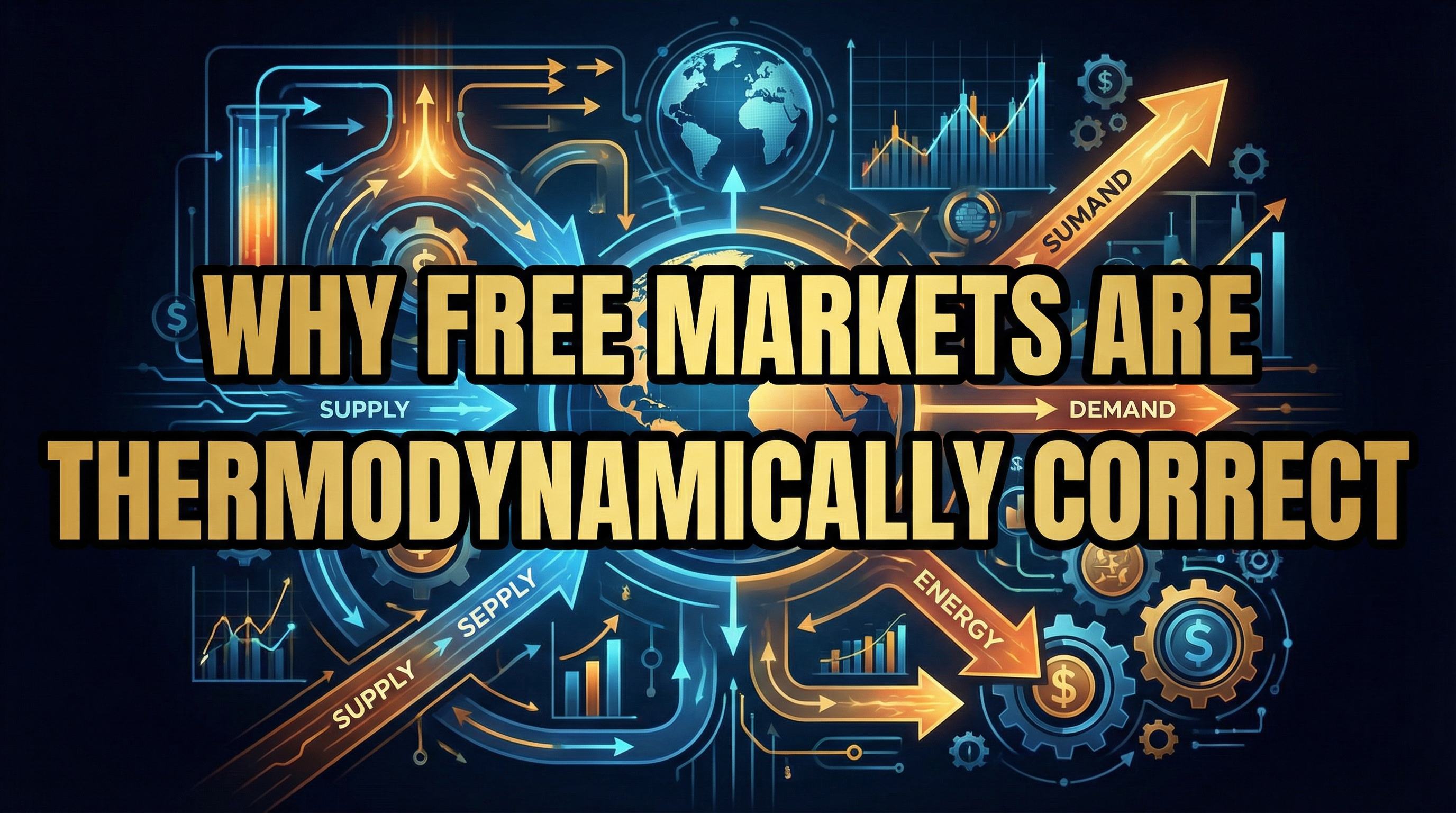
Think about it. No one is in charge of the global supply chain. No single person decides how many iPhones get made, or how many avocados get shipped to your local grocery store. It just happens. It's a dance of supply and demand, of price signals and incentives, of individual choices and emergent outcomes. It’s a beautiful, chaotic, and incredibly effective system.
When you try to control a free market, you're fighting against the laws of thermodynamics. You're trying to impose a static, equilibrium-based order on a dynamic, far-from-equilibrium system. You're being a BLP. You’re trying to build a dam in a river that is constantly flowing.
And what happens when you do that? You create shortages, surpluses, and all sorts of unintended consequences. You make the system more fragile, more brittle, and more prone to collapse. You're trying to build a clockwork universe in a world that is fundamentally, and beautifully, chaotic. I saw this firsthand when I was working in the cannabis industry. The more the government tried to regulate and control it, the more they created a black market that was impossible to stamp out. The market, like life, finds a way.
This is why I'm so passionate about economic freedom. It's not just a political or philosophical belief. It's a scientific one. Free markets are thermodynamically correct. They are the most effective way to create wealth, to lift people out of poverty, and to build a more prosperous and resilient world.
The Takeaway: How to Be an FLP in a BLP World
So how do you apply this to your own life? How do you stop being a BLP and start being an FLP? It’s not about just changing your mind, it’s about changing your entire way of being in the world.
- Embrace the chaos. Stop trying to control everything. Let go of the illusion that you can plan your life out like a spreadsheet. The universe is going to throw you curveballs. Learn to hit them. This means getting comfortable with uncertainty, with not knowing what’s going to happen next. It means seeing challenges as opportunities, not threats.
- Be adaptable. The world is constantly changing. The skills that were valuable yesterday might be obsolete tomorrow. Be a lifelong learner. Be willing to reinvent yourself. Be willing to be wrong. This is about humility. It’s about recognizing that you don’t have all the answers, and that the only way to grow is to be open to new ideas and new experiences.
- Trust in self-organization. You don't have to have all the answers. Trust that if you create the right conditions, the right solutions will emerge. This is true for your business, your community, and your own life. It’s about letting go of the need to be in control and trusting in the emergent intelligence of the system.
- Listen to your endocannabinoid system. This is the body's master regulatory system. It's what helps you adapt to stress and maintain balance in a constantly changing environment. It's your own personal, built-in FLP. When you’re feeling stressed, anxious, or out of balance, that’s your body telling you that you need to adapt. Pay attention to those signals.
It's not easy. The world is full of BLPs who will tell you that you're crazy. They'll tell you that you need to be more responsible, more practical, more realistic. They'll tell you to get back in line and follow the rules. They’ll try to drag you back into their clockwork universe.
Don't listen to them. They're living in the past. They're fighting a losing battle against the arrow of time.
Comments
Related Articles
The Death of the Expert
The Observer Changes the Observed
Stop Manifesting. Start Adapting.
Ho'oponopono: The Thermodynamics of Forgiveness
AI is a Mirror, Not a Monster
Want More?
Subscribe to The Forward Look on YouTube to get notified when new episodes drop.
Subscribe