Living Aloha in the AI Age
Hawaiian wisdom for modern chaos. How to maintain flow, connection, and power when the world is changing faster than ever. Practical Huna for FLPs.

Full Article
Living Aloha in the AI Age
You Think You Want Balance? Think Again.
Let’s get one thing straight. You’ve been sold a lie. A big, fat, comfortable lie. The lie is that the goal of life is to find “balance.” You’re told to seek equilibrium, to find your center, to achieve a state of perfect, Zen-like calm. It’s bullshit. Every last bit of it.
Life, real life, the kind that grows and evolves and creates something new, doesn’t happen in a state of balance. It happens on the edge of chaos. It’s a far-from-equilibrium state, a constant dance of creation and destruction, of order emerging from disorder. And right now, in the age of AI, that dance is faster, more intense, and more disorienting than ever before.
We’re living in a world that’s changing at an exponential rate. AI is rewriting the rules of work, of creativity, of what it means to be human. And most people are terrified. They’re clinging to the old ways, desperately trying to find their footing on a ground that’s constantly shifting beneath them. They’re what I call Backward-Looking People (BLPs), and they’re doomed to be left behind.
But there’s another way. A better way. It’s the way of the Forward-Looking People (FLPs), the ones who embrace the chaos, who see the opportunity in the disruption. And it’s a way that’s been understood for centuries by the ancient Hawaiians, the masters of living in flow with the universe.
The Problem: Our Addiction to Equilibrium
We’re addicted to the idea of a predictable, controllable world. We want to know what’s coming next. We want to have a plan. We want to feel safe. But that’s not how the universe works. The universe is a messy, unpredictable place. And the more we try to control it, the more we suffer.
This addiction to equilibrium is a recipe for anxiety, for depression, for a life of quiet desperation. It’s what keeps you stuck in a job you hate, in a relationship that’s not working, in a life that feels small and meaningless. You’re so afraid of the unknown that you cling to a miserable known.
And now, with AI, the unknown is expanding at an incredible rate. The old maps are useless. The old rules no longer apply. And if you’re still trying to find your way with those old tools, you’re going to get hopelessly lost.
The Application: Living Aloha in the Age of AI
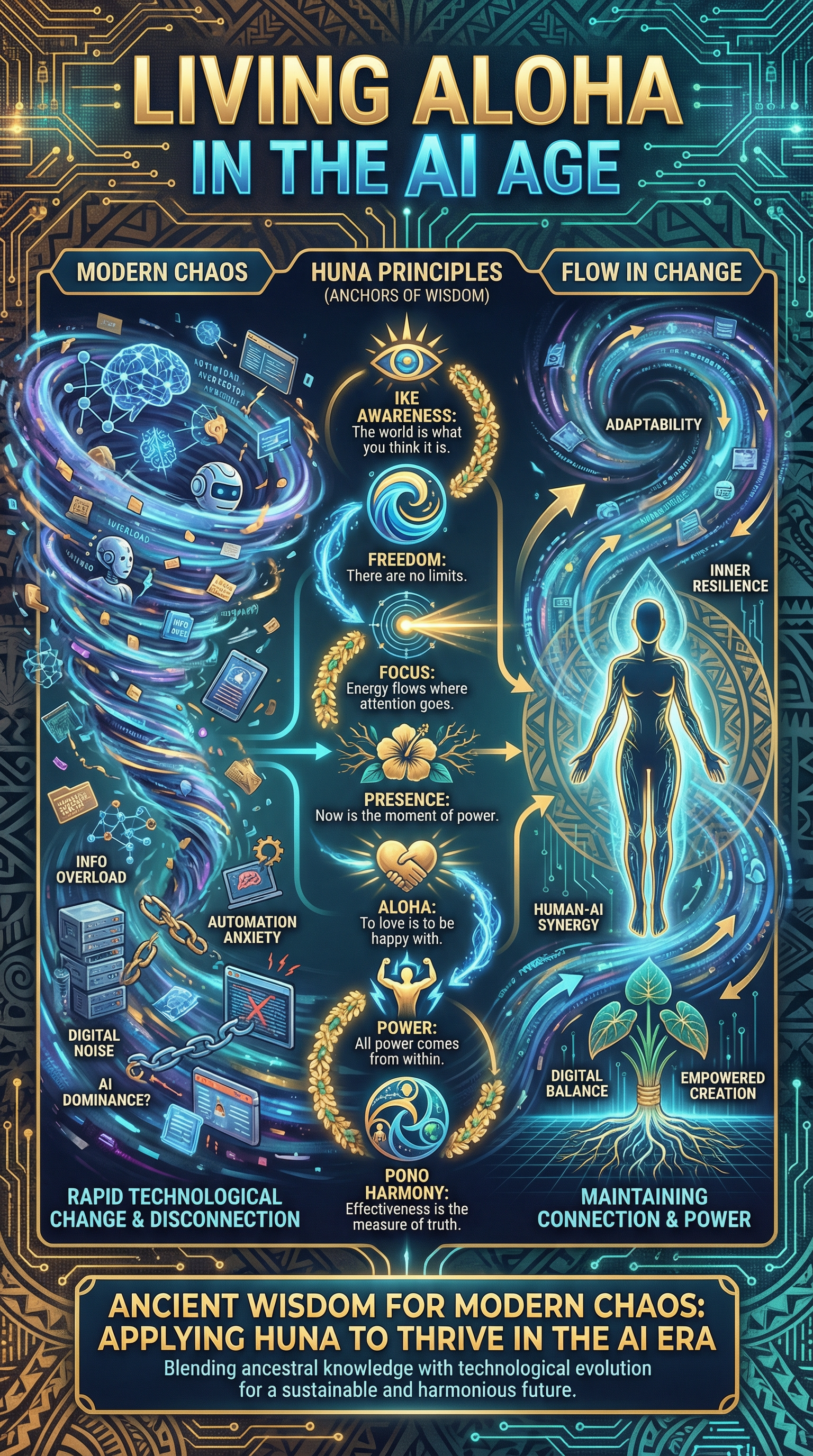
So what does all this have to do with ancient Hawaiian wisdom? Everything. The ancient Hawaiians understood this stuff intuitively. They didn’t have the fancy scientific language, but they had a deep, embodied understanding of how to live in a far-from-equilibrium world. They called it “living Aloha.”
Aloha is more than just a greeting. It’s a way of life. It’s about living in a state of love, of connection, of flow. It’s about recognizing that you’re not separate from the world around you, but a part of it. And it’s about embracing the chaos, the change, the constant unfolding of the universe.
In the age of AI, living Aloha is more important than ever. Here’s how you can start to apply this ancient wisdom to your modern life:
- Embrace the Flow: Stop trying to control everything. Let go of your attachment to a specific outcome. Trust that the universe will provide you with what you need, when you need it. This doesn’t mean being passive. It means being responsive, being adaptable, being willing to change course when the situation demands it.
- Cultivate Connection: In a world that’s becoming increasingly fragmented and disconnected, connection is a radical act. Connect with yourself, with your body, with your emotions. Connect with the people around you, with your community, with the natural world. And connect with your own inner wisdom, your own inner guidance system.
- Find Your Mana: Mana is the Hawaiian word for spiritual energy, for personal power. It’s the energy that allows you to create, to heal, to manifest your desires. You cultivate mana by living in alignment with your values, by speaking your truth, by taking care of your body and your mind. And you cultivate it by connecting with your endocannabinoid system, the body’s master regulatory system, which helps you to maintain a state of dynamic, far-from-equilibrium health.
The Takeaway: Your Action Items for the AI Age
This all sounds great in theory, but how do you actually put it into practice? Here are a few simple things you can do to start living a more far-from-equilibrium, Aloha-filled life:
- Do something that scares you. Step outside of your comfort zone. Take a risk. The more you embrace the unknown, the more you’ll grow.
- Spend time in nature. Get out of your head and into your body. Feel the sun on your skin, the wind in your hair, the earth beneath your feet. Remember that you’re a part of something much bigger than yourself.
- Practice Ho’oponopono. This is a traditional Hawaiian practice of reconciliation and forgiveness. It’s a simple but powerful way to clear out the old, stagnant energy and make space for the new. The practice involves repeating four simple phrases: “I’m sorry. Please forgive me. Thank you. I love you.”
- Learn about your endocannabinoid system. This is the biological system that allows you to adapt to stress, to maintain a state of health, to experience pleasure and joy. The more you understand how it works, the more you can do to support it.
Comments
Related Articles
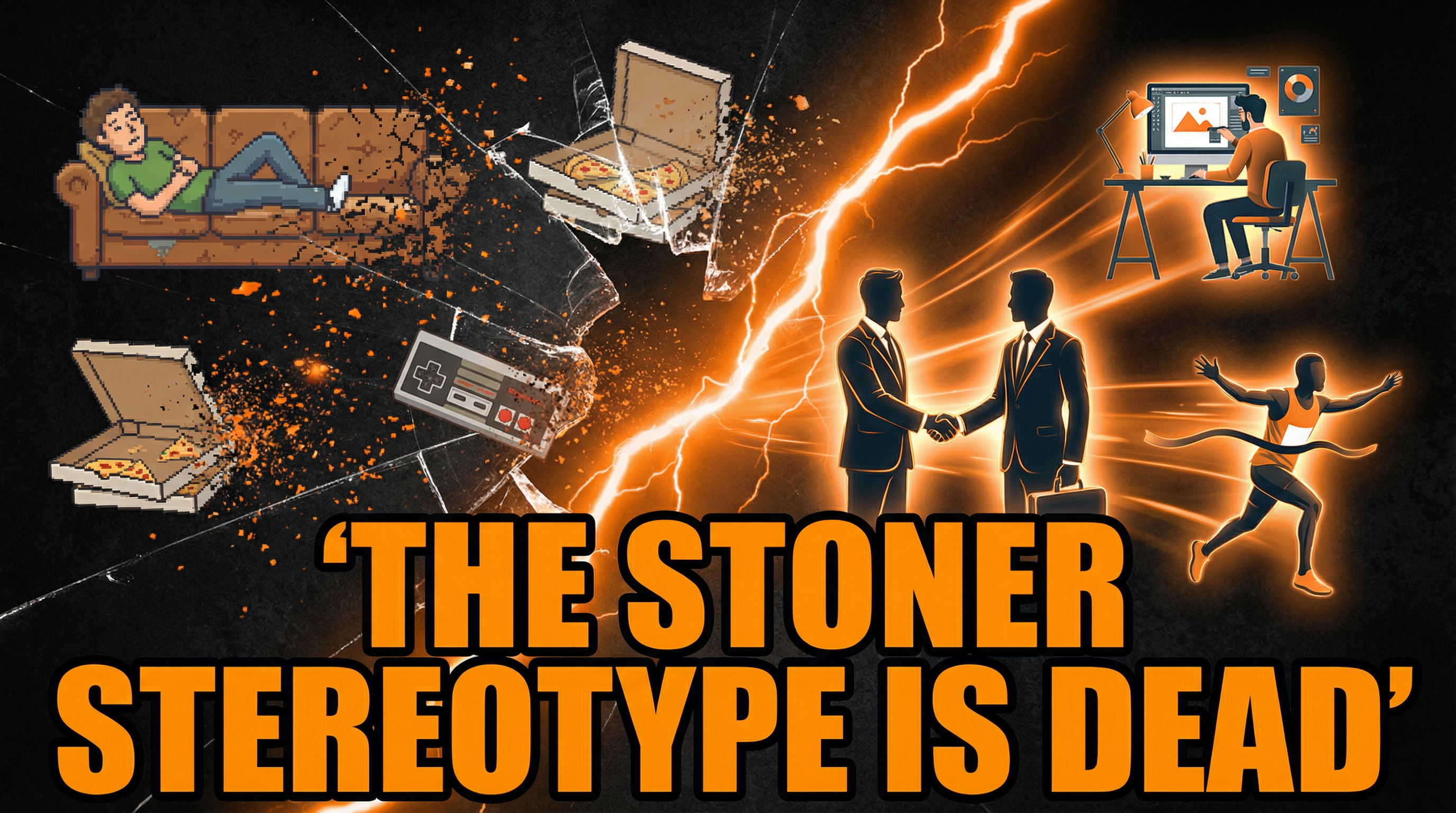
The Stoner Stereotype is Dead
Reality is Not What You Think
Carrying the Torch
AI is the Best Thing to Happen to Humans
Want More?
Subscribe to The Forward Look on YouTube to get notified when new episodes drop.
Subscribe