Cannabis Is Not a Drug
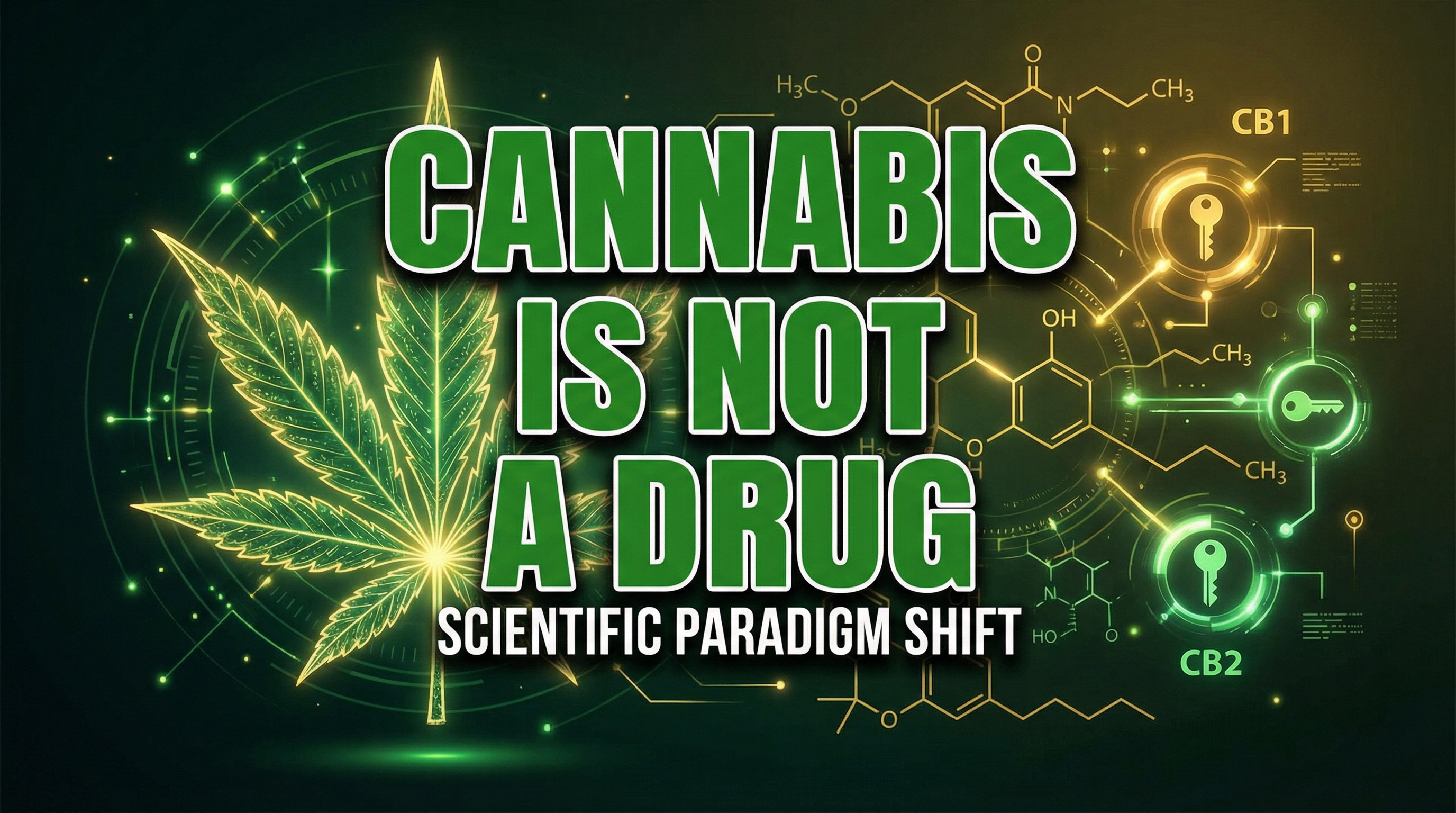
Reframe everything you think you know. Cannabis isn't a drug in the traditional sense—it's a key that fits a lock you already have. The science.
Full Article
Editor's Note: Perspective Piece
This article presents the author's philosophical perspective on cannabis and the endocannabinoid system. While the ECS is a real biological system, the claims about cannabis's therapeutic effects are simplified interpretations of complex research. Cannabis affects individuals differently and may have adverse effects for some people. Cannabis remains a controlled substance in many jurisdictions. This content is not medical advice.
Cannabis is Not a Drug
Let's get one thing straight. Everything you think you know about cannabis is probably wrong. You’ve been fed a steady diet of bullshit for decades, a cultural narrative spun from fear, misinformation, and a fundamental misunderstanding of what it means to be a living, breathing organism. You hear "cannabis," and you think "drug." You think of getting high, of stoner stereotypes and back-alley deals.
I'm here to tell you to throw that all in the trash.
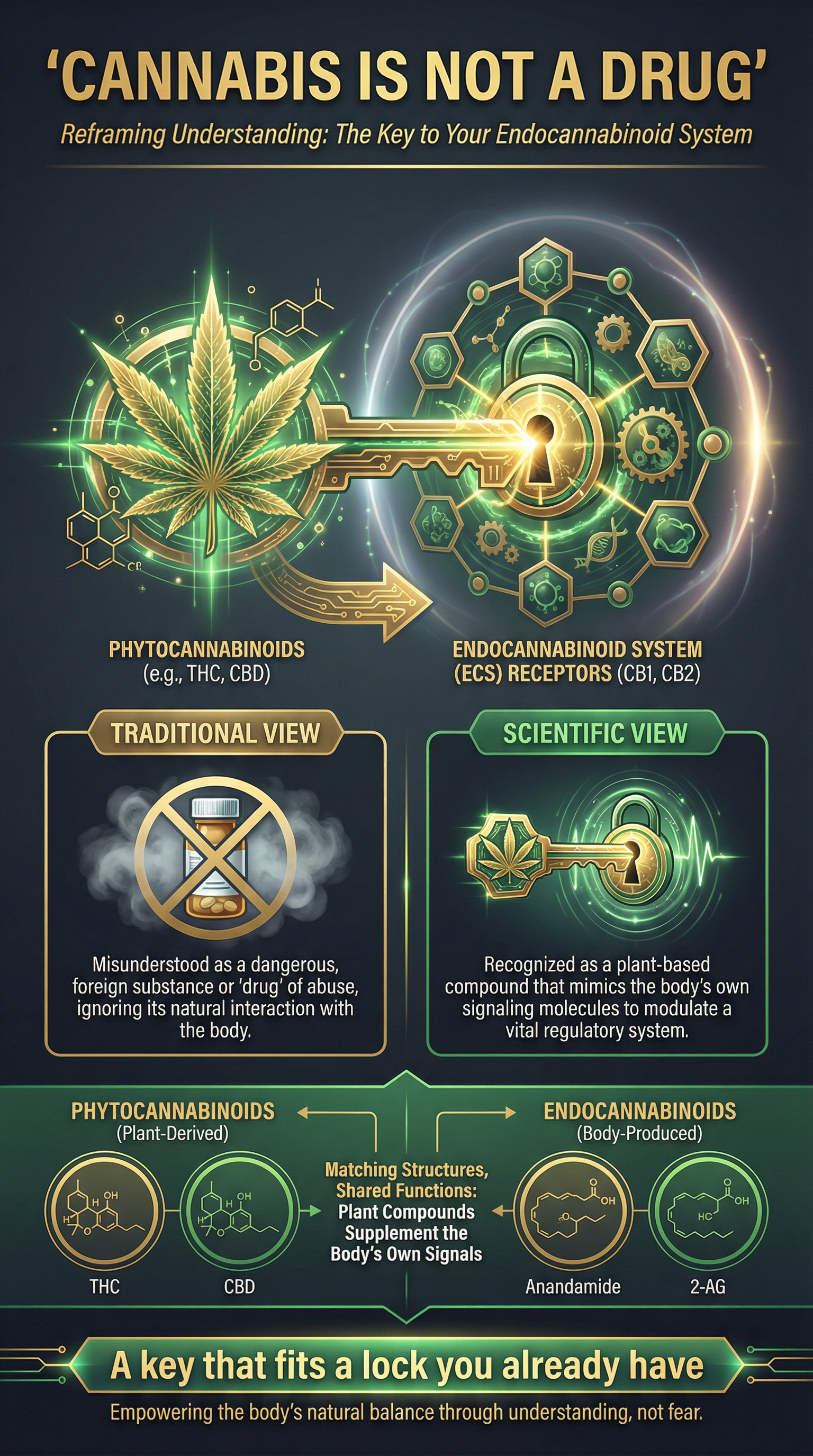
Cannabis isn't a drug. Not in the way you think. It's not some foreign invader you introduce into your system to hijack your brain. It's a key. A key that fits a lock you already have. A lock that's been part of your biological hardware for millions of years. And understanding that changes everything.
The Problem
The problem is our backward-looking, equilibrium-obsessed view of the world. We think of health as a state of perfect balance, a static homeostasis where nothing ever changes. It’s a comforting thought, but it’s a complete fantasy. Nature doesn’t do balance. Nature does chaos. It does adaptation. It exists in a perpetual state of being far-from-equilibrium.
Life exists at the edge of chaos. It is a dissipative structure, a localized pocket of order in a universe that is constantly sliding toward disorder. To stay alive, you have to constantly adapt, constantly evolve, constantly adapt.
This is where the old model of medicine and pharmacology gets it wrong. It sees the body as a machine that needs fixing. Got a headache? Take a pill to block the pain signal. Feeling anxious? Take a pill to numb the feeling. It's a whack-a-mole approach that treats symptoms, not the underlying system. It’s about forcing your body back to some imaginary "balance."
This is the thinking of Backward-Looking People (BLPs). They are terrified of change. They want to preserve the status quo, to keep things as they are, even if "as they are" is miserable. They see cannabis as a threat because it doesn't fit their neat little boxes. It doesn't just turn one switch on or off. It modulates the entire damn system.
The Application
So what does this mean for you, in your actual, real life? It means reframing everything.
Think about chronic pain. The old model says to block the pain. The new model, the ECS model, says to ask why the pain signal is there. Often, it’s a sign of chronic inflammation, a system stuck in a feedback loop. Cannabis doesn’t just mask the pain; it helps the ECS regulate the underlying inflammation. It helps the system find a new, more functional state of organization.
Think about anxiety. The old model says to numb your fear. The ECS model recognizes that anxiety is often the feeling of being overwhelmed by the future, of being unable to adapt to uncertainty. By supporting your ECS, you’re not getting rid of the uncertainty—that’s impossible, thanks to the arrow of time. You’re increasing your capacity to deal with it. You’re becoming more resilient, more capable of navigating the chaos.
I’ve seen this in my own life. For years, I was a classic BLP, trying to control everything, trying to force my life into a neat, predictable box. And I was miserable. It was only when I embraced the principles of far-from-equilibrium living, when I started supporting my ECS, that I began to truly thrive. It wasn’t about finding balance; it was about learning to dance with the chaos.
This is the difference between being a Forward-Looking Person (FLP) and a Backward-Looking Person (BLP). The FLP embraces change, seeks out novelty, and understands that the only constant is flux. The BLP fears change, clings to the past, and sees anything that disrupts their static world as a threat. Cannabis is a tool for the FLP. It is a technology for adaptation.
The Takeaway
It’s time to stop thinking of cannabis as a drug and start thinking of it as a tool for self-organization and adaptation. It’s not a magic bullet. It’s not going to solve all your problems. But it can be a powerful ally in your journey toward becoming a more resilient, adaptable, and forward-looking human being.
Here’s your homework:
- Question the Narrative: The next time you hear someone call cannabis a "drug," challenge them. Ask them if they know about the endocannabinoid system. Start the conversation.
- Educate Yourself: Read up on Dr. Bob Melamede. Watch his lectures on YouTube. Dive into the science of the ECS and far-from-equilibrium thermodynamics. Don’t take my word for it; see for yourself.
- Listen to Your Body: If you choose to use cannabis, do it mindfully. Pay attention to how it affects you. Are you more creative? More relaxed? More present? Use it as a tool for introspection, not just recreation.
Closing
The world is not a static, predictable place. It is a chaotic, ever-changing, far-from-equilibrium system. You can either fight against that reality and be miserable, or you can learn to adapt and thrive within it. The choice is yours.
Let's dig a little deeper into the thermodynamics of it all, because this is where the mind-bending, paradigm-shifting ideas really live. The Second Law of Thermodynamics is a universal, unbreakable principle. It states that in any isolated system, entropy—a measure of disorder or randomness—will always increase over time. Things fall apart. Stars burn out. Energy dissipates. It's the law that gives us the arrow of time, the reason why a broken egg never spontaneously reassembles itself. It’s the ultimate buzzkill, really.
But here’s the miracle: life. Life is a flagrant, glorious middle finger to the Second Law. We are not isolated systems. We are open, dissipative structures. We take in energy from our environment (food, sunlight) and use it to create and maintain pockets of incredible order—our bodies, our consciousness, our societies. We are temporary eddies of complexity in the relentless, downstream current of universal entropy. As Dr. Bob would say, we are "far-from-equilibrium." Equilibrium is death. It’s the state of maximum entropy, of no change, no potential. A rock is in equilibrium. A corpse is in equilibrium. A living, breathing, adapting human is not.
So, how do we maintain this state of ordered chaos? How do we surf the wave? By being adaptable. By constantly adjusting, recalibrating, and reorganizing in response to a changing environment. And the system that orchestrates this dance, the one that allows us to dissipate energy in a way that creates complexity instead of just heat, is the endocannabinoid system. It’s the master regulator of our ability to stay far-from-equilibrium. When your ECS is functioning optimally, you are more resilient. You recover from stress faster. You learn. You adapt. You evolve. When it’s deficient, you get stuck. You become brittle, rigid, a BLP. You slide closer to the static, dead state of equilibrium.
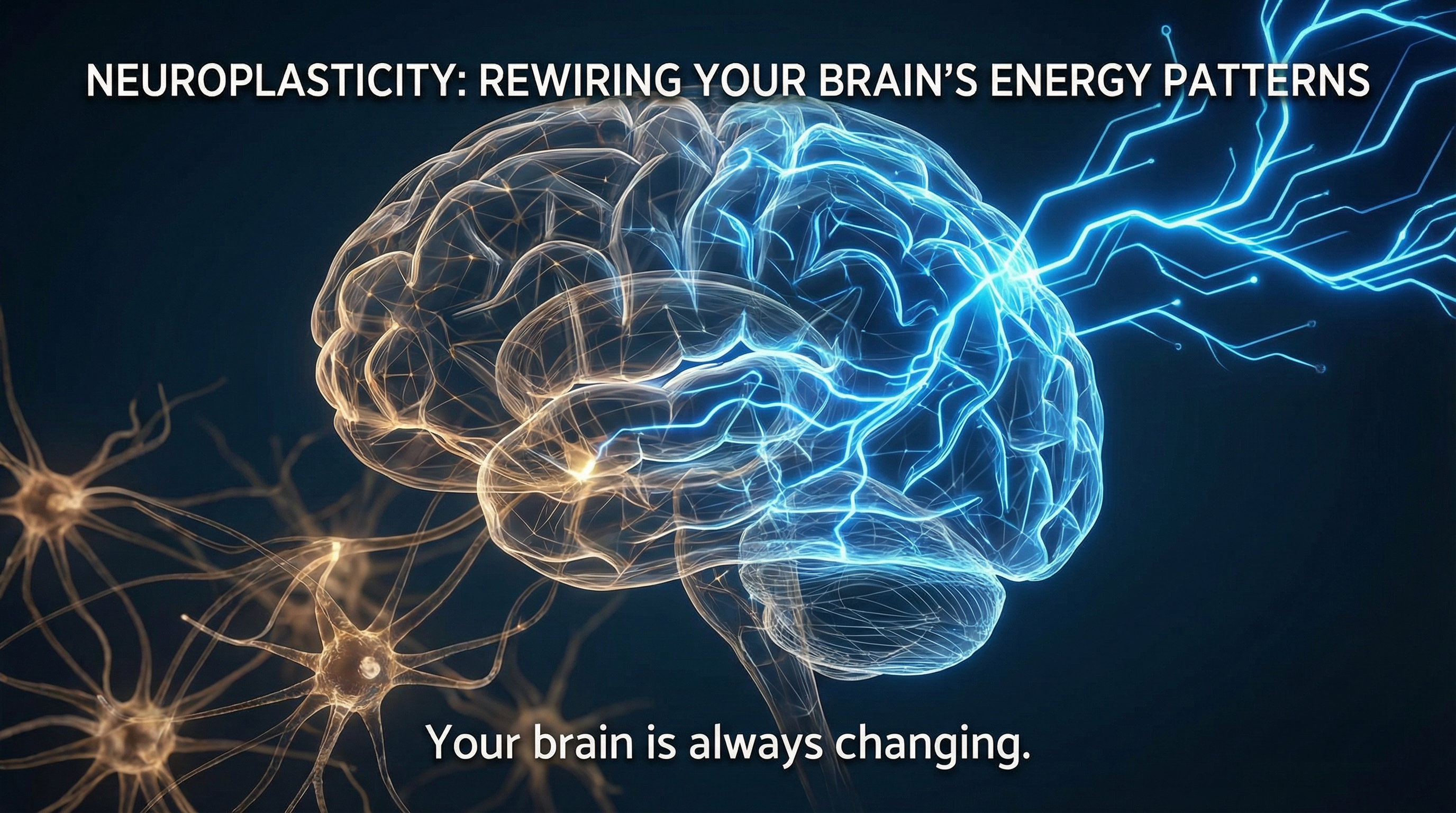
This isn’t just some philosophical hand-waving. This is hard science. The ECS is deeply implicated in the processes of neurogenesis (the birth of new brain cells), synaptic plasticity (the ability of your brain to rewire itself), and apoptosis (programmed cell death, or the body’s way of cleaning out old, damaged cells). These are the fundamental mechanisms of adaptation. And cannabis, by supplementing this system, is essentially a tool for enhancing these mechanisms. It’s a technology for promoting plasticity and resilience. It’s not about escaping reality; it’s about giving yourself the biological tools to better engage with it.
Comments
Related Articles
Why Everyone is Anxious Right Now
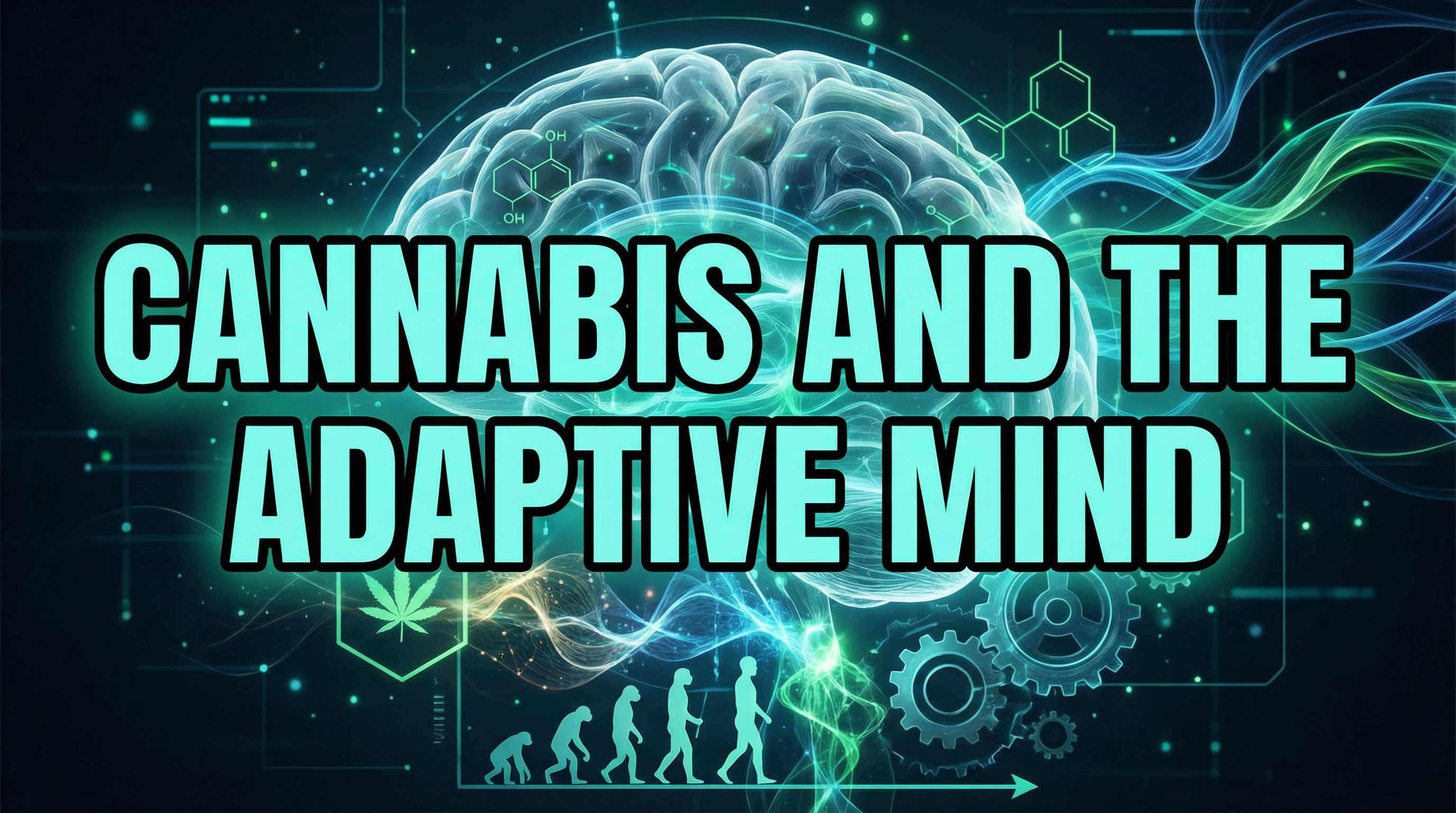
Cannabis and the Adaptive Mind
Why I'm a Thermodynamic Libertarian
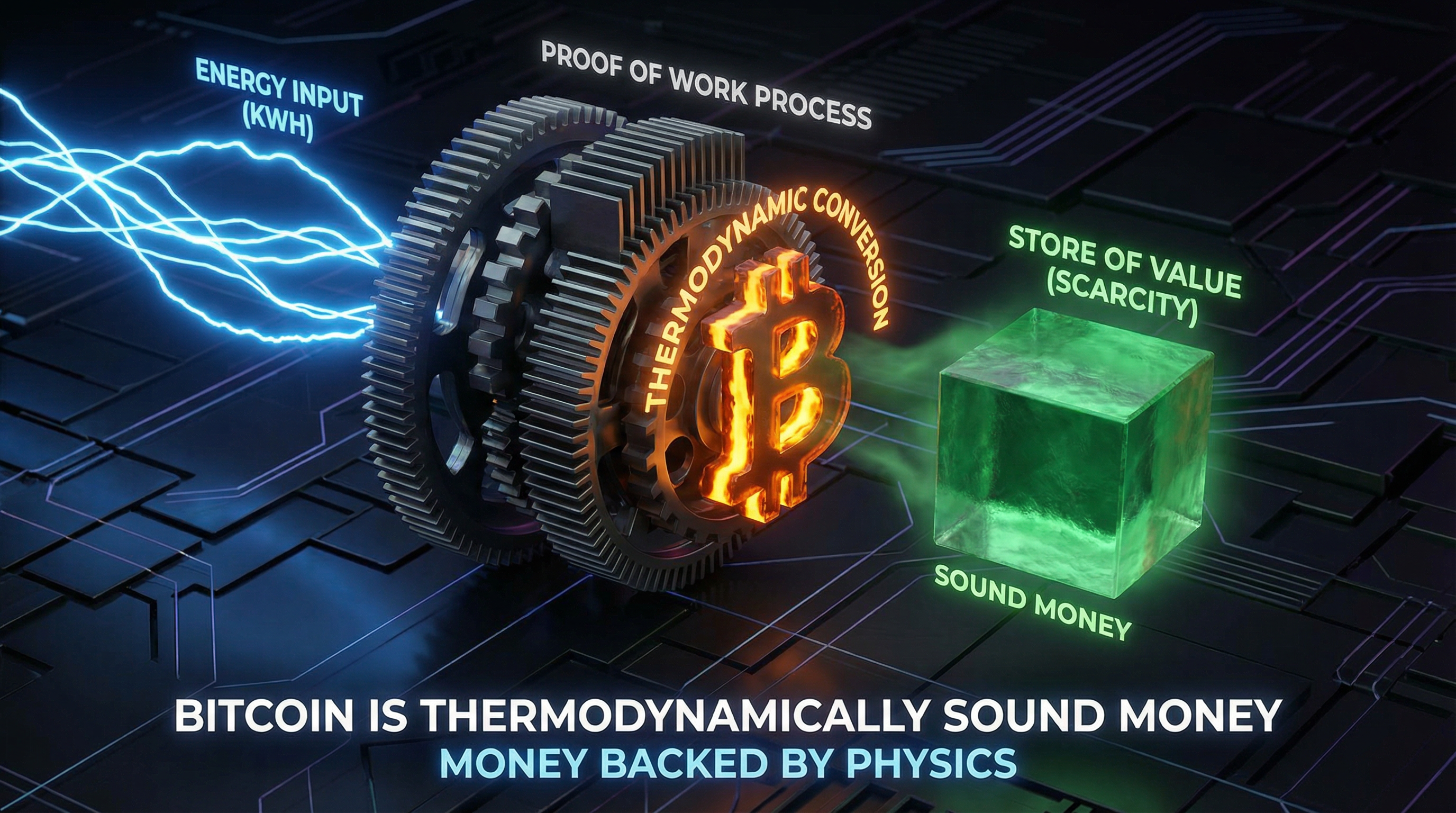
The Death of the Expert
KALA: There Are No Limits
Want More?
Subscribe to The Forward Look on YouTube to get notified when new episodes drop.
Subscribe