
No going back
The fork, time’s arrow, and the universes next door
 ▶ Play this chapter
The script
Every line as it is spoken in the film, in order.
When a system like that finally tips, what decides which way it goes? Sometimes nothing inside it does. A nudge too small to measure does.
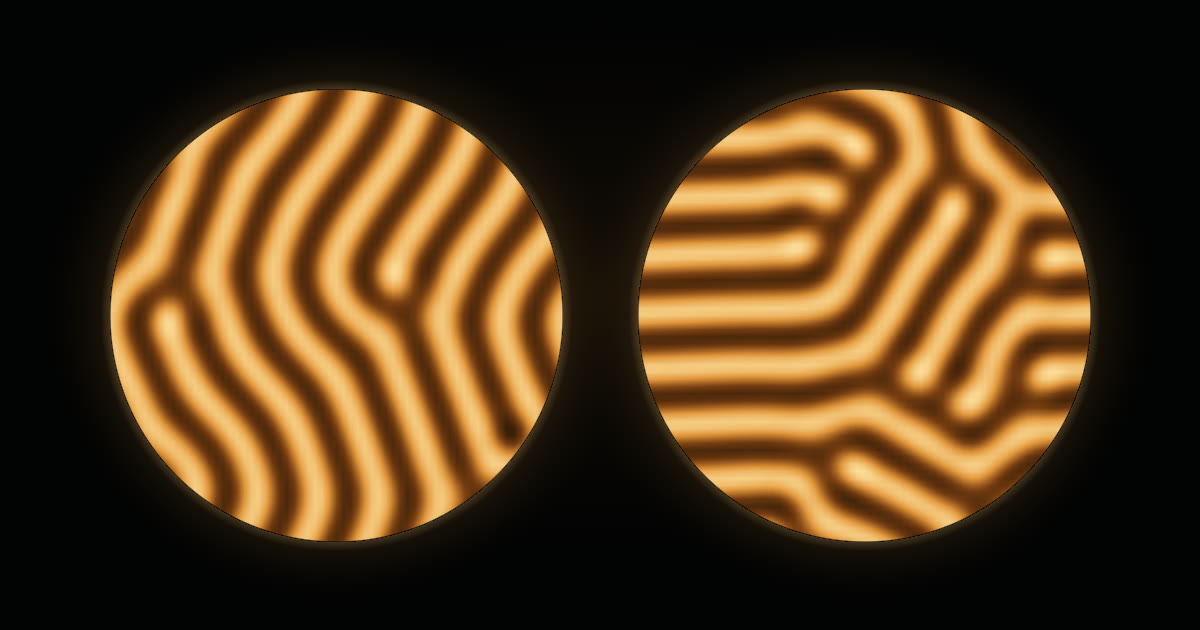
Back to the dish of oil. Heat it the same way twice, and you get the same kind of cells, but never in the same places. Turn it up and the oil rolls like a row of logs. Which way each one turns is settled by fluctuations too small to see.
Prigogine called this order through fluctuations. At a fork like that, more than one future is possible. Only one of them happens, and everything after it builds on that one.
And you can't simply back out of a fork. When a lake flips from clear to green, cutting the pollution back to where it was before the flip usually isn't enough. You have to cut much further to flip it back. The way in isn't the way out.
Some things don't go back at all. Pour cream into coffee and it swirls in. Wait all day, and it never swirls back out. Nothing strictly forbids it. It's just so unlikely that it wouldn't happen once in the whole life of the universe.
Almost every law of physics works just as well played backward. The second law of thermodynamics doesn't. Overall, disorder goes up. That one-way street is what physicists call the arrow of time.
Bob had a simpler way to say it.
Dr. Bob Melamede, in his own words · Cannabis Hemp Conference & Expo, 2017“The physics that we're taught in our schools says time can go backwards. Well, are you getting younger? When's the last time you drove your car and the gas tank filled up? You know, those things don't happen. There is an arrow to time.”
So where does the arrow come from? Most physicists say: from the beginning. The universe started out extraordinarily ordered, and everything since, stars, cells, you, is part of its long run downhill.
Prigogine thought that was only part of it. He argued the arrow is written into the laws themselves, and that far from equilibrium, time doesn't just wear things down. It builds them.
He loved a line from the philosopher Henri Bergson: the more we study the nature of time, the more we shall comprehend that duration means invention, the creation of forms, the continual elaboration of the absolutely new.
And Bob liked to quote Prigogine himself.
Dr. Bob Melamede, in his own words · Cannabis Hemp Conference & Expo, 2017“We are actually the children of the arrow of time, of evolution, not its progenitors.”
Quantum physics has a fork of its own. In Erwin Schrödinger's famous thought experiment, a cat sits in a sealed box with a poison that's released if a single atom decays. Until someone looks, the math holds both outcomes at once.
In 1957, a Princeton graduate student named Hugh Everett proposed that both outcomes happen. The universe splits, and each branch carries on without the other. It's called many worlds. Take it all the way, and there's a version of you for every choice you didn't make.
Can far-from-equilibrium physics rule that out? No. Nothing in it can see another branch. And even in many worlds, once branches split, they don't come back together. The arrow holds there too.
Prigogine bet the other way. To him, the future isn't sitting out there with every version already written. It's being made, one step at a time, and no step can be taken back. Nobody has settled who's right. But either way, you only ever get to live one branch.
Your body works the same way. It can't un-eat a meal or un-live a fight. What it can do is let go and update. Remember the mouse that kept swimming to where the platform used to be? That's what it looks like when letting go fails.
Here's what I take from all of it. There's no rewind. And if there's another version of me out there in another universe, we'll never compare notes. That can sound bleak. I think it's the opposite. It's the reason choices count.
Lots of futures were possible. One of them is happening right now, and part of it is made of what you do next. You can come back to a place. You can never come back to a moment.
Sources
Every claim in this chapter with its grade: E established · M emerging (one or two studies, or animals only) · F framework.
- EPrigogine I, Nicolis G, Babloyantz A. Thermodynamics of evolution. Physics Today 1972;25(11):23–8. (order through fluctuations) link
- EBénard H. Les tourbillons cellulaires dans une nappe liquide. Rev Gén Sci Pures Appl 1900;11:1261–71, 1309–28. (the hexagonal cells; in thin layers open to the air, surface tension does much of the driving: Pearson, J Fluid Mech 1958)
- ESwift J, Hohenberg PC. Hydrodynamic fluctuations at the convective instability. Phys Rev A 1977;15:319–28. (the model the film's dish runs) link
- EPrigogine I, Stengers I. Order Out of Chaos: Man's New Dialogue with Nature. Bantam, 1984. (convection rolls: which way each turns is decided by fluctuations)
- EPrigogine I. Time, structure, and fluctuations. Science 1978;201:777–85. (his 1977 Nobel lecture: far from equilibrium, energy flow can create and keep order, the dissipative structures) link
- EScheffer M, Carpenter S, Foley JA, Folke C, Walker B. Catastrophic shifts in ecosystems. Nature 2001;413:591–6. (shallow lakes: recovery needs far lower nutrient levels than the collapse did) link
- ECarroll S. From Eternity to Here: The Quest for the Ultimate Theory of Time. Dutton, 2010. (the statistical second law; the low-entropy beginning)
- EEddington AS. The Nature of the Physical World. Cambridge University Press, 1928. (the 1927 Gifford Lectures, where the phrase "time's arrow" was coined)
- ELees JP et al. (BaBar). Observation of time-reversal violation in the B0 meson system. Phys Rev Lett 2012;109:211801. link
- FBob Melamede, PhD. Talk at the Cannabis Hemp Conference & Expo, 2017 (full recording; the arrow of time at about 10:00, Prigogine's line at about 21:00). His framework. link
- EAlbert DZ. Time and Chance. Harvard University Press, 2000. (the "past hypothesis": the arrow traced to a low-entropy beginning)
- FPrigogine I. The End of Certainty: Time, Chaos, and the New Laws of Nature. Free Press, 1997. (irreversibility as fundamental; the future is not given. His view, not the consensus.)
- FBergson H. L’Évolution créatrice, 1907. In English: Creative Evolution, tr. Arthur Mitchell, 1911. link
- FRobinson A. Time and notion. Times Higher Education, 17 July 1998. (Prigogine: "We are not father of time, but its children.") link
- ESchrödinger E. Die gegenwärtige Situation in der Quantenmechanik. Naturwissenschaften 1935;23:807–12, 823–8, 844–9. (the cat) link
- FEverett H. "Relative state" formulation of quantum mechanics. Rev Mod Phys 1957;29:454–62. (many worlds: an interpretation, not a tested result) link
- EZurek WH. Decoherence, einselection, and the quantum origins of the classical. Rev Mod Phys 2003;75:715–75. (why branches, once split, in practice never recombine) link
- MVarvel SA, Lichtman AH. Evaluation of CB1 receptor knockout mice in the Morris water maze. J Pharmacol Exp Ther 2002;301:915–24. link
Answers on this
Short videos that each answer one question, with the studies behind them.