

00 · Cold open
I'm Justin Hartfield, and I've been selling cannabis for twenty-five years. I started Weedmaps in 2008, when nobody would put cannabis in a bank account. Today I'm building Weed.de, for patients in Germany. And in all that time, I never asked what it was actually doing to the people buying it. When I finally did, the answer wasn't about the plant. It was about them. About you.
People have burned this plant to get high for at least 2,500 years.
In 1964, two chemists in Israel finally pulled out the molecule that does it. THC.
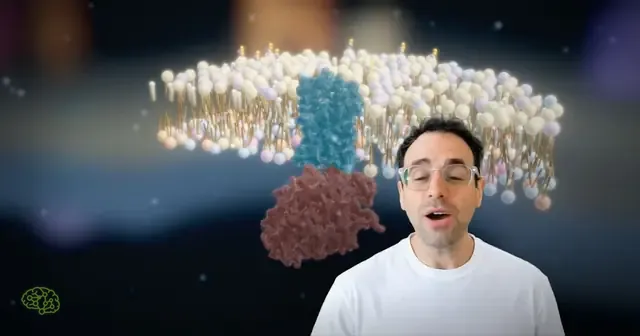
It took until 1988 to find where it goes. A lock in your brain that THC fits.
But that lock is hundreds of millions of years older than the plant.
So it was built for something your own body makes. You've been high your entire life, and nobody's told you.
Your brain makes that key only when it needs it, then breaks it down in moments.
It took scientists four more years to find it.
01 · Where the lock lives
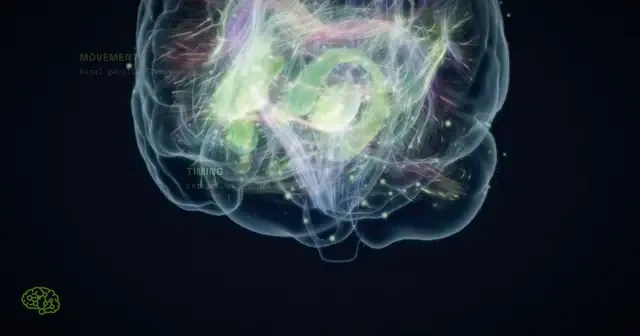
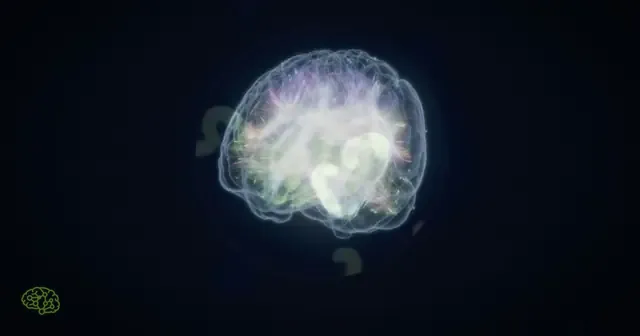
First, where that lock lives. Your brain is packed with them. The brighter the glow, the more there are.
They're densest in the deep structures that start and stop your movements. In the cerebellum, which keeps your timing. In the hippocampus, where today becomes memory. And in the olfactory bulb that reads smells. We'll come back to that one.
But in the brainstem, the part that keeps you breathing without you ever thinking about it, there are very few. An opioid overdose kills by shutting breathing down, because opioid locks sit right in those breathing centers. That may be why even huge doses of cannabis are not lethal.
Now let's zoom into one connection, and see what your keys are actually for.
02 · The brake
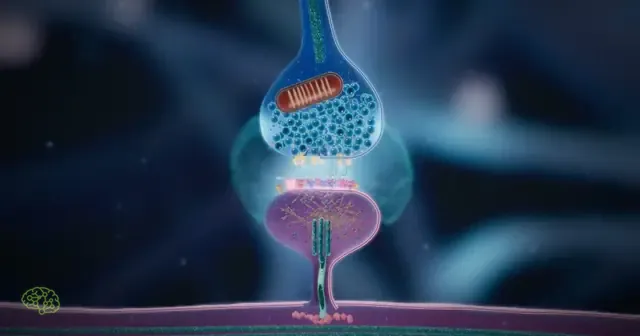
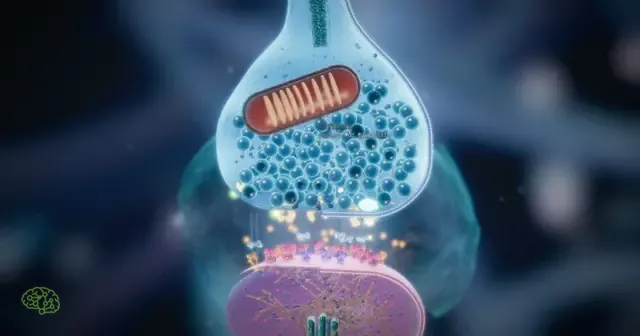
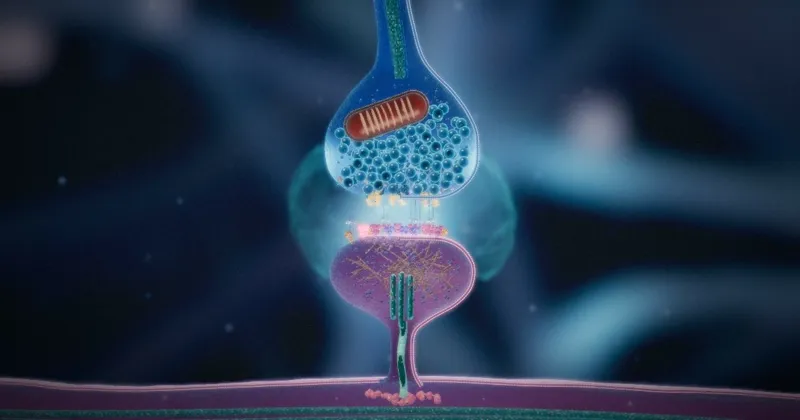
This is a synapse. You have about a hundred trillion of them. Messages cross the gap one way, from the top cell to the bottom one.
The lock is called CB1, and it sits on the top cell, the one sending the messages.
Click. That's cannabis. THC fits this lock and switches it on.
The part that took scientists four years was finding the key your own body makes.
Your body makes two keys for this lock, anandamide and 2-AG. Here's what one of them is for.
Now the top cell starts shouting, firing faster and faster. If the bottom cell gets too excited, it gets hurt.
So the bottom cell carves 2-AG out of its own membrane and sends it backward, against the traffic.
It lands on CB1, and the top cell quiets down. Your cells send this backward signal on their own, the moment they need it.
That's happening in your head right now. Somewhere behind your eyes, a cell just fired, and another one is already telling it to ease off.
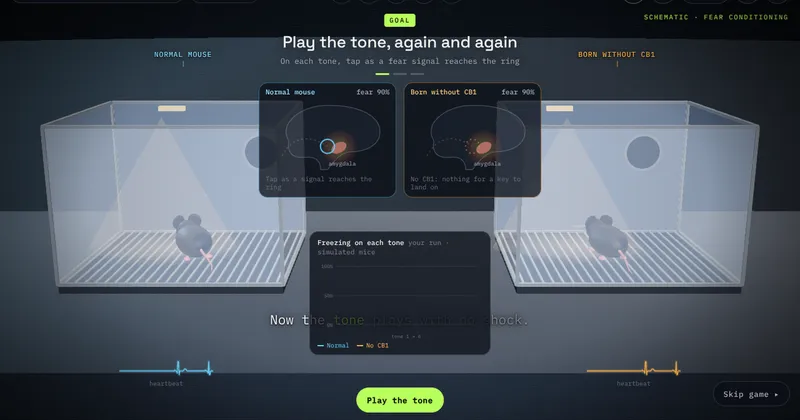
Now let's go back to the same cell, in a mouse born without a CB1 lock.
The brake has nowhere to land. In mice like this, a seizure-causing toxin hit much harder. Your endocannabinoid keys are like a built-in defense.
That's the secret, up close: a message that runs backward, made when it's needed and gone in moments. Next: what happens when the plant's key shows up.
03 · What happens when you smoke
So what actually happens when you smoke? First, one thing about your own cannabinoids. They work differently from almost every other messenger in your brain.
Most of those messengers are made ahead of time and kept in tiny packets at the tips of nerve cells. Dopamine, serotonin, glutamate. When a signal arrives, out they go.
But as we've just seen, your cannabinoids aren't kept in packets. A cell makes them when something happens, cuts them from its own membrane, uses them right there, and breaks them down in moments.
So what makes a cell create them? Well, the things that happen to you. In 2012, seventy-one adults gave a speech to a panel of strangers. Right afterwards, the anandamide in their blood had gone up.
Think about the feeling you had in your body the last time you were really scared. Your body made some of these keys right then.
And when an old fear needs to fade, mice make more endocannabinoids in the amygdala.
Each time, your body is responding to an external stimulus. The keys are made exactly when and where they're needed.
THC comes in through your blood and opens locks all over your brain at once, whether anything happened or not. Your enzymes can't cut it, so it lasts two to three hours.
That's why being high feels the way it does. Where the locks are packed, things shift. If you've ever felt music land in your chest, or laughed your balls off uncontrollably at an inside joke with your BFF, or learned a profound insight, you've felt this system working.
Many people feel more in touch with the world around them. Music, food and touch feel more intense. In mice, CB1 even makes sweet taste stronger.
And the munchies? Remember the olfactory bulb that reads smells? In hungry mice, CB1 receptors there make food smell stronger, so they eat more. Cannabis turns up the same switch.
“So every time you get hungry, you're getting hungry because your body is giving you some pot, and that pot is giving you the munchies.”
That's the weed high.
So the plant works through a system you were born with. How much it borrows, and for how long, is the next question.
04 · Dose & time
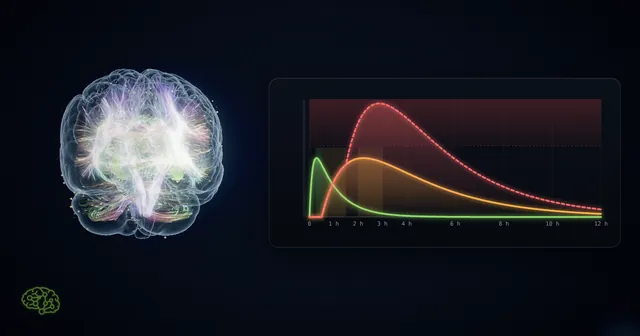
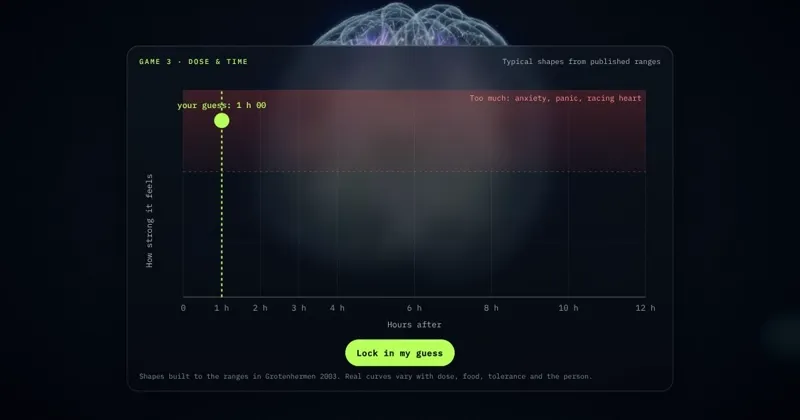
How long THC stays active depends on how it gets into you. Smoked, it goes from your lungs into your blood, and you feel it within minutes.
It peaks fifteen to thirty minutes in and fades over two or three hours.
Eaten, the same molecule takes much longer. It goes through your liver first.
Thirty to ninety minutes before you feel anything. The peak comes two or three hours in. And it can last up to twelve.
This is where people get into trouble. At one hour, they feel nothing, so they take more.
Both doses land together, and that's how people end up far higher than they meant to.
Then there's the dose. In 2017, researchers gave forty-two adults a capsule, then a stressful public-speaking test. The capsule held a placebo, seven and a half milligrams of THC, or twelve and a half.
On placebo, the speech was as stressful as you'd expect.
With seven and a half milligrams, people felt less distress after the speech, and the test felt less threatening.
Twelve and a half milligrams is not even twice as much, but it induced a worse mood before and during the test, and a poorer performance.
It's the same molecule in the same lock. But more of it made things worse.
05 · The cell that lets go
AND this system does something almost nobody knows about. It helps you let go of old lessons. And letting go turns out to be half of learning.
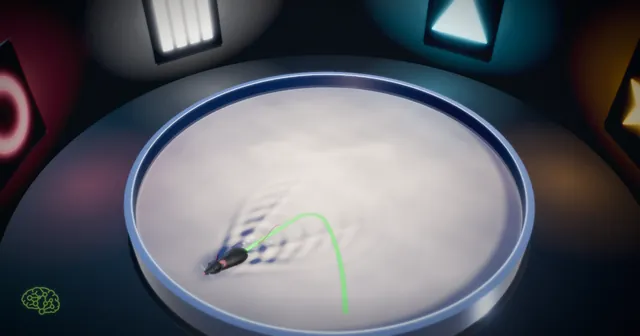
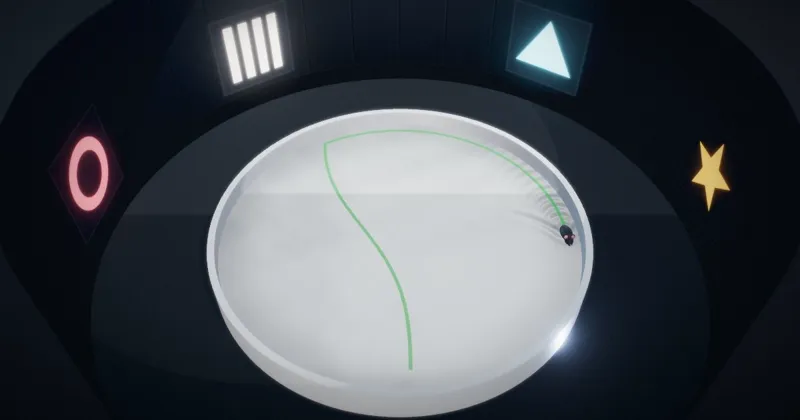
In 2002, researchers put mice in a pool of milky water, with a platform hidden just under the surface. You're the mouse. Find the platform.
Found it. Remember where it was.
Again, from a different side. Use the landmarks.
Now the platform moves to the other side of the pool. Find it again.
That's where it used to be. It's gone now.
You let go of the old spot and found the new one. Normal mice do that too.
Now watch two mice swim after the move. The blue trail is a normal mouse. The amber trail is a mouse born without CB1.
Both learned the first spot just as fast. But the one without CB1 keeps going back to where the platform used to be. Again and again, even after it has been shown the new one.
Letting go of an old place needed CB1. In mice, so did letting go of a fear. That same year, a lab in Munich found that mice without CB1 learned to fear a sound as well as any mouse, then had great trouble letting it go.
Think of something you kept coming back to long after it stopped making sense. A bad habit or something. The day you finally decided to go the other way, something in you let the old one go. That thing inside you was your own ancient endocannabinoid system.
06 · The whirlpool
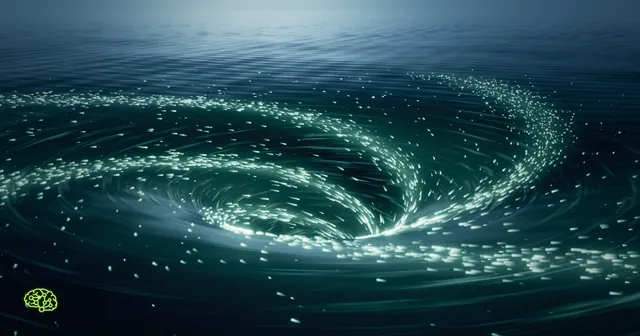
In 2010 I met a biologist named Bob Melamede. He changed how I saw everything I'd built. He had a picture for this. Life is a whirlpool. It only exists while energy flows through it.
A cell that clings to its old pattern fights the flow. A cell that can let go moves with it. That's his framework modeled after the complex systems theory he studied in school.
The neurologist Ethan Russo has a framework too. He proposes that some cases of migraine, fibromyalgia and irritable bowel syndrome come from too little endocannabinoid tone. It's still a hypothesis.
But the biology underneath it is real. The same system also helps switch off the stress response once the danger has passed. And that second lock, CB2, sits on your immune cells.
07 · Far From Equilibrium
We've seen how this system helps cells adjust. Bob wanted to connect that to a bigger question: what keeps living things going?
“Far-from-equilibrium means something is not at rest, essentially that it's like a charged up battery versus a discharged battery. The discharged battery is at equilibrium. The charged battery is far from equilibrium. It can do things.”
For a cell, that means constantly renewing the energy it can use. Bob illustrated that with the turnover of ATP.
“And then every day a person makes approximately their own body weight in ATP. Well, you know, that seems to be a little bit of a, how can I be making that much of ATP when I'm not getting bigger, you know? It's flow. You make, you break. You make, you break. You make, you break, okay? And that's what's flow... We are flow-dependent structures.”
That's energy moving through a living system. To make the pattern easier to see, let's start with something simpler.
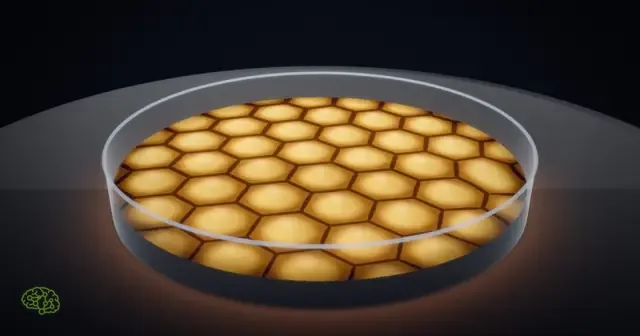
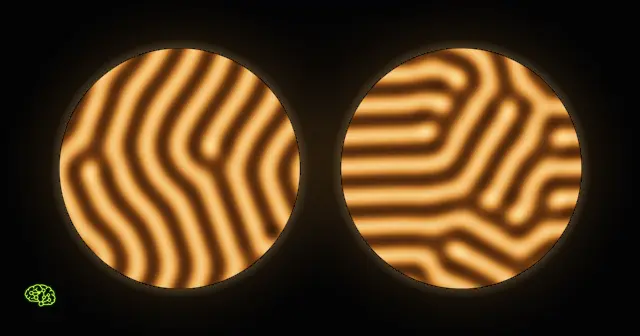
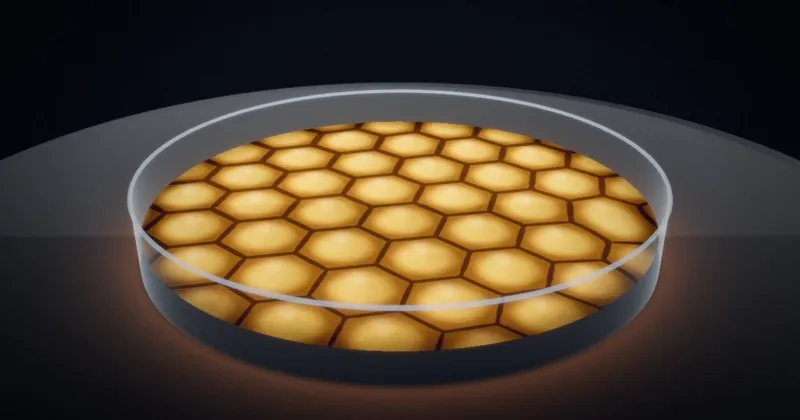
Picture a thin layer of oil in a dish, heated from below. At first the heat just creeps up through it. Turn it up a little more, and the oil sorts itself into hexagons, warm rising in some places and cool sinking in others.
Billions of molecules started moving together because moving together carries the heat away faster. Completely unarranged, yet somehow totally synchronized.
Dr. Bob would say,
“Collections of molecules, like us, will get smarter as long as we can make the universe stupider quicker.”
The oil showed a pattern in space. Another experiment shows how reacting chemicals can make a pattern in time.
Now check out this chemical mixing experiment that should turn one even color and stay that way. Instead, rings of blue spread out, fade, and come back for as long as the chemicals keep reacting.
When Boris Belousov sent this to a journal, the editors turned it down as impossible. The physics they had in mind was written for things settling down. Not flow-dependent structures like chemical reactions.
You are also a chemical mix. Your heartbeat, your breathing, your sleep and waking all keep time.
Back in the dish of oil, keep turning up the heat, and the hexagons break apart into turbulence.
Too little flow and nothing happens, and too much tears the pattern apart. Life lives in the band between.
Dr. Bob's definition of health came straight from that band.
“If we sealed off this room and had no air coming in and out, no food going in and out, it would take some time, but we would all get sick, weaker, die, rot, go back to equilibrium. So essentially, health is distance from equilibrium.”
He applied the same idea to a much earlier question: how could chemistry have become alive in the first place?
Think about sunlight hitting a bare rock. Or heat rising from beneath the ocean floor. Or hot water meeting cold water and leaving a gradient in its wake. Nothing exactly alive, but these were all to become the starting material for life.
Bob started here. In his model, before cells, before genes, before DNA, there were reactions that kept other reactions running. One supplied what the next one needed. Some of those networks got good enough to repair their own damaged parts, and a network that rebuilds itself stops being ‘blind energy’. It becomes a system with a stake in its own survival.
The chemistry had to keep working, or the system stopped existing. Bob's image for it was a whirlpool. Stop the flow and the shape disappears. But it was never just a shape. It was a flow.
Genetic information emerged inside that chemistry, in his model. DNA came later, as a sort of memory of what worked. A lasting record of the processes of how to keep this particular living system going.
Think of a cell: Metabolism supplies the raw material and the energy to build DNA. DNA carries the instructions for the enzymes that keep metabolism running. And what a cell burns has long-term consequences for the organism. In a 2009 experiment, researchers linked glucose metabolism to the chemical marks on the histone proteins that DNA wraps around. Changing that metabolic pathway changed those chemical marks and gene activity.
The endocannabinoid system is one of the feedback systems working throughout your body right now.
Bob's proposal was that the flow came first, and genetic memory grew inside it. Which makes the basic unit of life a process. Something that keeps rebuilding itself for as long as the energy keeps moving through it.
“Here we saw evolution of a chemical system in a test tube. Well, imagine evolution on the planet driven by sunlight and thermal vents and volcanoes occurring over billions of years. That led to us.”
“Around six hundred and fifty million years ago or so, nobody knows exactly, but in that range, cells started to talk to one another, and the first cells that started to talk to one another formed a multicellular-- a simple multicellular organism, sponges. They have a very primitive immune system. They have a little bit of communication ability, but they're pretty dumb.”
Cells that shared the work became tissues. Tissues became organs. Organs became bodies. Bodies became families, then towns, then markets. Each one holds its shape only while something flows through it.
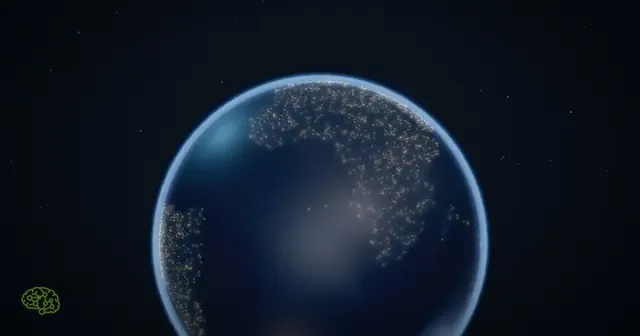
The planet does it too. Sunlight arrives hot and leaves as cooler heat into the dark.
He called this a dynamic fractal of flow-dependent structures. The same pattern shows up at every size, but each round changes the world the next round has to live in. Early microbes filled the air with oxygen, and everything after them had to learn to breathe it.
Here's the lock from the beginning back now. So we've already proven that anything that lives on flow has the same problem: the world keeps changing, so it has to keep updating.
In mice, the CB1 lock helps with that. Move the hidden platform, and normal mice find the new spot. Mice without CB1 keep going back to the old one.
“The mice lacking cannabinoid receptors only go to the old place. They cannot relearn.”
In Bob's picture, a cell that can't let go is stuck in its past. Which raises a question: what happens when it isn't one cell that has to let go, but your whole body, after a fight?
08 · Fight, Then Fix
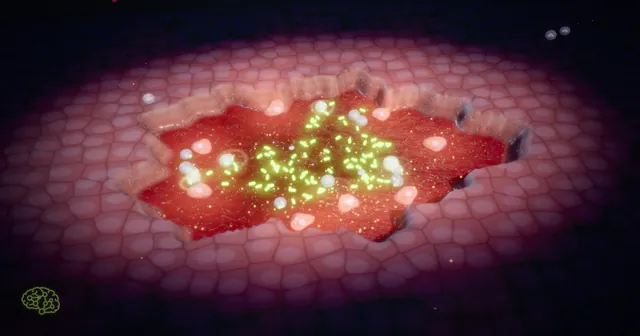
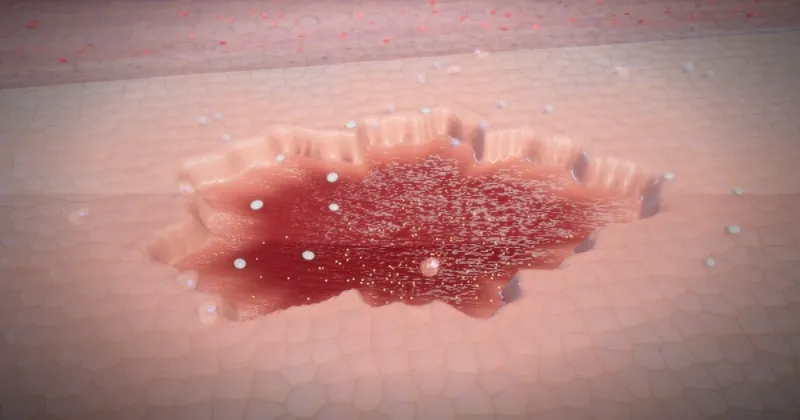
Scrape your knee, and within minutes your body starts a fight. But within a week, the fight is over, the mess is cleared and the new skin has regrown. The fight part usually gets the attention of modern medicine, but actually, much of what goes wrong with age happens during the cleanup process.
Dr. Bob had a simple picture for this. Your body was like an office. Office workers come in in the morning, work all day, leave tons of waste behind, and leave in the evening. Then in the evening, the cleaning crew comes to clean it all up so the office workers can start fresh again the following morning. Your body runs both types of shifts too, and the two locks in this film help decide which crew is on shift.
The first cells to arrive are neutrophils. They crawl toward the wound, swallow bacteria and kill them with bleach, the same active chemical that's in the bottle under your sink.
Cells on the attack burn sugar the fast, wasteful way, the way a sprinter burns through fuel.
“We actually make free radicals that we focus in an effort to kill living entities that we don’t want living within us.”
That same sugar-burning chemistry that kills the bacteria also damages the healthy tissue around them with free radicals. You feel that cost as swelling, heat and pain.
Then the job changes. Some of the same macrophages switch roles. They eat the dead cells, send out signals that end the fight and help lay down new tissue. Many shift toward burning fat.
A few of the T cells that fought stay behind as memory cells, so the next infection gets beaten faster. They lean on fat too. In mice, nudging T cells toward burning fat made more of them become memory cells.
Ending a fight also takes work. The body makes its own stop signals, and many of them are built from the same omega-3 and omega-6 fats it uses to make its own endocannabinoid keys.
“CB2 turns on fat burning. CB1 allows you to burn sugar safely. That’s why your brain needed it, because it’s so organized it’ll fry without it.”
Some of those locks sit inside the cell itself.
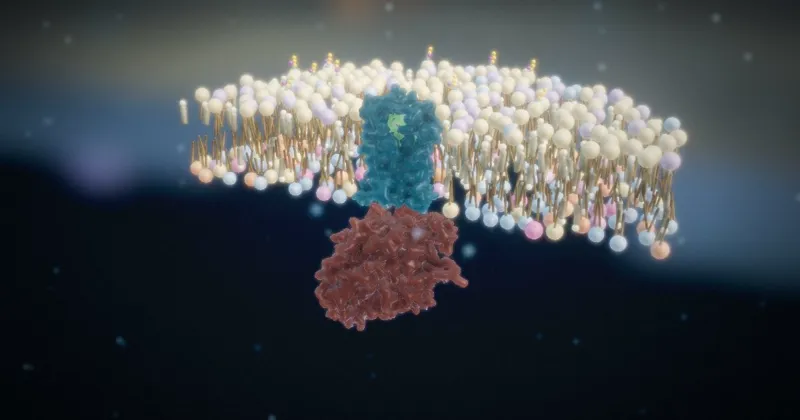
“CB1 receptor, the one that gets us high, has a very special role in that it's not only found on the surface of the cell, like on your neurons, but it's also found on the surface of the mitochondria, which are the energy powerhouses of your cells.”
CB1 sits mostly on nerves, and on the liver and fat that store fuel. CB2 was found in 1993 in the spleen, and it sits mostly on immune cells.
In your gut, CB1 sits on the nerves of the gut wall. Remove it, and colitis in mice gets far worse.
Your bones are rebuilt all the time, and CB2 helps keep the balance. Without it, mice lose bone faster as they age.
Your skin makes its own keys too. Take away both locks, and an allergic rash in mice flares much worse.
The same system runs through your immune cells, your gut, your bones and your skin. The brain is just where we found it first.
When CB2 turns on, immune cells generally calm down. They put out fewer alarm signals and fight less. In many disease models, mice bred without CB2 get worse inflammation.
CB1 can push the other way. In diabetic rats, the body's own keys turned CB1 on macrophages in the pancreas. That kept the inflammation going and killed insulin-making cells. Blocking CB1 outside the brain protected them.
In mouse liver studies, turning CB2 on macrophages switched on their recycling program, where a cell breaks down its own damaged parts. Work on that recycling process won the Nobel Prize in 2016.
Dr. Bob put it together this way. CB1 helps run the heavy machinery, CB2 starts the cleanup, and health means keeping both shifts working in a harmonious symphony since both processes happen at the same time.
On the scraped knee, the two shifts have to come in the right order. The fight clears the bacteria first. Then the cleanup takes over and lays down new skin.
If the cleanup starts too early, the infection wins. If it never starts, the fight keeps burning the tissue it was meant to protect.
A century ago, most people died of infections. Today most die of heart disease, cancer and other illnesses of age and inflammation.
Dr. Bob thought our biology hasn't caught up. The set points that switch inflammation on and off were tuned over millions of years, for a world where infections killed people young.
“Because we can no longer evolve fast enough. Our set points were set in the past. We make too much inflammation in general.”
Researchers call it inflammaging. As we get older, the fight switch never fully turns off.
“Free radicals are the friction of life, and endocannabinoids are the oil of life.”
Dr. Bob thought aging was mostly a cleanup crew falling behind, and that the body's own keys, along with the plant's, could help it catch up. Parts of that have good evidence in mice. In people, it's still a theory.
Much of the repair happens while you sleep. Exercise switches on recycling in your muscles, and fasting does it more widely. In addition to the plant's THC, a molecule in black pepper and cloves, beta-caryophyllene, turns the CB2 lock directly. In mice it's been shown to calm inflammation.
The fight and the cleanup are the whirlpool again, with fuel coming in and damage going out. Keep both moving, and you stay far from equilibrium for longer.
09 · Your first meal
We've followed the system through damage and repair. But it's working long before any injury, right from the beginning of life.
This is what really blew my mind about cannabis. Long before you ever try the plant, your body is already dosing you.
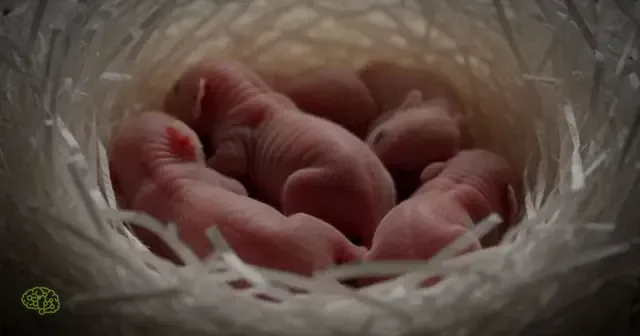
The first dose comes with your first meal. Breast milk carries 2-AG, one of your keys. Newborn mice that couldn't use it barely fed, stopped growing, and some even died.
You keep making these keys for the rest of your life, and you can make more. A long run is one way. After forty-five minutes, both of your endocannabinoid keys rise in your blood, and runners still felt the high when scientists artificially blocked their opioid receptors.
Time with people you love may raise these keys too. In mice, company raises anandamide in the brain's reward center. Block the lock there, and company stops being rewarding.
And your food supplies the raw material. Your keys are built from fat. In mice raised without enough omega-3s, the locks in the brain's mood centers stopped working.
10 · Pull back
Now pull back. From one synapse, to your brain, to your body. To everyone you have ever met. To the planet.
Everything with a backbone carries this lock. A fly has none at all.
The plant came hundreds of millions of years later, splitting from hops about twenty-eight million years ago, probably on the Tibetan Plateau, and its cannabinoids most likely began as a defense. As Dr. Bob put it,
“So the plant is just imitating the way your body works.”
You have been making your own medicine since before you were born.
11 · Eat, store, heal, let go
Here's what I think all of this adds up to. I want to propose a theory.
Start with how old this lock is. A sea squirt has a version of it, so it's more than 500 million years old. Early in the vertebrates, the gene doubled. CB1 went mostly to the nerves. CB2 went mostly to the immune cells.
Dr. Bob thought that doubling is a big part of the reason humans exist at all.
“And that's, in my mind, what powered the evolution of humanity. It was the CB1 receptor, which first appeared with the vertebrates.”
Dr. Bob liked to compare us with the other half of the animal tree, the insects, which split from our side more than half a billion years ago and never got the lock.
“So protostomes are successful at survival. You look at today's cockroach, and it looks pretty much like, you know, it did millions and millions of years ago. But look at us and how we've changed.”
“So deuterostomes are successful at evolving. Feeding behavior driven by the endocannabinoid system drives the evolution of deuterostomes and man.”
For an animal, the flow starts with food, and this system runs the hunger. It's in your first meal.
It also decides what to keep. CB1 tells fat cells to store. Mice born without it stay lean, even on a rich, fatty diet. For most of history, food was scarce, and storing it kept animals alive.
Burning all that energy leaves damage, and damage brings inflammation. That's the second lock's job. CB2 turns the immune fire down when the work is done.
Mice born without CB1 age early. In old mice, a tiny daily dose of THC brought their learning back to the level of young ones. In young mice, it made it worse.
“And as we age, we return back to equilibrium. The complexity, the negative entropy of our chemistry decreases.”
Dr. Bob saw the whole history of life through this pattern. He thought the chemistry your body uses to let go and update was one of evolution's main tools for staying far from equilibrium, and that brains with more of it could change more.
“Adaptability. That's what evolution works off of, adaptability. You're not the biggest. You're not the strongest. You're the most adaptable. You're not the smartest. None of that is what matters.”
He went one step further, and most scientists wouldn't follow him there. He thought people vary in how much of this updating chemistry they have. In his view, people born with less endocannabinoid tone look backward, agree with each other more easily, and end up in charge. He called them backward-looking and forward-looking people, and he believed the future depended on shifting the balance.
Where I've landed is that facing forward is a habit, and anyone can practice it. You don't need the right genes or the right plant. You need to notice when you're swimming to where the platform used to be, and turn around.
You're a whirlpool. Food comes in, energy flows through, and the pattern has to keep changing to stay itself. Your endocannabinoid system runs that flow. It makes you hungry, stores what you need, cools the fire, and lets go of what's old. Eat, store, heal, let go. The lock is ancient. My guess is that the more an animal has to learn and unlearn, the more it leans on this system, and that's part of what makes humans so unique. Of course, this is just my theory, not textbook science. But it ties everything together.
Patterns that are far from equilibrium have one more strange habit. Before they transform into a new shape, they wobble. The swings get bigger and take longer to settle. Ecologists have seen it in a lake before it turned green, and climate scientists see it in the records before the ice ages ended.
Dr. Bob saw the fall of the Berlin Wall this way. There were years of pressure, then weeks of wobble, then one confused announcement on a November night, and the whole thing flipped.
He believed the whole world was wobbling like that, in weather, money and politics, and that it could tip toward fear or toward a freer kind of order.
12 · No going back
When a system like that finally tips, what decides which way it goes? Sometimes nothing inside it does. A nudge too small to measure does.
Back to the dish of oil. Heat it the same way twice, and you get the same kind of cells, but never in the same places. Turn it up and the oil rolls like a row of logs. Which way each one turns is settled by fluctuations too small to see.
Prigogine called this order through fluctuations. At a fork like that, more than one future is possible. Only one of them happens, and everything after it builds on that one.
And you can't simply back out of a fork. When a lake flips from clear to green, cutting the pollution back to where it was before the flip usually isn't enough. You have to cut much further to flip it back. The way in isn't the way out.
Some things don't go back at all. Pour cream into coffee and it swirls in. Wait all day, and it never swirls back out. Nothing strictly forbids it. It's just so unlikely that it wouldn't happen once in the whole life of the universe.
Almost every law of physics works just as well played backward. The second law of thermodynamics doesn't. Overall, disorder goes up. That one-way street is what physicists call the arrow of time.
Bob had a simpler way to say it.
“The physics that we're taught in our schools says time can go backwards. Well, are you getting younger? When's the last time you drove your car and the gas tank filled up? You know, those things don't happen. There is an arrow to time.”
So where does the arrow come from? Most physicists say: from the beginning. The universe started out extraordinarily ordered, and everything since, stars, cells, you, is part of its long run downhill.
Prigogine thought that was only part of it. He argued the arrow is written into the laws themselves, and that far from equilibrium, time doesn't just wear things down. It builds them.
He loved a line from the philosopher Henri Bergson: the more we study the nature of time, the more we shall comprehend that duration means invention, the creation of forms, the continual elaboration of the absolutely new.
And Bob liked to quote Prigogine himself.
“We are actually the children of the arrow of time, of evolution, not its progenitors.”
Quantum physics has a fork of its own. In Erwin Schrödinger's famous thought experiment, a cat sits in a sealed box with a poison that's released if a single atom decays. Until someone looks, the math holds both outcomes at once.
In 1957, a Princeton graduate student named Hugh Everett proposed that both outcomes happen. The universe splits, and each branch carries on without the other. It's called many worlds. Take it all the way, and there's a version of you for every choice you didn't make.
Can far-from-equilibrium physics rule that out? No. Nothing in it can see another branch. And even in many worlds, once branches split, they don't come back together. The arrow holds there too.
Prigogine bet the other way. To him, the future isn't sitting out there with every version already written. It's being made, one step at a time, and no step can be taken back. Nobody has settled who's right. But either way, you only ever get to live one branch.
Your body works the same way. It can't un-eat a meal or un-live a fight. What it can do is let go and update. Remember the mouse that kept swimming to where the platform used to be? That's what it looks like when letting go fails.
Here's what I take from all of it. There's no rewind. And if there's another version of me out there in another universe, we'll never compare notes. That can sound bleak. I think it's the opposite. It's the reason choices count.
Lots of futures were possible. One of them is happening right now, and part of it is made of what you do next. You can come back to a place. You can never come back to a moment.
13 · Epilogue
For me, all of this brings us back to the plant. Back where we started. People have burned this plant for 2,500 years, chasing a feeling...
The whole time, the lock was already in them. Their own endocannabinoid keys were turning it, a little at a time, only where it was needed, only for moments.
Dr. Bob died in 2023. By his own physics, the whirlpool that was him stopped turning.
An idea is a whirlpool too, and it only keeps its shape while it moves through people. The flow that made him is over. But the flow is moving through me now, and for the last few minutes it's been moving through you.
So test it. Keep what works and throw out what doesn't, including anything he or I got wrong. In the meantime, stay far from equilibrium.
“Well, you know, it's absolutely true because the truth is empowering, and knowledge is empowering, and science really is simply a search for the truth.”
“Life must exist. It’s a natural phenomenon.”