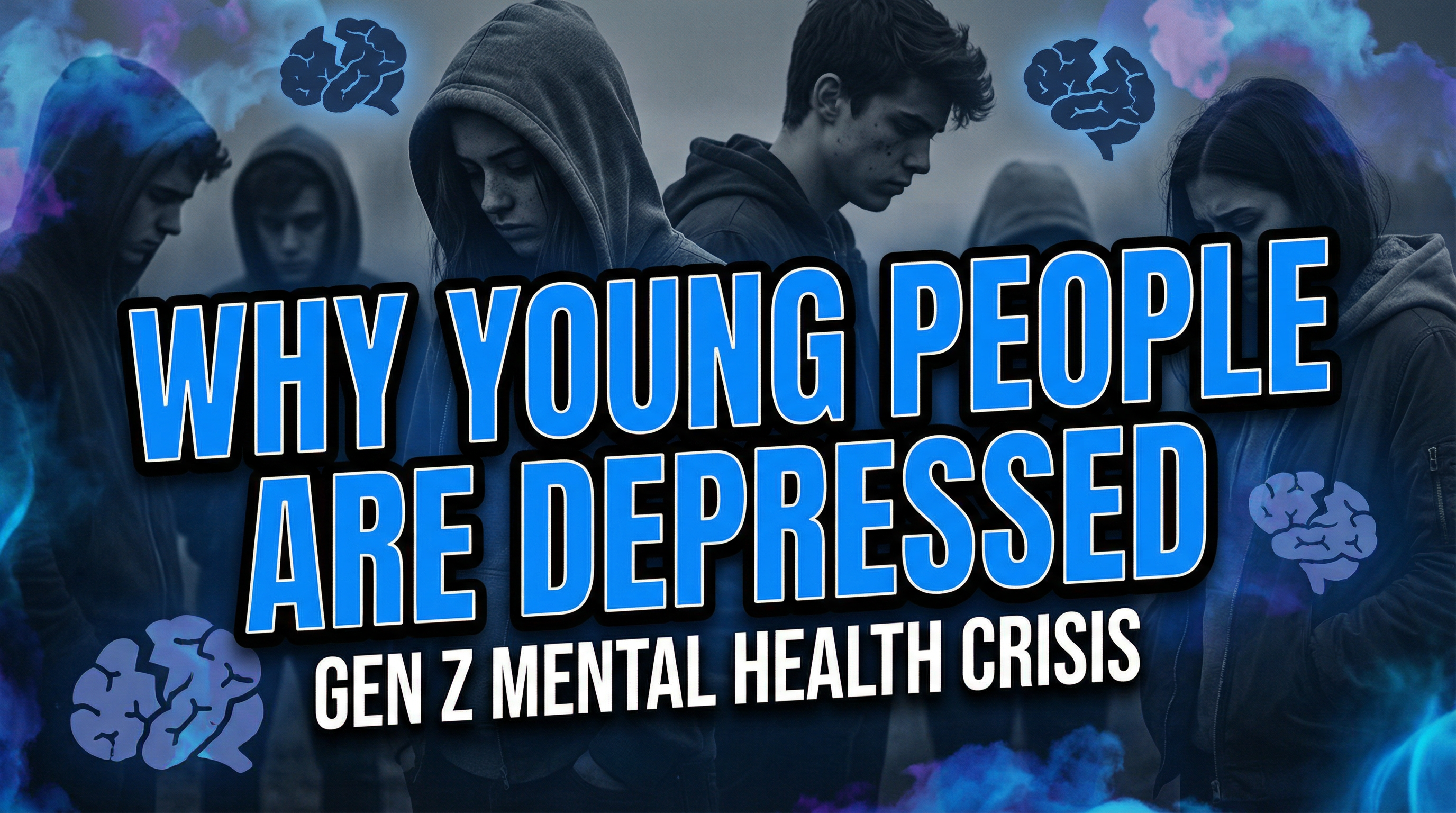
Why Young People Are Depressed
It's not weakness. It's a mismatch between ancient brains and modern environments. The Forward Look diagnosis—and prescription.
Full Article
Are You Depressed, Or Just Adapted to a World That No Longer Exists?
Let's cut the bullshit. If you're young and feel a constant, gnawing sense of dread, you've probably been told you're broken. You're "mentally ill." You have a "chemical imbalance." You need a pill, a therapist, a wellness retreat, or maybe just more damn kale.
What if I told you that's all a convenient lie? A story we tell ourselves because the truth is far more terrifying—and also far more empowering. What if the depression, the anxiety, the feeling of being utterly overwhelmed isn't a sign of your weakness, but a sign that your ancient, beautifully-evolved brain is screaming for a world that no longer exists?
You're not broken. You're a finely tuned survival machine stuck in the wrong zoo. And the zookeepers are handing you Prozac while they sell tickets to watch you pace in your cage.
The Problem: We're Diagnosing the Symptom, Not the Disease
The entire mental health industry is built on a backward-looking model. It sees your depression as a personal failing. A bug in your code. They slap a label on you—Major Depressive Disorder, Generalized Anxiety—and prescribe a solution designed to bring you back to "balance."
But what if balance is the last thing you need? Life isn't about balance. Life, as the great Dr. Bob Melamede taught us, exists far from equilibrium. It thrives at the edge of chaos, in a constant state of flux and adaptation. Your body, your mind, your very consciousness are self-organizing systems, creating order out of the relentless storm of the universe.
"The arrow of time only moves in one direction. You can't go back. The past is a ghost. Trying to restore some mythical 'balance' is like trying to un-burn a log. It's a fool's errand, and it's making you miserable."
We pathologize the pain of young people because it's easier than admitting the truth: the modern world is a toxic, soul-crushing environment for a species that evolved to hunt, gather, and connect in tight-knit tribes. We've traded open savannas for open-plan offices, genuine connection for social media validation, and meaningful struggle for meaningless comfort.
Your brain, hardwired over millennia for a dynamic, unpredictable world, is suffocating in the sterile, predictable, and deeply isolating environment we've built. The depression isn't the problem. The depression is the alarm bell. And we're trying to fix the bell instead of evacuating the burning building.
The Application: The Modern World is a BLP Factory
Think about your life. You wake up, stare at a glowing rectangle. You commute, trapped in a metal box. You work, staring at another glowing rectangle. You come home, exhausted, and relax by... staring at yet another glowing rectangle. You are fed a diet of processed, nutrient-poor food that inflames your body and brain. You are sold a dream of success that involves accumulating things you don't need to impress people you don't like.
Where is the novelty? Where is the challenge? Where is the genuine human connection?
We've created a world that is perfectly designed to turn vibrant, forward-looking young people into depressed, backward-looking adults. We've replaced the acute, short-term stressors our bodies are designed for (like running from a damn tiger) with chronic, inescapable stressors (like student loan debt and the 24/7 news cycle).
Your depression is a perfectly rational response to an irrational environment. It's your brain's way of conserving energy when it perceives no path forward. It's a forced hibernation. It's a retreat from a world that offers no outlet for your innate drive to create, to explore, to connect, to live.
One particularly lonely Saturday night while I was at home in front of my computer watching porn (at this point, I had yet to hold a girl's hand, let alone kiss one), I had a moment of clarity. "What the fuck am I doing?" I thought. Do I plan to spend the next 50 some-odd years in front of the computer screen fantasizing about girls who would never want touch me? Does this life even have a point? Does it even have a purpose? I had no answers, only questions. However, for the first time in my life, I was able to set aside my absurdly large ego for long enough to realize I needed serious help.
The Takeaway: How to Be an FLP in a BLP World
So what the hell do you do? You can't just pack up and go live in the woods (or maybe you can, what do I know?). But you can start making conscious choices to push your system back towards a state of far-from-equilibrium health.
- Embrace Novelty: Your brain craves new experiences. Break your routine. Take a different route to work. Learn a new skill. Talk to a stranger. Do something that scares you a little bit every single day. This is like a workout for your ECS.
- Move Your Damn Body: You are an animal. You were designed to move. Sitting is the new smoking. Find a way to move that you enjoy. Lift heavy things. Sprint. Dance. Walk in nature. Don't do it to "get in shape." Do it to remind your body that it's alive.
- Feed Your Brain, Not Your Anxiety: Your gut is your second brain. The crap you eat directly impacts your mood. Ditch the processed garbage and eat real, whole foods. Your ancestors wouldn't recognize a Twinkie. You shouldn't either.
- Cultivate Real Connection: Social media is a cheap substitute for the real thing. Put your phone down and have a conversation with a real human being. Look them in the eye. Be vulnerable. Share your struggles. We are a tribal species. We need each other.
This isn't a quick fix. It's a lifelong practice. It's about consciously choosing to be a forward-looking person in a world that wants to drag you backward. It's about embracing the chaos and finding the order within it.
It's not easy. But it's a hell of a lot better than sitting in a cage, waiting for the next feeding time.
The Deeper Dive: Why 'Balance' Is a Dangerous Myth
Let's really get into the weeds on this, because it's the most important and misunderstood part of the whole equation. The idea of "balance" has been co-opted by the wellness industry to sell you yoga pants and green juice. They present it as this serene, zen-like state of perfect equilibrium. It sounds lovely. It's also complete and utter bullshit, and it's fundamentally anti-life.
Life is a rebellion against equilibrium. Equilibrium is death. When a system reaches equilibrium, it stops changing. It’s a closed-off, static, and ultimately dead state. A rock is at equilibrium. A corpse is at equilibrium. A living, breathing, thinking human being? You are a raging fire of chaotic, far-from-equilibrium processes. And that is a beautiful thing.
Dr. Bob Melamede used to say that life is like a whirlpool. A whirlpool maintains its structure, its "whirlpool-ness," only because water is constantly flowing through it. It has a stable form, but it is made of entirely unstable components that are in constant motion. The moment the flow stops, the whirlpool disappears. There is no "balance." There is only dynamic, structured flow. That's you. You are a whirlpool of matter and energy.
Your depression is what happens when the flow slows down. When you stop taking in new energy—new ideas, new experiences, new challenges—and you start trying to hold onto the water that's already in the whirlpool. You become stagnant. You resist the natural pull of the universe, the arrow of time that demands constant forward movement. You become a BLP, trying to preserve a state that was only ever meant to be temporary.
Think about it in practical terms. When were you happiest? Was it when everything was stable, predictable, and "balanced"? Or was it when you were learning something new, falling in love, overcoming a challenge, creating something from nothing? Those are all far-from-equilibrium states. They are states of high energy flow. They require adaptation, vulnerability, and a willingness to let go of the old to make way for the new.
The modern environment actively discourages this flow. It encourages you to find a comfortable niche and stay there. Get the stable job, the mortgage, the predictable routine. It sells you insurance against risk. It provides you with endless, passive entertainment to distract you from the terrifying, exhilarating reality of your own existence. It’s a system designed to turn dynamic whirlpools into stagnant ponds.
And your endocannabinoid system is screaming in protest. The ECS is the mediator of flow. It’s what allows your brain to prune away old, useless connections to make way for new ones—a process called long-term depression (LTD), ironically. When you learn, when you adapt, when you overcome fear, your ECS is firing on all cylinders. It’s the neurochemical engine of being an FLP.
When you are stuck in a rut, bombarded by chronic stress, and disconnected from meaningful experience, your ECS downregulates. It gets tired. The flow slows. The whirlpool starts to break down. That’s the feeling of depression. It’s a thermodynamic crisis. It’s your biology telling you that you are getting dangerously close to equilibrium.
So, the next time someone tells you to "find your balance," tell them to go balance on a tightrope over a volcano. Your goal isn't balance. Your goal is flow. Your goal is to become a more efficient, more adaptable, more complex whirlpool. To embrace the chaos, to surf the edge of entropy, and to become a master of self-organization.
This isn't just a metaphor. It's the fundamental organizing principle of the universe. And understanding it is the first step to reclaiming your mind from the soul-crushing cage of modern life.

Comments
Related Articles

Reality is Not What You Think
IKE: The World Is What You Think It Is
The Skillset Cannabis Unlocks
Cannabis Prohibition: A Case Study in Government Failure
The System Inside You That Nobody Told You About
Want More?
Subscribe to The Forward Look on YouTube to get notified when new episodes drop.
Subscribe