The Exercise Paradox: Why Breaking Down Builds You Up
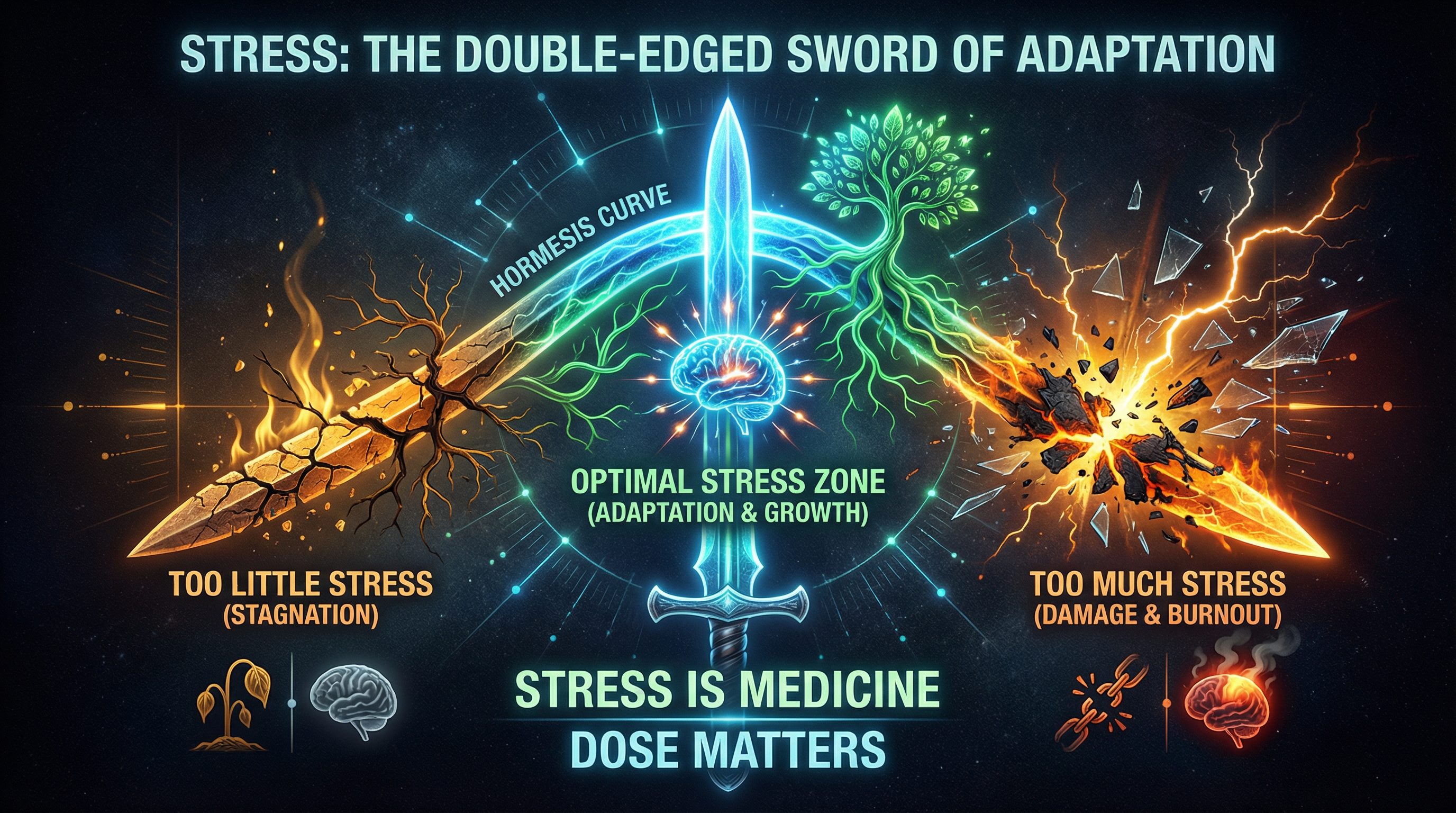
Exercise creates stress and damage. But it makes you stronger. The thermodynamic explanation for why breaking down builds up.
Full Article
The Exercise Paradox: Why Breaking Down Builds You Up
You think you’re getting stronger at the gym. You’re not.
You think that hour on the treadmill is burning fat. It isn’t.
You’ve been told that exercise is about “building” muscle and “burning” calories. That’s bullshit. You’re not building anything. You’re breaking yourself down. And that’s the whole damn point.
Welcome to the Exercise Paradox. The counterintuitive, mind-bending truth is that the stress and damage you inflict on your body through exercise is the very thing that makes you more resilient, more powerful, and more alive. It’s a perfect example of a far-from-equilibrium system in action, and understanding it will change not just how you train, but how you see the world.
The Problem: Your Body Isn't a Bank Account
Most people approach fitness with a simple, linear, and utterly wrong model. They see the body as a bank account. Calories in, calories out. Lift weights, deposit muscle. Do cardio, withdraw fat. It’s a neat, tidy, equilibrium-based view of the world. And it’s a fantasy.
This is the thinking of the Backward-Looking People (BLPs). They see life as a quest for balance, for stasis. They want to find a comfortable equilibrium and stay there. But life, real life, doesn’t happen in equilibrium. Equilibrium is death. Life exists at the edge of chaos, in a state of constant flux, a dance of creation and destruction. It’s a far-from-equilibrium system.
Your body isn’t a spreadsheet. It’s a complex, adaptive system that responds to stress. When you treat it like a simple machine, you get frustrated. You hit plateaus. You wonder why the "calories burned" on the elliptical doesn’t match the number on the scale. You’re trying to apply second-grade math to a quantum physics problem.
The entire fitness industrial complex is built on this flawed premise. It sells you gadgets to count your steps, apps to log your meals, and magazines with ‘guaranteed’ 6-week transformations. It’s all designed to reinforce the idea that your body is a simple, predictable machine. It’s a lie. A profitable lie, but a lie nonetheless. It keeps you trapped in a cycle of effort and frustration, always feeling like you’re failing when it’s the model itself that’s broken.
"The arrow of time is a one-way street. You can’t go back. You can only adapt to what’s next. The BLPs are constantly trying to reverse down a one-way street, and they wonder why they keep crashing."
The Application: Train for Adaptation, Not Exhaustion
Once you understand this, your entire approach to fitness changes. You stop chasing the feeling of being "wrecked" after a workout. You stop obsessing over calories burned. You start thinking like a Forward-Looking Person (FLP). You start training for adaptation.
What does that look like in practice?
- Embrace Variety: If you do the same workout every day, your body will adapt and then stop changing. It has reached a new, stable state. To keep adapting, you have to keep introducing new stressors. Change the weight, the reps, the tempo, the exercise itself. Keep your body guessing. This is why a CrossFitter who does a different WOD every day is often more resilient than a bodybuilder who has been doing the same 3x10 split for a decade. A sample week for an FLP might look like this:
- Monday: Heavy strength training (e.g., squats, deadlifts)
- Tuesday: High-Intensity Interval Training (HIIT) on a bike or rower
- Wednesday: Active recovery (long walk, yoga, foam rolling)
- Thursday: Upper body hypertrophy (e.g., pull-ups, bench press)
- Friday: A new sport or activity (rock climbing, swimming, martial arts)
- Saturday: Long, slow endurance work (a hike or a long run)
- Sunday: Complete rest.
See the pattern? It’s chaos. But it’s structured chaos, designed to provoke the widest possible range of adaptations.
- Prioritize Recovery: The magic doesn’t happen in the gym. It happens when you’re resting. That’s when your body is doing the hard work of repairing and rebuilding. If you are constantly stressing your system without giving it time to adapt, you’re just accumulating damage. This leads to overtraining, injury, and burnout. Sleep, nutrition, and active recovery are not optional extras; they are the moments when the thermodynamic miracle of adaptation actually occurs. This means prioritizing 7-9 hours of quality sleep per night. It means fueling your body with nutrient-dense, anti-inflammatory foods that provide the raw materials for repair. Think high-quality proteins, healthy fats, and a rainbow of vegetables. It means taking days off, going for walks, and allowing your nervous system to switch from ‘fight or flight’ to ‘rest and digest.’ The BLP sees rest as weakness; the FLP knows it’s where the real growth happens.
- Listen to Your Endocannabinoid System: Your body has an innate intelligence. The endocannabinoid system (ECS) is constantly monitoring your internal state and trying to maintain a dynamic balance, or homeostasis. When you feel good, energized, and clear-headed, your ECS is humming along. When you feel run-down, inflamed, and foggy, your ECS is screaming for a change. Learn to listen to those signals. Some days, you’ll be ready to smash a personal record. Other days, a long walk or some gentle yoga is the most productive thing you can do. The FLP knows that adaptation is a dance, not a forced march. How do you listen? Pay attention to your resting heart rate. Notice your mood and energy levels. Are you consistently sore? Are you feeling motivated or dreading your workouts? Your body is sending you data constantly. The ECS communicates through feelings of well-being, pain, and fatigue. Learning to interpret this data is the highest form of bio-hacking there is. It’s the art of surfing the waves of stress and recovery, rather than being crushed by them.
The Takeaway
Stop thinking of exercise as a punishment for what you ate. Stop seeing your body as an enemy to be beaten into submission. Your body is a complex, self-organizing, far-from-equilibrium system, and exercise is your tool for guiding its evolution.
You are not building muscle. You are creating the conditions for your body to build itself. You are not burning calories. You are creating an energy deficit that signals your body to re-optimize its fuel sources. You are a catalyst for your own transformation.
This is the exercise paradox. The damage is the signal. The stress is the stimulus. The breakdown is the breakthrough. It’s not about balance; it’s about the beautiful, chaotic, life-affirming dance at the edge of chaos.
References
- Melamede, R. (2005). Harm reduction-the cannabis paradox. Harm Reduction Journal, 2(1), 17.
- Prigogine, I. (1977). Self-Organization in Non-Equilibrium Systems. Wiley.
- Ji, L. L., Radak, Z., & Goto, S. (2010). Exercise-induced hormesis may help healthy aging. Annals of the New York Academy of Sciences, 1197(1), 134-141.
Comments
Related Articles
The Stoner Stereotype is Dead
Cannabis Is Not a Drug
The Same Physics Runs Both

Why the Old Institutions Are Failing
The Extinction of Backward-Looking People
Want More?
Subscribe to The Forward Look on YouTube to get notified when new episodes drop.
Subscribe