Central Planning Always Fails (Here's Why)
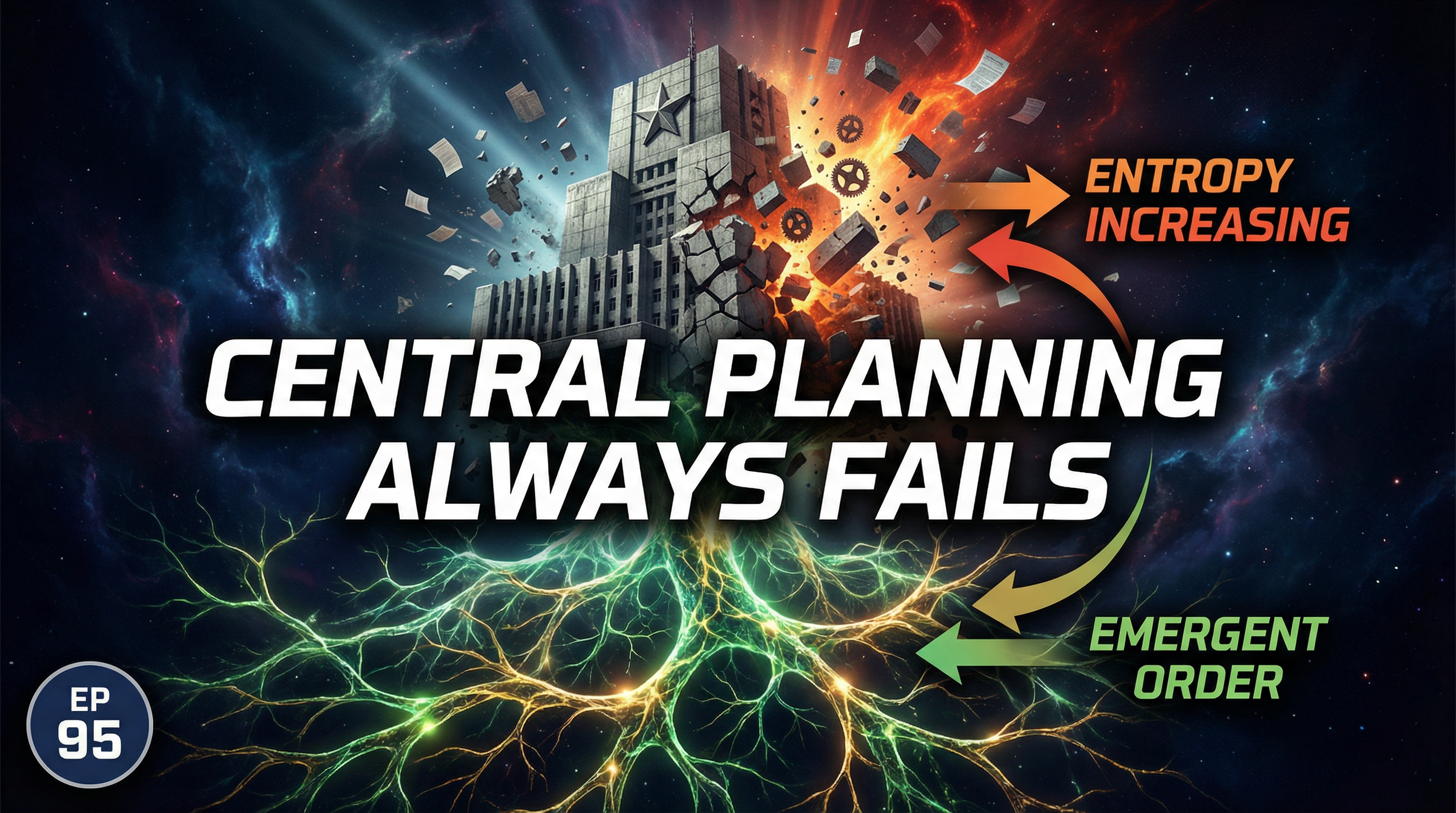
The Soviet Union. Venezuela. Your company's 5-year plan. Central planning fails because it fights thermodynamics. The science of spontaneous order.


Full Article
Central Planning Always Fails (Here's Why)
Your Five-Year Plan is a Thermodynamic Joke
Let’s be honest. You’ve sat in those meetings. The ones where some suit unveils a grand five-year plan, complete with color-coded charts and projections down to the last decimal. Everyone nods along, pretending this crystal ball view of the future is anything other than corporate fan fiction. I’m here to tell you what your gut has been screaming all along: it’s bullshit.
That five-year plan, the Soviet Union’s Gosplan, Venezuela’s socialist paradise—they’re all doomed from the start. Not because of bad intentions or incompetent leaders (though those certainly don’t help), but because they violate the most fundamental laws of the universe. They spit in the face of physics. Specifically, they fail because they ignore the relentless, unforgiving march of far-from-equilibrium thermodynamics.
The Problem: We’re Addicted to Order
We humans crave certainty. We want to believe we can tame the chaos of the world, bend it to our will, and chart a predictable course. We build intricate models, create detailed plans, and establish rigid hierarchies to control every variable. We think we’re creating order, but we’re actually building a prison of our own making.
This is the central flaw in the thinking of what I call Backward-Looking People (BLPs). They are obsessed with maintaining the status quo, with forcing the world into a neat, tidy box. They see the universe as a system that should be in equilibrium—a state of perfect balance and predictability. But here’s the damn truth: equilibrium is death. A system in perfect thermodynamic equilibrium is a dead system. It’s a cup of coffee gone cold, a star that has burned out, a universe devoid of life.
"Life doesn't exist in a state of balance. It exists at the edge of chaos, in a constant, dynamic dance with disorder. We are not equilibrium-seeking machines; we are far-from-equilibrium systems."
Central planners, whether in a boardroom or a government bureau, are the ultimate BLPs. They believe they can gather all the necessary information, process it, and make optimal decisions for everyone. This is the height of arrogance. It’s a fantasy that ignores the sheer complexity and ever-changing nature of reality.
The Application: From the USSR to Your Startup
The Soviet Union is the classic, tragic example of central planning’s failure. For decades, a handful of bureaucrats in Moscow tried to manage the entire economy of a vast nation. They set prices, dictated production quotas, and allocated resources for everything from steel mills to toilet paper. The result was a disaster. Chronic shortages of basic goods existed alongside massive surpluses of things no one wanted. The system was brittle, inefficient, and ultimately collapsed under its own weight.
Why? Because the planners in Moscow could never have access to the real-time, on-the-ground information that flows freely in a market system. A price in a free market isn’t just a number; it’s a complex signal carrying vast amounts of information about supply, demand, scarcity, and innovation. To think you can replace that dynamic, self-organizing system with a spreadsheet is pure folly.
But this isn’t just about communist regimes. Look at your own company. How many times have you seen a brilliant idea from a junior employee get crushed by layers of bureaucracy? How many times has a "strategic initiative" from the C-suite completely missed the mark because it was disconnected from the reality of the customers and the market? That’s central planning at work.
This is the battle between Forward-Looking People (FLPs) and Backward-Looking People (BLPs). FLPs embrace the chaos. They understand that the future is unknowable and that the best way to navigate it is to be adaptable, resilient, and open to feedback. They build decentralized, empowered teams. They experiment, they iterate, they learn. They are the innovators, the entrepreneurs, the ones who thrive at the edge of chaos.
BLPs, on the other hand, cling to the illusion of control. They build rigid hierarchies, create suffocating rules, and punish failure. They are the managers who demand detailed five-year plans in a world that changes every five minutes. They are fighting a losing battle against the fundamental laws of the universe.
The Takeaway
You can’t fight the Second Law of Thermodynamics. It will win. Every time. The question is whether you’re going to be a BLP, crushed by the relentless increase of entropy, or an FLP, who learns to surf the wave.
Here’s how to apply these principles in your life and work:
- Embrace Decentralization: Push decision-making down to the lowest possible level. Trust your people. Give them the autonomy to act on local information. The person closest to the problem is usually the one who knows how to solve it.
- Favor Adaptation Over Prediction: Stop trying to predict the future. It’s a waste of time. Instead, build systems that can adapt quickly to whatever the future throws at you. This means short feedback loops, constant experimentation, and a culture that isn’t afraid to say, "We were wrong."
- Listen to the Signals: In a market, prices are the signals. In your body, it’s the endocannabinoid system—the master regulatory system that helps you adapt to stress and maintain a dynamic, healthy state. Are you listening? Or are you ignoring the feedback the universe is giving you?
- Be an Entropy Exporter: Create value. Solve problems. Build things. Every time you create order in your own life or business, you are doing it by consuming energy and exporting disorder. This is the engine of progress, the very essence of life.
Closing
The universe is not a clockwork machine. It’s a raging, chaotic, beautiful river of energy and information. You can try to build a dam and control it, but eventually, the river will win. It will overflow your dam and wash away your pathetic attempts at control.
Or, you can build a raft, grab a paddle, and learn to navigate the currents. You can become a Forward-Looking Person who understands that the only constant is change and the only viable strategy is adaptation.
The choice is yours. But physics doesn’t care about your opinion.

Comments
Related Articles
Aka Cords and Energy Flow

Spontaneous Order: The Most Beautiful Idea

Why Socialism Violates Physics

Cannabis Prohibition: A Case Study in Government Failure

The Tao is Thermodynamics
Want More?
Subscribe to The Forward Look on YouTube to get notified when new episodes drop.
Subscribe