What are free radicals, and are they bad for you? This covers what mitochondria do, where free radicals come from, how much energy your brain uses, what oxidative stress is, whether antioxidant pills help, what excitotoxicity is, the cannabinoid receptor on your mitochondria, and how your body repairs the damage, with my teacher, the biologist Dr. Bob Melamede, in his own voice from his talks and interviews.
The full answer
What are free radicals?
What are free radicals? They're molecules with an unpaired electron, which makes them grab at whatever they touch, and most of yours come from your mitochondria as they turn food into energy. A little works as a signal, and too much does damage. I'm Justin Hartfield, I've spent twenty-five years in cannabis, and the biologist who taught me about it, Dr. Bob Melamede, who I met in 2010, started out studying these molecules.
He compared the place they come from to a nuclear reactor.
Dr. Bob Melamede, in his own words
A nuclear reactor is fine, as long as it doesn't leak, you know, but what a nuclear reactor leaks, what does it leak? Radiation creates free radicals by splitting water, and free radicals are chemicals with unpaired electrons that like to react with other things.
In your body they're mostly forms of oxygen, starting with superoxide, which is oxygen carrying one extra electron.
What do mitochondria do?
What do mitochondria do? They turn food into ATP, the molecule your cells spend for energy. They pass electrons from your food down a chain of proteins, which pumps protons across their inner membrane and charges it like a battery, to about 0.15 to 0.18 volts. The protons flow back through a protein called ATP synthase, and its rotor spins as they pass. Dr. Bob liked to point out how much of it you make.
Dr. Bob Melamede, in his own words
And then every day a person makes approximately their own body weight in ATP. Well, you know, that seems to be a little bit of a, how can I be making that much of ATP when I'm not getting bigger, you know? It's flow. You make, you break. You make, you break. You make, you break, okay? And that's what's flow... We are flow-dependent structures.
Where do free radicals come from?
Where do free radicals come from? Mostly from that chain. At its end, oxygen should take four electrons and become water, but now and then one slips off early, mostly at two points called complex one and complex three, and oxygen catches it alone. That's superoxide. Dr. Bob called the chain a leaky hose.
Dr. Bob Melamede, in his own words
And the reason I call them a nuclear reactor is because if we force too much through this leaky hose, so to speak, the pressure builds up and it leaks. And what does it leak? It leaks free radicals. But if there's too much pressure in it because you're eating too much and not exercising enough, those are the two ends of this leaky hose.
A 2009 review from Cambridge confirms it: the leak is largest when fuel is plentiful and the energy isn't being used, and far smaller while the cell is busy making ATP. Dr. Bob also put a number on it.
Dr. Bob Melamede, in his own words
Every year you make about four kilograms of superoxide, which is a free radical, which is, again, why I emphasize how much of what we are has to be designed to protect us.
In 1993, Bruce Ames at Berkeley estimated that free radicals hit the DNA in each of your cells about ten thousand times a day, and repair enzymes fix most of it.
How much energy does the brain use?
How much energy does the brain use? About a fifth of what you burn at rest, from about two percent of your weight. That's roughly twenty watts, a dim light bulb's worth.
Dr. Bob Melamede, in his own words
Your brain is 5% of your body weight, and it uses 20% of your energy. And you feel your head, it's always hot.
He was right about the heat. In 2022, a team in Cambridge scanned forty healthy adults, and their brains averaged thirty-eight and a half degrees Celsius, two and a half degrees warmer than their mouths. Most of that energy recharges batteries. Every brain cell holds a small voltage across its membrane, each signal spends some of it, and pumps running on ATP charge it back up.
What is oxidative stress?
What is oxidative stress? It's free radicals outrunning the systems that handle them. Helmut Sies, the German biochemist who coined the term in 1985, separates the low, steady levels cells use as signals from the higher levels that do damage. Dr. Bob put it shorter.
Dr. Bob Melamede, in his own words
Free radicals are the friction of life, and endocannabinoids are the oil of life.
Are free radicals bad?
Are free radicals bad? Not always. Your cells turn superoxide into hydrogen peroxide and read it as a sign that something in the flow is off.
Dr. Bob Melamede, in his own words
You make all this ATP, but if there's any impairment in the flow, then you make more free radicals, which then homeostatically tell the system to do something differently, because otherwise you're gonna make too many free radicals and the cell will die.
Are antioxidants good for you?
Are antioxidants good for you? As pills, the trials say no. A hard workout raises free radicals in your muscles, and in 2009, researchers in Jena, Germany, had thirty-nine young men train for four weeks. The ones taking high doses of vitamins C and E missed out on the gain in insulin sensitivity and the antioxidant enzymes their muscles made without them. In 2012, a Cochrane review of seventy-eight trials found the supplements didn't help people live longer, and beta-carotene and vitamin E seemed to raise the death rate slightly. Dr. Bob would rather change how much leaks than mop it up afterwards.
Dr. Bob Melamede, in his own words
You take your vitamin C or your vitamin E and they're going to negate the free radical because they have antioxidant properties. But in contrast, we can change those flow patterns of our biochemistry. In doing that, you can also wind up regulating free radicals.
What is excitotoxicity?
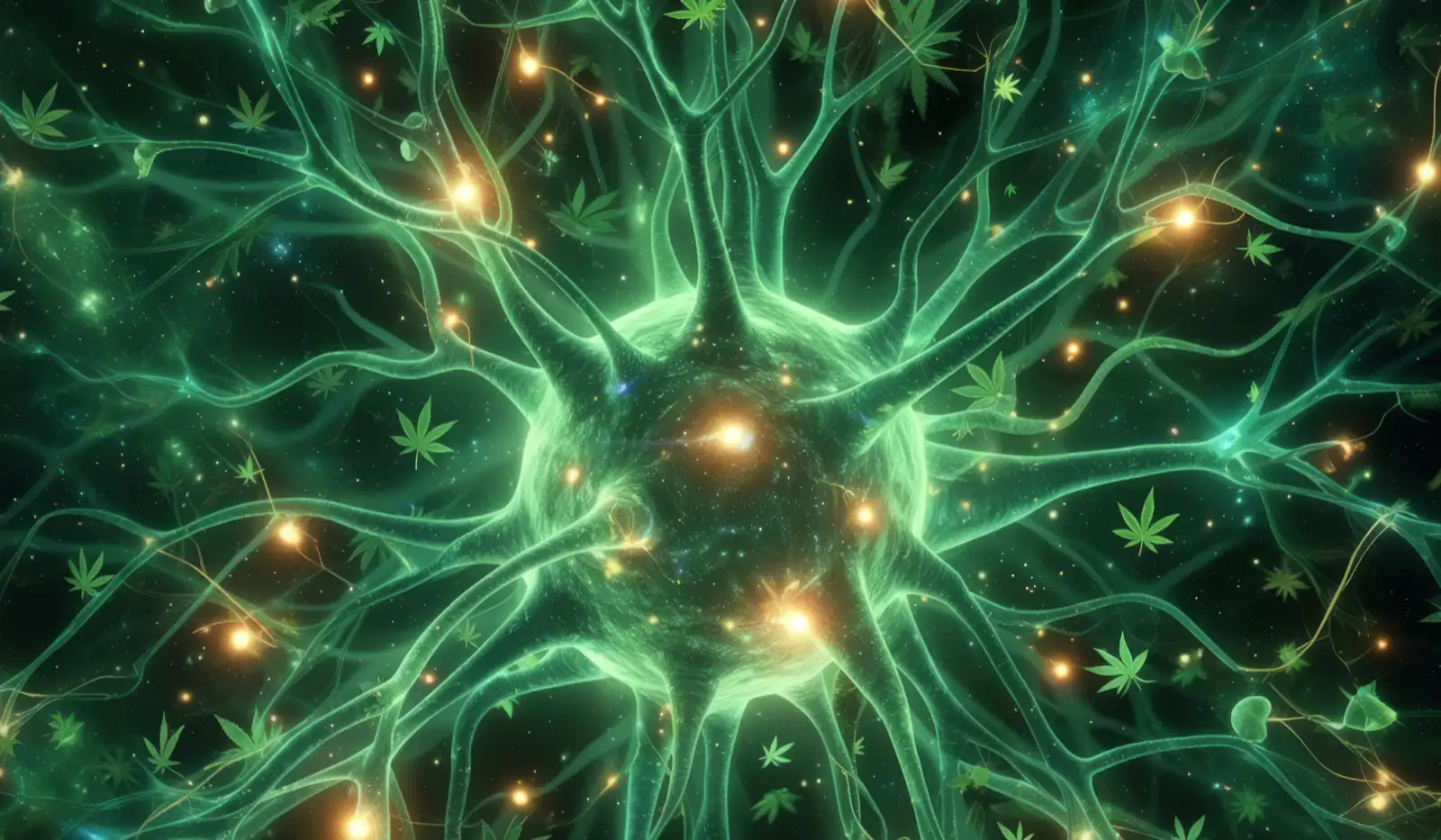
What is excitotoxicity? It's brain cells being damaged by too much excitement. Glutamate, the brain's main "go" signal, lets calcium into the next cell, and a flood of calcium overloads its mitochondria. In 1995, a lab in St. Louis watched mouse brain cells fill with free radicals this way, and blocking the mitochondrial chain stopped it.
Your brain has a brake for this. The overexcited cell sends endocannabinoids backward to CB1 on the cell firing at it, and CB1 shuts that cell's calcium channels, as my video on THC shows.
Dr. Bob Melamede, in his own words
And what it does is it regulates the nuclear reactor to minimize the release of extra free radicals. It does that by regulating calcium channels because calcium is always involved in activating things.
Are there cannabinoid receptors in mitochondria?
Are there cannabinoid receptors in mitochondria? In mice there are, and Dr. Bob pointed to them.
Dr. Bob Melamede, in his own words
CB1 receptor, the one that gets us high, has a very special role in that it's not only found on the surface of the cell, like on your neurons, but it's also found on the surface of the mitochondria, which are the energy powerhouses of your cells.
In 2012, a team in Bordeaux found that CB1 on mouse brain mitochondria turns down their chain. In 2016 they showed it's how cannabinoids block new memories in mice, because mice whose CB1 couldn't reach their mitochondria kept theirs. The brake on the power plant was also the forgetting.
How does your body repair free radical damage?
How does your body repair free radical damage? Enzymes neutralize the radicals, others cut damage out of DNA, and in autophagy a cell digests its own worn-out parts, mitochondria included. Dr. Bob tied that cleanup to the other cannabinoid receptor.
Dr. Bob Melamede, in his own words
And it turns out that the CB1 receptor drives us into the future, while the CB2 receptor turns on the recycling. What a miracle, you know?
In his model, CB1 lets a busy brain burn sugar and CB2 shifts tissue toward burning fat and recycling. A 2016 mouse study near Paris backs part of it: CB2 on liver immune cells calmed inflammation by switching on autophagy. He saw each of us as an experiment in adapting.
Dr. Bob Melamede, in his own words
We are really just probes in adaptability in a big chemistry set. That's all humanity is. That's all we are as individuals. We are quantized probes.
So free radicals are the sparks your mitochondria throw off while they make your energy. A few tell your cells to adapt, too many wear you down, and your own cannabinoids help keep the leak in check. The whole film is on my site, linked below, and next, why we age.
What the studies show
Every claim in this answer, the study behind it, who was studied, and who paid for the research. “None listed” means the paper names no funder.