Eastern Philosophy & Ancient Wisdom
Ancient wisdom through modern physics: Huna, Taoism, Hinduism, Buddhism, and Sufism as flow frameworks.
Educational content, not medical or legal advice. The course discusses health, supplements, cannabis, personal development, and philosophy for educational purposes only.
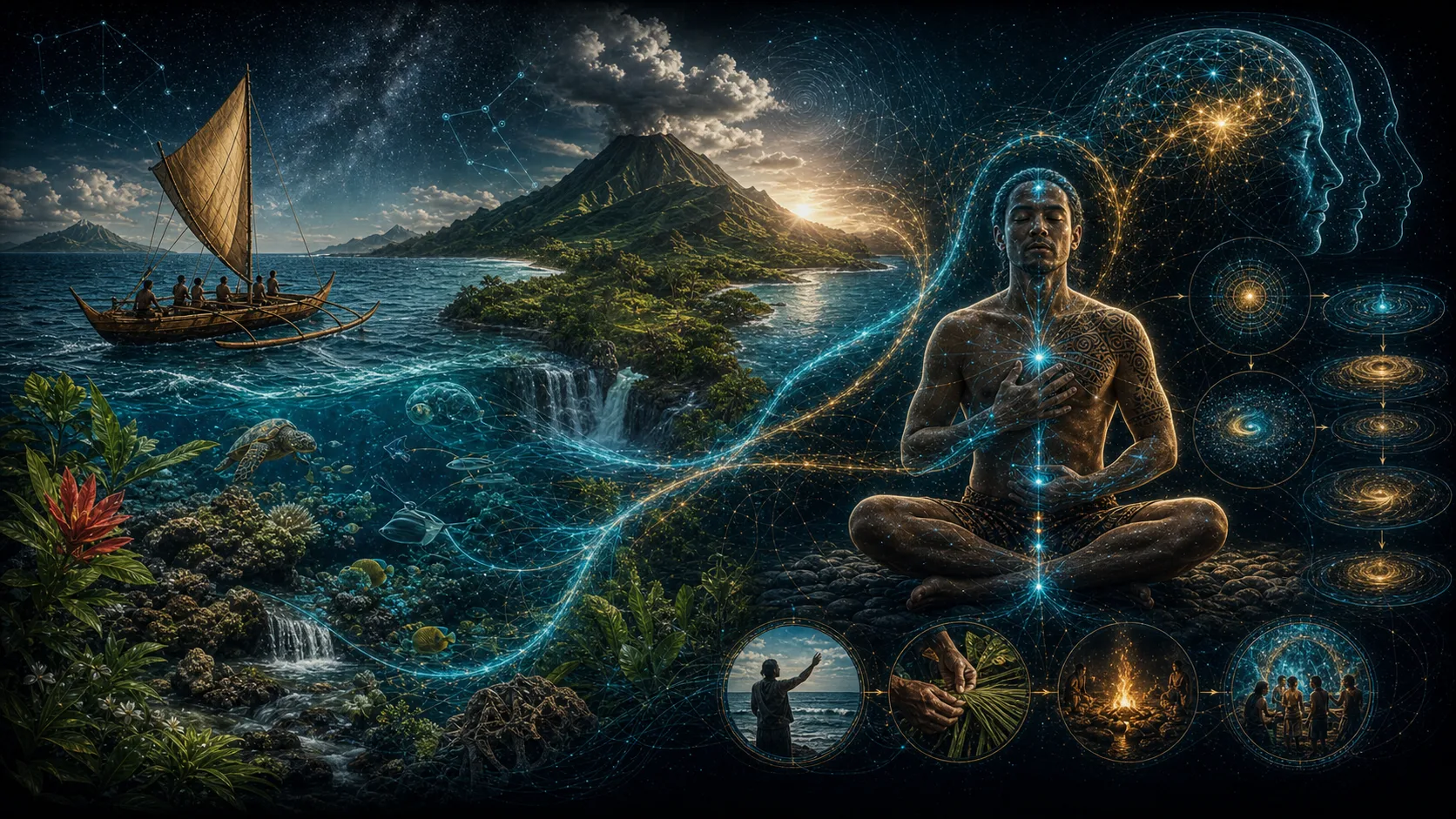
HUNA — the Hawaiian Science of Life
- Wisdom practice
- Flow state
- Discipline path
- Inner harmony
Lesson 5.1.1 Overview
Start here Huna is an ancient Hawaiian philosophy and practice that, when examined through the lens of far-from-equilibrium thermodynamics, turns out to be a remarkably accurate qualitative description of the physics of life.
The Kahuna (practitioners of Huna) arrived at their understanding through centuries of direct observation of nature and inner practice — not through mathematics and particle accelerators. Yet their conclusions converge with Prigogine's in ways that cannot be coincidental.
Huna is organized around seven principles, each corresponding to a "power animal" that embodies that principle.
Lesson 5.1.2 The Seven Principles
Start here 1. IKE — "The World Is What You Think It Is" (Power animal: Dolphin) Reality is not fixed. Your perception of reality — your model of the world — shapes how you interact with it, which shapes the outcomes you experience, which reinforces your model. You are always operating inside your map of the territory, not the territory itself.
Thermodynamic translation: Consciousness is not a passive observer of reality. It is a participant in the far-from-equilibrium process. The quantum mechanical principle of the observer effect echoes this: the act of measurement influences the measured.
Practical implication: If you think the world is hostile, you will act defensively, which will invite hostility, which will confirm your model. If you think the world is abundant, you will act generously, which will invite generosity, which will confirm your model. Choose your beliefs carefully — they are self-fulfilling.
2. KALA — "There Are No Limits" (Power animal: Bird) Separation is an illusion. All things are connected. The boundaries we draw between self and other, between disciplines, between possibilities, are mental constructs, not physical laws.
Thermodynamic translation: Living systems are open systems — they have no hard boundaries. Energy and matter flow through them continuously. The boundary of "you" is defined by the flow pattern, not by a wall. You are connected to and dependent on everything around you.
Practical implication: Your limits are almost entirely self-imposed mental constructs. The FLP questions every assumed limit. The BLP accepts them.
3. MAKIA — "Energy Flows Where Attention Goes" (Power animal: Cat) Whatever you focus on, you amplify. Whatever you give sustained attention, you move toward.
Practical implication: This is both a warning and a tool. Be extremely careful what you habitually attend to — that is what you will become. The person who obsessively attends to what's wrong with their life will find more wrong. The person who obsessively attends to what's possible will find more possibilities.
4. MANAWA — "Now Is the Moment of Power" (Power animal: Ox) The past is a memory. The future is an imagination. Only the present moment is real. Only in the present can you act, change, choose.
Practical implication: Stop living in the past (BLP territory) or in anxiety about the future. The present moment is where the creative process is happening. This is the meaning of "now is the moment of power" — not in some mystical sense, but in a thermodynamic one.
5. ALOHA — "To Love Is to Be Happy With" (Power animal: Horse) Aloha is not a greeting. It is a state of being so full of life-energy (Mana) that you overflow into others. It is the antithesis of scarcity thinking. Trying to "get" love from others is neediness. Radiating love because you are overflowing with it is Aloha.
Thermodynamic translation: A high-Mana (high-energy) dissipative structure exports more organized energy to its environment than a low-Mana one. A person radiating Aloha is literally creating more order in their social environment — lifting the energy states of those around them.
6. MANA — "All Power Comes From Within" (Power animal: Bear) Mana is the life force — the energy flow that maintains your far-from-equilibrium state. High Mana = healthy, energetic, creative, influential. Low Mana = depleted, stuck, stagnant.
7. PONO — "Effectiveness Is the Measure of Truth" (Power animal: Wolf) A belief, a strategy, an action is "true" to the extent that it is effective — that it produces the results you want in the real world. This is the HUNA version of pragmatism.
Lesson 5.1.3 The Four Levels of Reality
Start here The HUNA principle "Everything Works Out Perfectly" is a statement about Level 4 reality. It does not mean things always go the way you want them to. It means that the thermodynamic process underlying all events is unfolding according to the laws of physics — which are, in the deepest sense, perfect.
This is an enormously useful perspective during crisis. When your life seems to be falling apart, shifting into Level 4 awareness — recognizing that the chaos you're experiencing is the pre-phase-change instability that precedes a new, more complex order — can transform panic into equanimity.
Lesson 5.1.4 The Power Animals as Practical Tools
Taoism and the Physics of Flow
- Wisdom practice
- Flow state
- Discipline path
- Inner harmony
Lesson 5.2.1 The Tao Is Thermodynamics
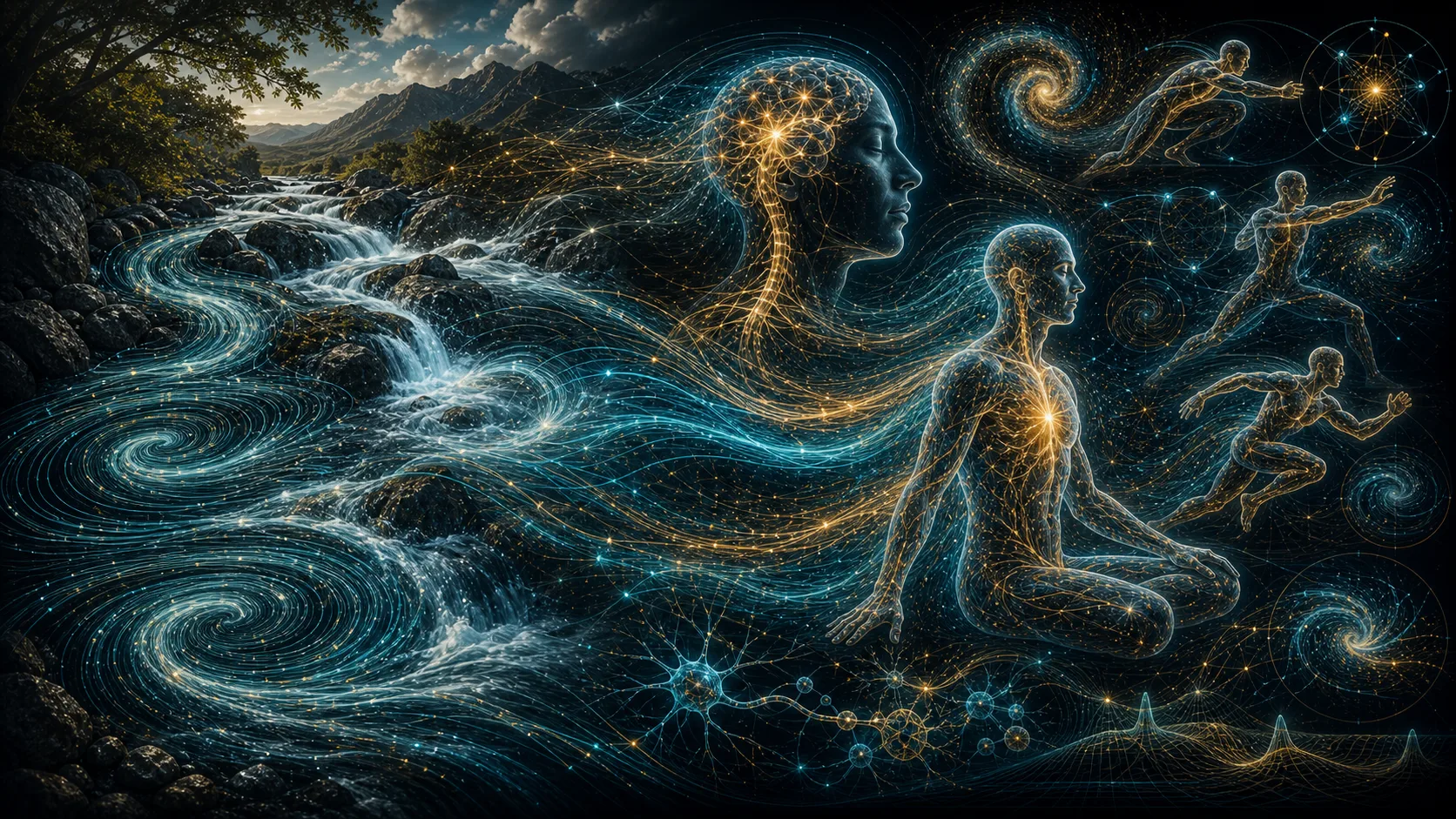
Start here The ancient Chinese philosophical tradition of Taoism, as expressed in Lao Tzu's Tao Te Ching, can be read as a qualitative description of far-from-equilibrium thermodynamics written 2,500 years ago.
Lesson 5.2.2 Wu Wei: the Art of Effortless Action
Start here Wu Wei (non-doing, effortless action) is one of the central concepts of Taoism. It does not mean passivity or laziness. It means acting in such perfect alignment with the Tao — with the flow of the situation — that no unnecessary effort is expended.
Water is the classic metaphor. Water does not force its way over obstacles. It flows around them, through them, under them. It yields, apparently weak, and yet over time it wears away the hardest stone. Wu Wei is the water strategy: maximum effect through minimum effort, achieved by aligning with the natural flow rather than fighting it.
The FLP naturally practices Wu Wei. They are aligned with the arrow of time, flowing with change rather than against it. When they act, they act in harmony with the far-from-equilibrium process that is already unfolding, which is why their actions are remarkably effective.
The BLP practices constant, exhausting, ultimately futile resistance. Like a salmon swimming upstream against a river in flood.
Lesson 5.2.3 The Tao and the ECS
Start here Dr. Bob draws a direct connection: the Tao, as the effortless creative flow underlying all things, has its biological expression in the endocannabinoid system. The ECS is the biological Tao — the system that keeps the organism flowing, balanced, adaptive, alive.
When your ECS is functioning well, you are in Tao. Your biochemistry flows effortlessly. Your immune system, nervous system, and metabolic system communicate and balance without friction. You are in Wu Wei.
When your ECS is depleted — through poor diet, stress, lack of sleep, excess carbohydrates, cannabinoid deficiency — you are out of Tao. Friction accumulates. Free radicals multiply. Inflammation develops. Disease follows.
Cannabis, in this framework, is a tool for returning to Tao — for supplementing the endocannabinoid system and restoring the effortless flow.
Hinduism, the Bhagavad Gita, and the Four Yogas
- Wisdom practice
- Flow state
- Discipline path
- Inner harmony
Lesson 5.3.1 The Bhagavad Gita as Far-from-Equilibrium Framework
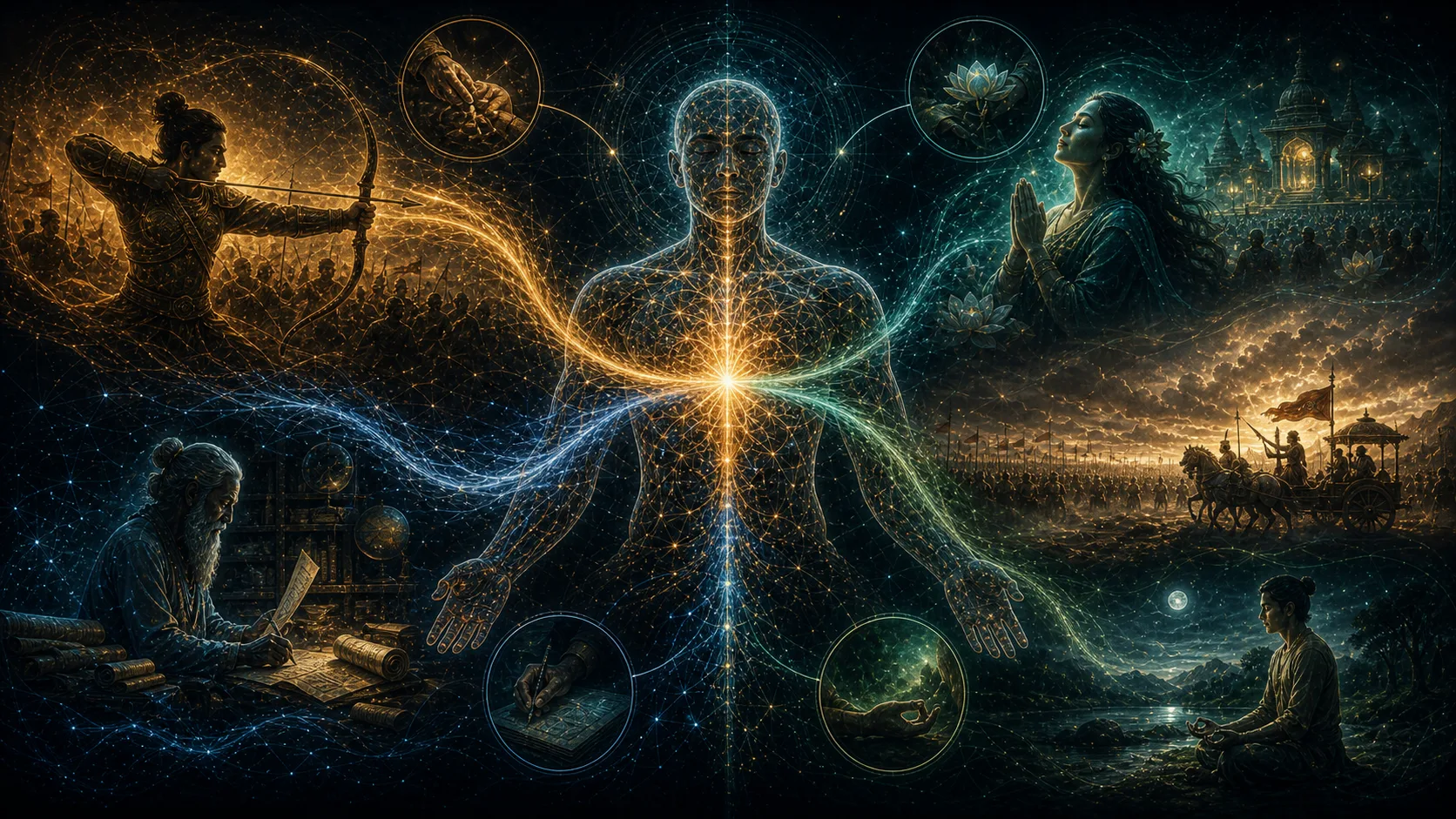
Start here The Bhagavad Gita — one of the foundational texts of Hindu philosophy — is a dialogue between the warrior Arjuna and the god Krishna, set on a battlefield. But the battle is symbolic: it is the battle of the individual soul against the forces of inertia, attachment, and confusion that prevent it from fulfilling its dharma (purpose).
The self that fears and desires is the ego — the constructed narrative of who you think you are. Behind it is the True Self, which is not separate from the divine creative process.
In far-from-equilibrium terms: by understanding the nature of the process you are — by achieving clarity about what you are and how reality works — you free yourself from the reactive patterns (karma) that keep you swimming to where the platform used to be.
Lesson 5.3.2 The Four Yogas: Paths to Alignment
Start here Justin Hartfield's path — reading thousands of books, studying the classics, relentlessly pursuing intellectual understanding — is fundamentally Jnana Yoga.
Hatha Yoga — The Yoga of Energy: Working with the body, breath, and energy directly. Postures (asanas), breath control (pranayama), meditation. The physical practices that align the body-mind system with the divine flow.
In far-from-equilibrium terms: Hatha Yoga is deliberate optimization of the dissipative structure. Exercise, breathing practices, meditation — these are technologies for increasing your distance from equilibrium, improving your energy flow, and reducing the friction of free radical accumulation.
Lesson 5.3.3 The Four Ashrams: the Life Plan
Start here The Hindu concept of the four ashrams (stages of life) provides a framework for the FLP life path:
Brahmacharya (0-25): The Student This phase is for learning. Both worldly education (mathematics, language, science, skills) and spiritual education (meditation, philosophy, character development). The foundational phase. Do not rush it. Build the base.
Justin Hartfield's early life — growing up in Inglewood, struggling socially and academically, discovering books and philosophy — fits this phase perfectly, even if chaotically.
Grihastha (25-50): The Householder This is the phase of living fully in the world. Building a career or business. Forming intimate partnerships. Having children if called to it. Experiencing all the pleasures and challenges the world has to offer. Living your purpose in the world.
The phase of "burning hot" — of being completely engaged with life.
Vanaprastha (50-75): The Retirement A gradual turning inward. Stepping back from the full engagement of the Grihastha phase. More meditation, more contemplation, more generosity, less striving for personal gain. Giving back what you have learned.
Sanyasa (75+): The Monk Complete release from worldly duties. Full attention on the divine. Preparation for the transition back to the flow that exists beyond individual form.
Buddhism and the Arrow of Time
- Wisdom practice
- Flow state
- Discipline path
- Inner harmony
Lesson 5.4.1 Buddha's Core Insight
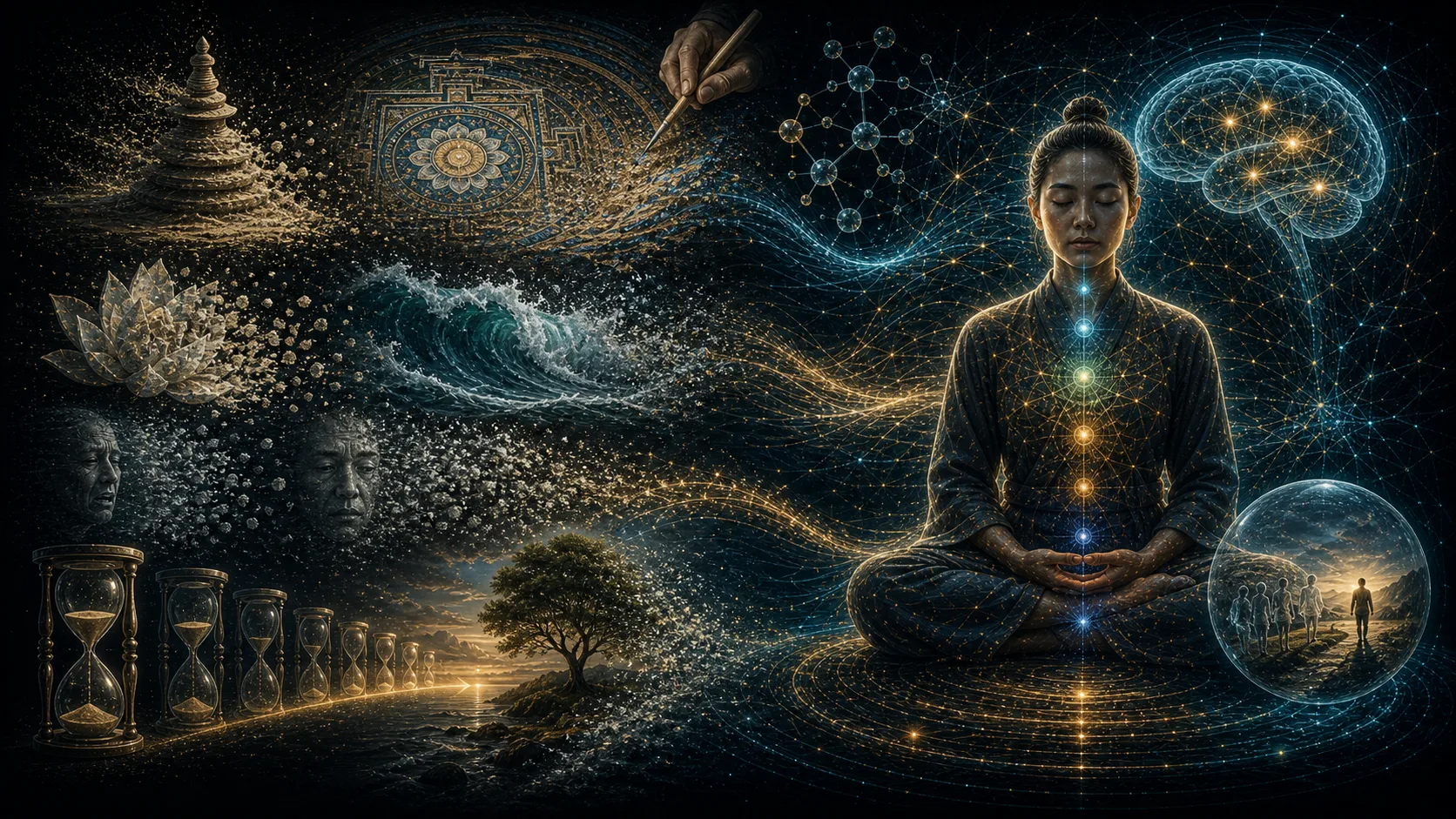
Start here The Buddha's core insight — the cause of suffering is attachment — maps directly onto the thermodynamic understanding of time.
You suffer when you cling to what is impermanent. You suffer when you insist that the pattern that gave you joy yesterday should exist today. You suffer when you fight the arrow of time.
A relationship that was right for you ten years ago may not be right for you now. An identity you built five years ago may have become a prison. A worldview that was adequate last decade may be obsolete this year. The dissipative structure that you are is constantly changing — you are not the same collection of molecules you were seven years ago. Clinging to a fixed idea of who you are is clinging to a ghost.
Buddhism's prescription — non-attachment — is not apathy or indifference. It is the willingness to engage fully with life while being willing to release everything that is impermanent when the time comes. It is the FLP relationship with the world.
Lesson 5.4.2 The Twelve Nidanas: Buddhist Biochemistry
Start here Liberation (Nirvana in Buddhism, enlightenment in Hindu terms) is the dissolution of these reactive patterns. It corresponds, in the far-from-equilibrium framework, to being so fully aligned with the flow of reality — so FLP — that there is no resistance, no friction, no suffering from fighting what is.
Lesson 5.4.3 Impermanence and the Platform
Start here The Buddhist doctrine of impermanence (anicca) states that all phenomena are transient, impermanent, constantly changing. There is no fixed, permanent self. There is no permanent anything. Everything that arises passes away.
Core lineThis is the Buddhist expression of the arrow of time. Everything is downstream. Nothing stays the same. The platform is always moving.
The BLP suffers because they cannot accept this. They experience impermanence as a constant threat, an ongoing loss, a source of anxiety. They try to hold on — to yesterday's certainties, yesterday's identities, yesterday's world — and suffer because the effort fails.
The FLP embraces impermanence. It is not something to be feared — it is the very nature of the far-from-equilibrium process. The platform moves because life is a flow. Rejoice in it.
Sufism and the Harmony of Life
- Wisdom practice
- Flow state
- Discipline path
- Inner harmony
Lesson 5.5.1 Hazrat Inayat Khan and the Rhythm of Life
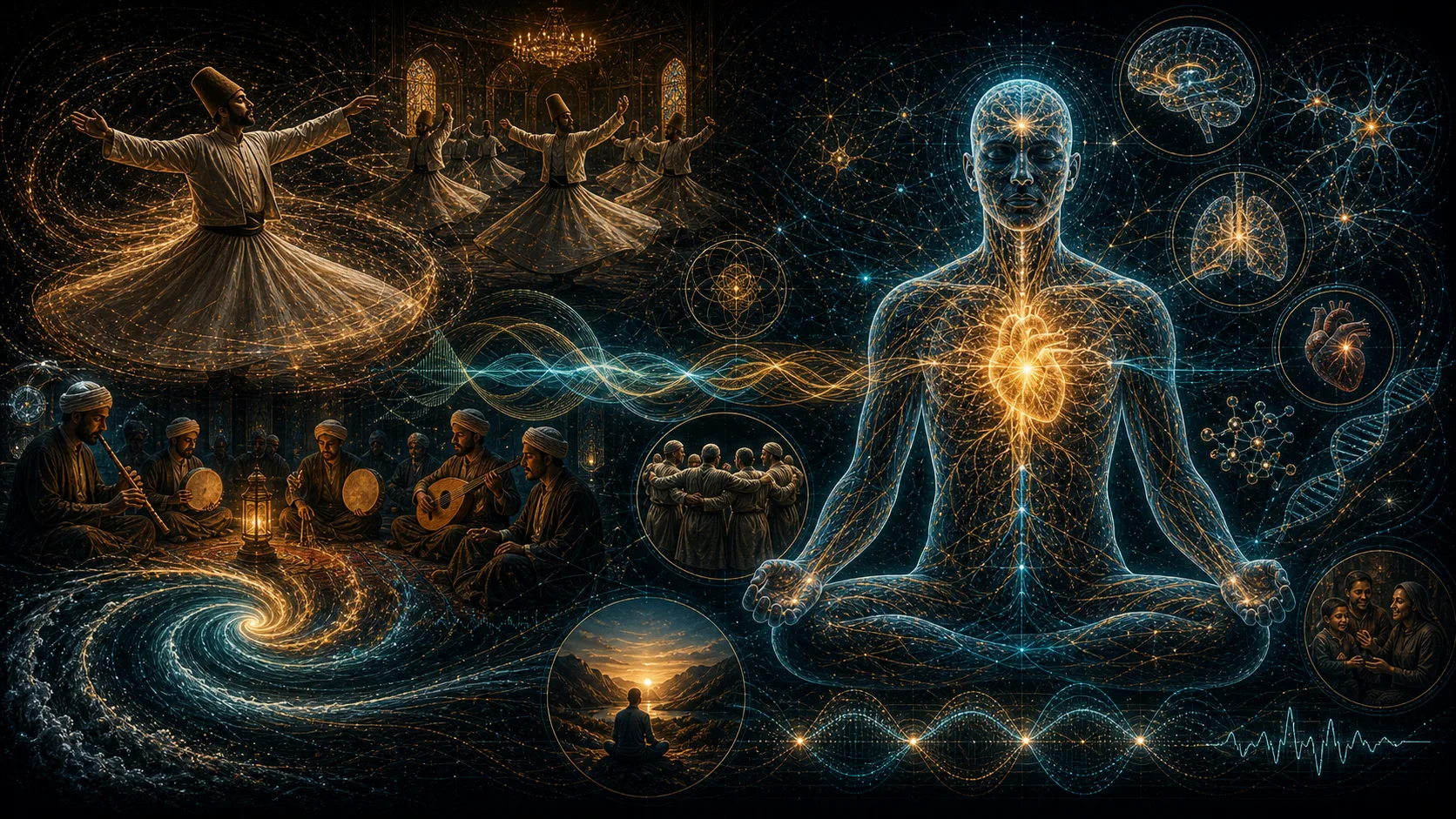
Start here The Sufi musician and philosopher Hazrat Inayat Khan taught that the key to happiness is aligning with the natural rhythm and harmony of life. Every soul, he said, vibrates at a unique frequency — a personal resonance with the divine symphony of existence. When you are in tune with your authentic vibration, life flows with beauty and ease. When you are out of tune — when you are living someone else's life, suppressing your true nature, fighting the flow — you experience distress, failure, and disease.
In far-from-equilibrium terms: each dissipative structure has its own characteristic modes of oscillation, its own natural frequency of energy flow. Health is being in resonance with your natural frequency. Disease is dysrhythmia — a disruption of the natural oscillations that maintain the system.
Your duty is to play your part perfectly. Not someone else's part — yours. This requires knowing your True Self — which is the subject of Module 6.
Lesson 5.5.2 Eloquence and Knowledge by Presence
Start here Inayat Khan distinguishes between two ways of knowing: knowledge by correspondence (intellectual, conceptual, second-hand) and knowledge by presence (direct, immediate, experiential).
Most of what we call "knowledge" is knowledge by correspondence. You have read about love but perhaps not felt it. You have read about courage but perhaps not lived it. Knowledge by correspondence is necessary but insufficient.
Knowledge by presence is what transforms theoretical understanding into lived wisdom. It is what happens when you stop reading about meditation and actually meditate. When you stop thinking about asking someone out and actually do it. When you stop planning a business and actually start one.
The arrow from knowledge by correspondence to knowledge by presence is the arrow from theory to practice, from FLP aspiration to FLP actuality. Every lesson in this course is knowledge by correspondence. Your life is where you develop knowledge by presence.
Module 5 Quiz: Eastern Philosophy
Use this as a retention check. Nothing is saved, scored, or required to keep reading.