There Are Only Two Types of People
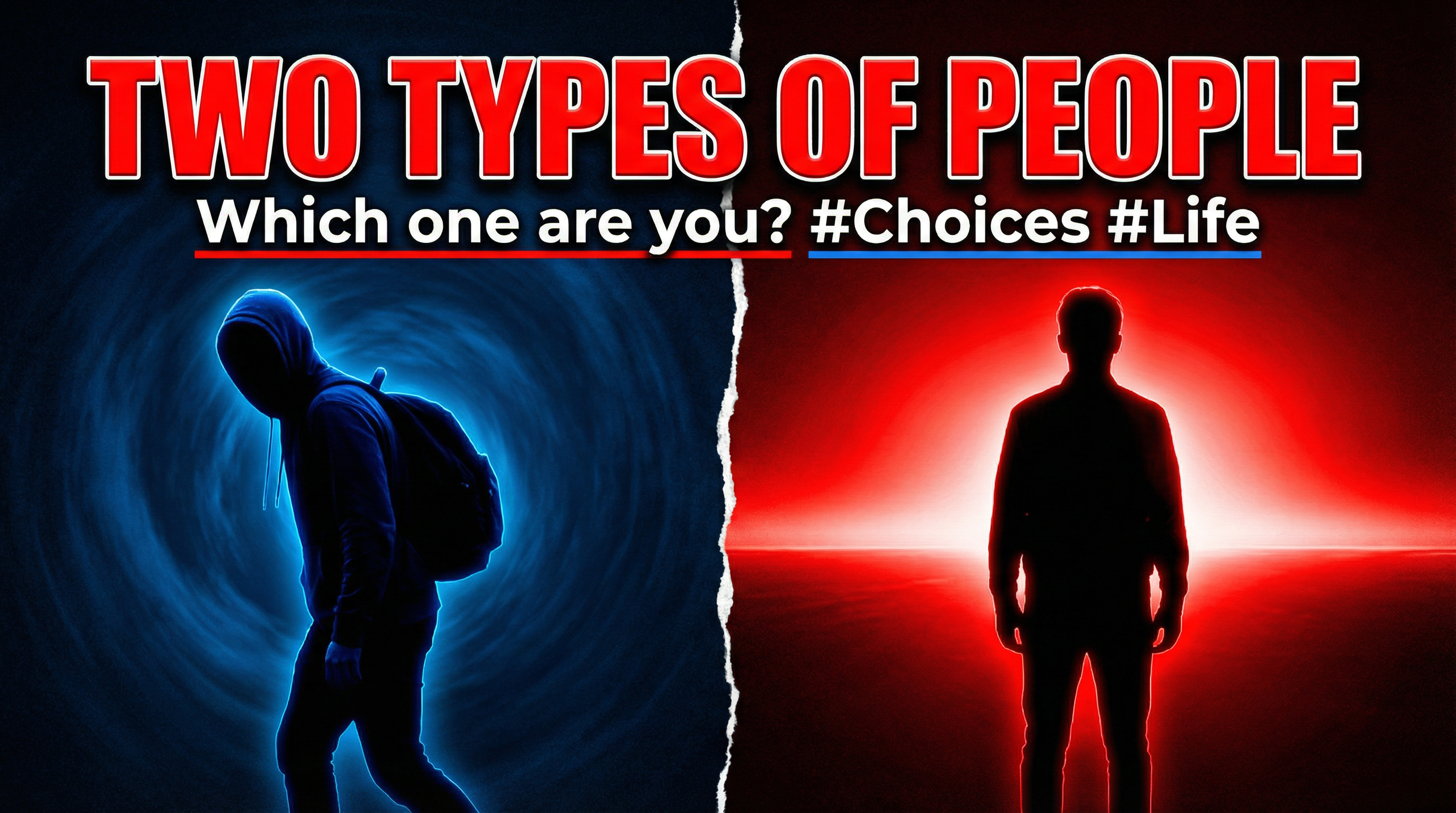
Dr. Bob's most controversial idea: Forward-Looking People vs Backward-Looking People. It's not about politics. It's about how you respond to change.
Full Article
There Are Only Two Types of People
Let’s cut the bullshit. You’ve been fed a lie your entire life. The lie is that balance is the goal. That equilibrium is the ideal state. That you should strive for a life of comfortable, predictable stability. It’s a seductive idea, isn’t it? A life without waves, without chaos, without the gut-wrenching feeling of uncertainty. But it’s a damn fantasy. And it’s a dangerous one.
This idea of “balance” is a relic of an outdated, Newtonian way of thinking. It’s a machine-age concept that has no place in the messy, beautiful, chaotic reality of biological life. You are not a machine. You are a swirling, dynamic, ever-changing process. You are a system teetering on the edge of chaos, and that, my friend, is where the magic happens. That’s where life happens.
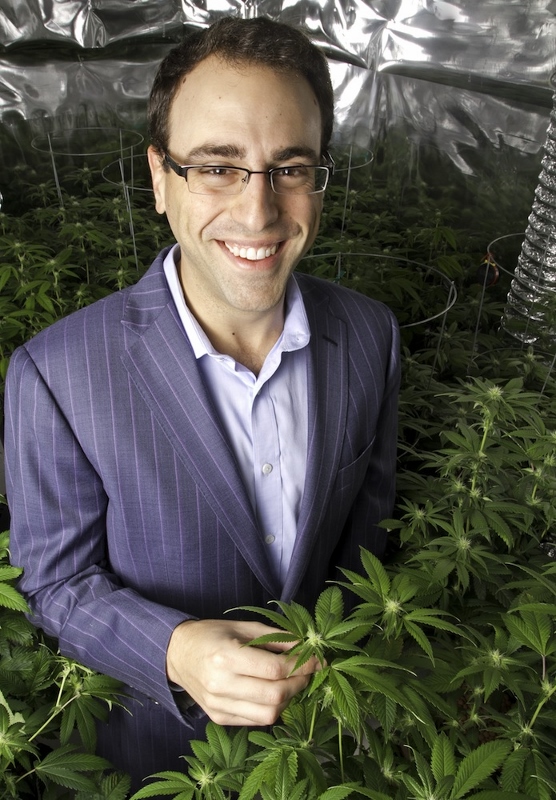
This shift away from rigid concepts of balance led me to question many assumptions I had long held, including those about altered states of consciousness. On one occasion, I found myself among a group of people using cannabis—not the stereotypes I’d imagined, but thoughtful, accomplished individuals who challenged my preconceived notions. Trying it myself, I realized that my sense of self remained intact, unchanged by the experience. This moment reinforced a deeper understanding: while external factors may influence us briefly, the core of our consciousness—and how we choose to engage with time—remains steadfast. And it’s this engagement with time that draws the true divide between two fundamentally different types of people in this world.
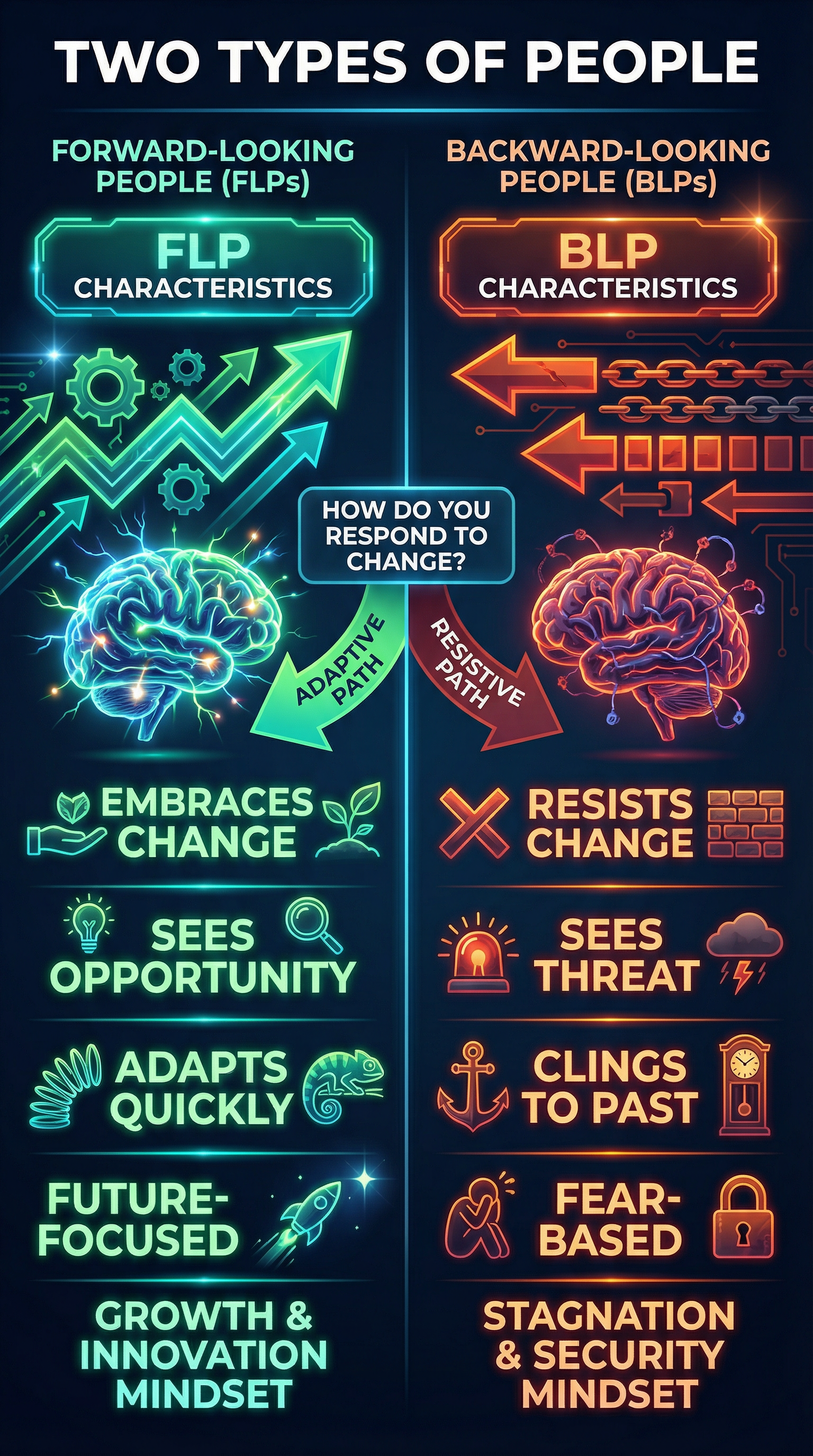
And it’s the dividing line between two fundamentally different types of people in this world. It has nothing to do with your politics, your religion, or how much money you have in the bank. It’s about how you face the relentless, unforgiving arrow of time. Are you a Forward-Looking Person (FLP) or a Backward-Looking Person (BLP)?
That’s it. That’s the only distinction that matters.
The Problem: Our Addiction to the Past
Most of the world is populated by BLPs. These are the people clinging to the past, desperately trying to maintain the status quo. They see change as a threat. They build walls, both literally and metaphorically, to keep the chaos out. They are the “good old days” people, the “if it ain’t broke, don’t fix it” crowd. They are obsessed with certainty, with control, with a world that makes sense according to their outdated rulebook.
But here’s the cosmic joke: the past doesn’t exist. It’s gone. A memory. A ghost. The arrow of time only moves in one direction. The universe is in a constant state of expansion and increasing disorder—a concept known as entropy. The second law of thermodynamics is the most ruthless law in the universe. It states that shit will always fall apart. Disorder, or entropy, always increases in a closed system. Your car will rust. Your body will age. Your perfectly organized desk will descend into chaos.
BLPs fight this. They spend their entire lives trying to swim upstream against the current of time. They are constantly trying to put things back in the box, to restore a state of “balance” that never truly existed. They are the people who get paralyzed by a new technology, who freak out when their favorite restaurant changes the menu, who can’t handle a relationship ending because it disrupts their carefully constructed fantasy of forever.
“The price of security is insecurity.” - Dr. Bob Melamede
This quote from Dr. Bob is a punch to the gut, isn’t it? The more you try to control everything, the more you try to build a fortress against the unknown, the more fragile you become. You become brittle. You become a house of cards waiting for the slightest breeze to knock you over. Because you can’t stop the wind from blowing. You can’t stop the arrow of time. And the more you resist it, the more you suffer.
The Application: Are You an FLP or a BLP?
This isn’t just some abstract scientific theory. This is the most practical framework you will ever find for living your life. It applies to everything: your career, your relationships, your health, your personal growth.
Think about your career. Are you in a job that is slowly becoming obsolete? Are you clinging to a set of skills that are no longer in demand? That’s the BLP mindset. The FLP mindset is to be constantly learning, constantly adapting, constantly looking for the next wave to ride. It’s about seeing the disruption in your industry not as a threat, but as a signal to evolve.
What about your relationships? Are you trying to force a relationship to be something it’s not? Are you holding on to a connection that has run its course because you’re afraid of being alone? That’s the BLP trap. The FLP approach is to allow relationships to evolve, to change, and yes, sometimes to end. It’s about recognizing that people grow and change, and that’s okay. It’s about seeking connections that are alive, dynamic, and supportive of your own growth.
And your health? The BLP approach to health is to wait until something is broken and then try to fix it. It’s a reactive, disease-focused model. The FLP approach is proactive. It’s about creating a state of resilient, adaptive health. It’s about nourishing your endocannabinoid system, managing your stress, and giving your body the resources it needs to thrive in a constantly changing world.
The Takeaway: How to Be an FLP
So how do you make the shift? How do you stop being a BLP and start living like an FLP? It’s not a switch you flip overnight. It’s a practice. It’s a daily choice to lean into the discomfort of the unknown.
- Embrace Novelty: Actively seek out new experiences, new ideas, new people. Break your routines. Travel. Read a book on a topic you know nothing about. Get comfortable with being a beginner again.
- Question Everything: Don’t accept the status quo just because it’s the way things have always been done. Ask why. Challenge your own assumptions. Be willing to be wrong.
- Let Go of the Past: You can’t move forward if you’re constantly looking in the rearview mirror. Forgive yourself for your past mistakes. Let go of old grudges. The past is a story you tell yourself. It’s time to write a new one.
- Nourish Your ECS: Your endocannabinoid system is your biological ally in the quest to be an FLP. Support it with a healthy diet, exercise, stress management, and, if it’s right for you, cannabis. A healthy ECS is a flexible ECS.
- Find Your Flow: Flow is the state of being fully immersed in an activity, of being so engaged that you lose track of time. It’s the psychological manifestation of being in a far-from-equilibrium state. Find the things that put you in a state of flow and do more of them.
Closing
Look, I get it. This is not the easy path. It’s much easier to be a BLP. It’s easier to pretend that you can control the world, that you can build a life free from pain and uncertainty. But it’s a life of quiet desperation. It’s a life that is already over, even if your heart is still beating.
To be an FLP is to be fully alive. It’s to embrace the beautiful, terrifying, exhilarating dance of existence. It’s to recognize that you are a part of a universe that is constantly creating, constantly destroying, constantly becoming something new. And your only job is to participate in that process with as much courage, curiosity, and love as you can muster.
So, the question is, which one are you? Are you going to spend your life trying to hold back the tide? Or are you going to learn how to surf?
Comments
Related Articles
Living Aloha in the AI Age
Mana is Energy (And Energy is Everything)

Your Body Wants to Heal
The Skillset Cannabis Unlocks

What AI Reveals About Your Own Mind
Want More?
Subscribe to The Forward Look on YouTube to get notified when new episodes drop.
Subscribe