The Problem With Regulation
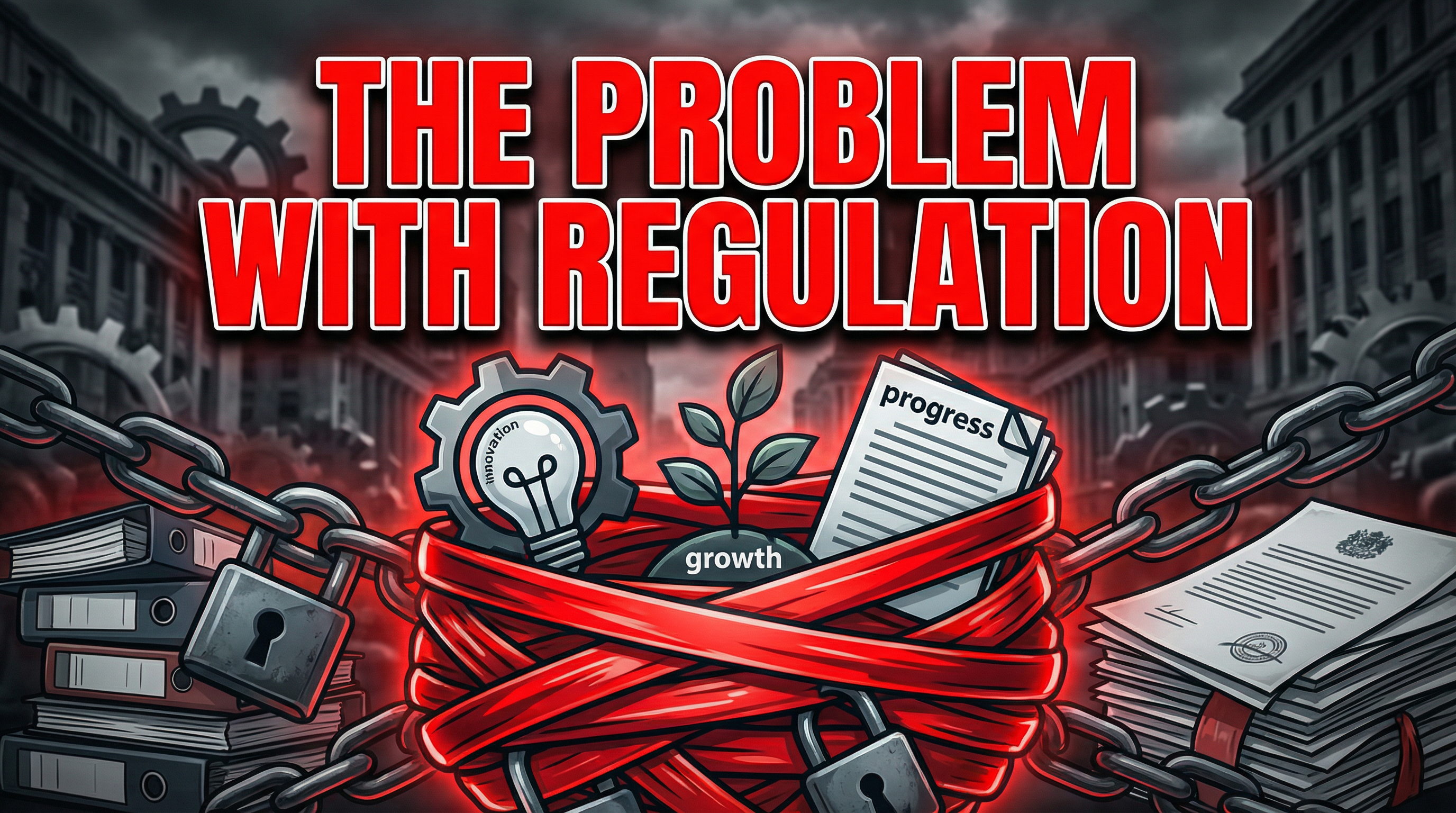
Every regulation is an attempt to freeze a system in place. But systems need to flow. The thermodynamic case against over-regulation.
Full Article
The Problem With Regulation
Let's Talk About Control
You think you’re in control. It’s a comforting thought, isn’t it? The idea that with enough rules, enough planning, enough foresight, you can tame the world around you. You can build a safe, predictable little bubble where nothing unexpected ever happens. Politicians sell you this fantasy every election cycle. Bureaucrats build entire careers on it. Your boss probably manages you with this illusion in mind.
Well, I’m here to tell you it’s bullshit.
Every regulation, every five-year plan, every attempt to nail down the future is a fool’s errand. It’s not just a bad idea; it’s a violation of the fundamental laws of the universe. You’re not creating order. You’re building a dam in the middle of a hurricane, and sooner or later, the water is going to find a way through. And when it does, it’s not going to be pretty.
The Static Death of Equilibrium
Here’s what most people—from your local city council member to the talking heads on TV—get wrong: they think the ideal state of any system is equilibrium. Balance. A perfectly stable, unchanging state. It sounds nice, doesn’t it? A world without chaos. A market without volatility. A life without surprises.
But here’s the damn truth: equilibrium is death. In thermodynamic terms, it’s the state of maximum entropy, where all energy has dissipated, all potential is gone, and nothing interesting can ever happen again. It’s a cold, dead rock floating in the void. Life, on the other hand, is a raging fire. It’s a system that is, by its very nature, far-from-equilibrium.
Think about it. Your body isn’t in equilibrium with the room you’re sitting in. If it were, you’d be the same temperature as the air, and you’d be dead. A forest isn’t in equilibrium. A thriving economy isn’t in equilibrium. All of these are complex, dynamic systems that maintain their structure and function by constantly processing energy and information. They exist on the edge of chaos, in a delicate dance between order and disorder.
Regulation is an attempt to force a living, breathing, far-from-equilibrium system into a static, predictable, equilibrium state. It’s an attempt to freeze the river. And what happens when you freeze a river? You kill everything in it.
The Universe Doesn’t Give a Damn About Your Five-Year Plan
This isn’t just some philosophical rant. This is hard science. The Second Law of Thermodynamics is the most battle-tested, universally applicable law we know. It states that in an isolated system, entropy—a measure of disorder or randomness—never decreases. Things fall apart. That’s the arrow of time. You can’t unscramble an egg, and you can’t go back to yesterday.
My friend and mentor, the late, great Dr. Bob Melamede, a "stoned-out hippie with a PhD," as he liked to call himself, was a genius at connecting these cosmic laws to the messy reality of our lives. He taught me that life isn’t about fighting entropy; it’s about surfing it. Living systems are open systems. We take in energy from our environment (food, sunlight, information) and use it to create pockets of order (our bodies, our businesses, our societies). But this process of creating local order always generates a greater amount of disorder in the environment as a whole. You eat a salad, you create order in your cells, but you increase the entropy of the universe by breaking down the complex molecules in the lettuce.
"Life is a dissipative structure. It maintains its order by pissing entropy into its environment." - Dr. Bob Melamede (paraphrased)
This is the fundamental trade-off of existence. You can’t have order without creating disorder somewhere else. Regulations try to deny this. They try to create a closed system where everything is predictable and nothing ever changes. They are an attempt to deny the arrow of time. They are, in a very real sense, an attempt to fight the universe. And that’s a fight you will always lose.
Forward-Looking People vs. Backward-Looking People
So how does this apply to the real world? Look at any market, any industry, any aspect of your life. You’ll see two kinds of people: Forward-Looking People (FLPs) and Backward-Looking People (BLPs).
BLPs are the regulators, the central planners, the micromanagers. They are obsessed with the past. They look at what has happened, identify a problem, and create a rule to prevent it from ever happening again. They are trying to freeze the system in a state they perceive as safe. They are the ones building the dam.
FLPs, on the other hand, are the entrepreneurs, the innovators, the risk-takers. They understand that the future is unknowable and that the only way to thrive is to be adaptable. They embrace the chaos. They see the ever-increasing entropy of the universe not as a threat, but as an opportunity. They are the ones building the surfboard.
Free markets are the ultimate far-from-equilibrium system. They are a chaotic, messy, and beautiful example of self-organization. Millions of individuals, all pursuing their own self-interest, create a complex and adaptive order that no central planner could ever hope to design. Prices are information. Profits are signals. Losses are feedback. It’s a constant flow of energy and information, a system that is constantly adapting, evolving, and creating new solutions to new problems.
When you introduce regulation, you are throwing a wrench in this self-organizing machine. You are distorting the signals. You are slowing down the flow of information. You are preventing the system from adapting. You are trying to replace the distributed intelligence of millions with the limited knowledge of a few. And the result is always the same: stagnation, inefficiency, and, eventually, collapse.
Your own body is a perfect example of this. You have an endocannabinoid system (ECS), which Dr. Bob called the body’s master regulatory system. The ECS doesn’t work by setting a fixed target and forcing your body to hit it. It works by sensing changes in your internal and external environment and making constant, subtle adjustments to maintain a dynamic, stable state called homeostasis. It’s a system of adaptation, not of control. It’s a system that flows.
When you try to override this system with blunt instruments—whether it’s a pharmaceutical drug or a government regulation—you are creating more problems than you solve. You are treating the symptom, not the cause. You are building a dam, when what you really need is to learn how to surf.
The Takeaway: Stop Building Dams
So what’s the takeaway here? Am I saying all rules are bad? No. I’m saying that our entire approach to regulation is fundamentally flawed. We are trying to solve dynamic problems with static solutions. We are trying to control a system that can only be guided.
Here’s what you can do:
- Embrace the Flow: Stop trying to control every little detail of your life and your business. Create systems that are resilient and adaptable, not rigid and brittle. Let go of the illusion of control and learn to trust the process of self-organization.
- Be an FLP: Look to the future, not the past. Embrace uncertainty. See problems as opportunities. Be the person who adapts, who innovates, who surfs the wave of change instead of being crushed by it.
- Question the Regulators: The next time a politician or a pundit tells you they have a plan to fix everything, ask them: Are you building a dam or a surfboard? Are you trying to freeze the river or are you helping us navigate it? Are you denying the laws of thermodynamics, or are you working with them?
We are at a crossroads. We can continue down the path of the BLPs, the path of ever-increasing regulation, of stagnation, and of eventual collapse. Or we can choose the path of the FLPs, the path of freedom, of adaptation, and of evolution.
The universe doesn’t care which path you choose. It will keep on flowing, keep on creating, keep on evolving, with or without you.
Comments
Related Articles
What the AI Panic Gets Wrong
The Skillset Cannabis Unlocks
Your Body Wants to Heal
Why Everyone is Anxious Right Now
Why Some People Can't Handle Change
Want More?
Subscribe to The Forward Look on YouTube to get notified when new episodes drop.
Subscribe