The Paradox of Control
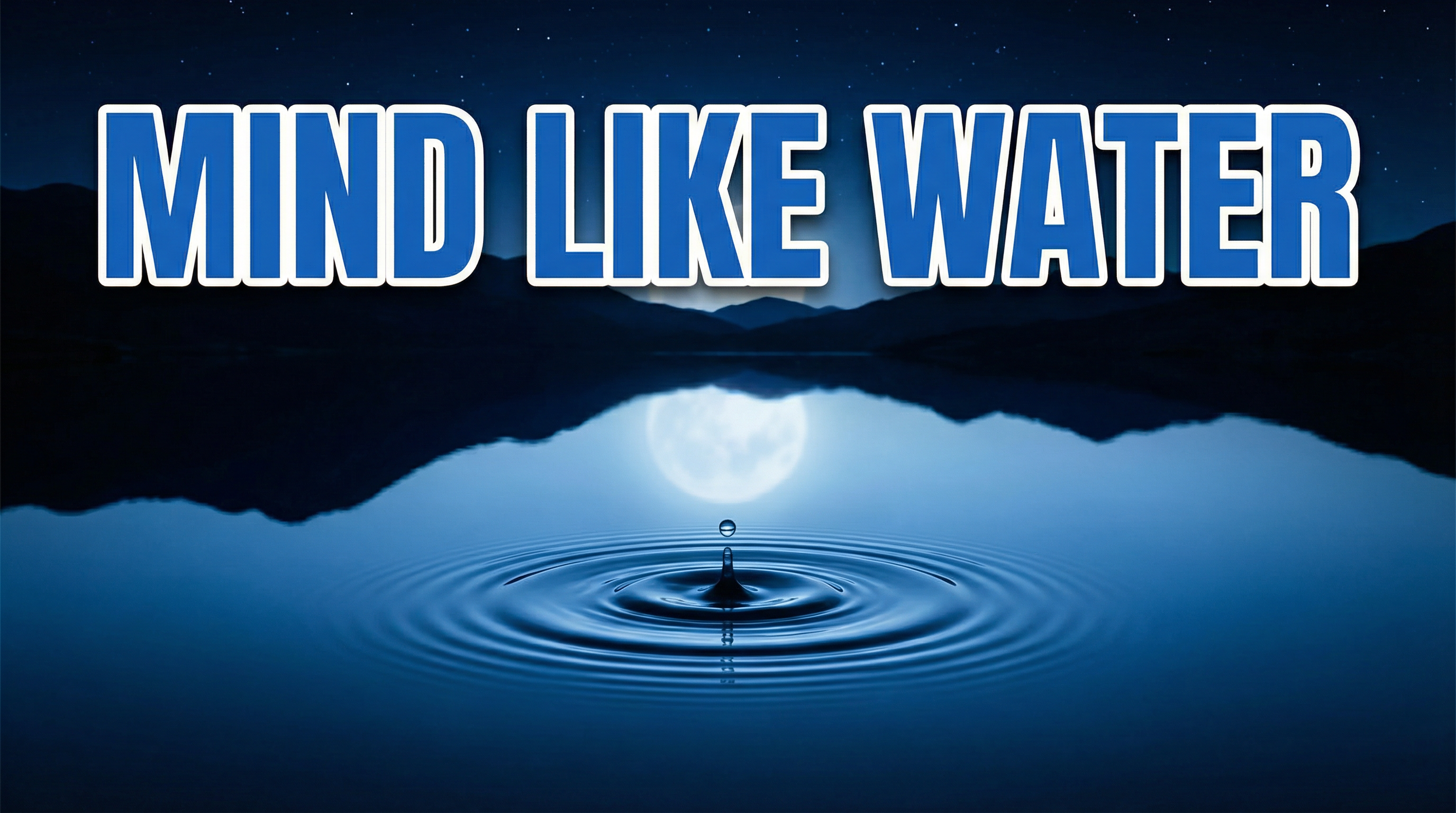
The martial arts concept of mushin—no mind. How to achieve the flow state where adaptation becomes automatic. The science of letting go.
Full Article
The Paradox of Control: Why Letting Go is Your Greatest Power
Stop trying so damn hard.
Seriously. All that white-knuckled, teeth-grinding effort you’re putting into controlling every little detail of your life? It’s not just exhausting you. It’s actively working against you. You think you’re steering the ship, but you’re just spinning the wheel in a hurricane, wondering why you’re still getting thrown against the rocks.
The greatest illusion you’ve ever bought into is the idea that you are in control. The more you tighten your grip on your career, your relationships, your health, your future—the faster it all slips through your fingers like sand. This isn’t some feel-good, new-age platitude. This is a fundamental law of the universe, backed by the unforgiving reality of thermodynamics. And understanding it will change everything.
The Problem: Your Control Addiction is a Lie
You’ve been fed a lie from day one. The lie says that success comes from meticulous planning, from brute-force effort, from bending the world to your will. It’s the gospel of the Backward-Looking People (BLPs), those who are terrified of uncertainty and desperately try to recreate a past that never really existed. They build rigid systems, five-year plans, and color-coded spreadsheets, believing they can tame the chaos of reality.
Bullshit.
This obsession with control is a symptom of fear. You’re afraid of the unknown, so you try to nail everything down. You’re afraid of failure, so you micromanage every step. You’re afraid of looking weak, so you project an aura of unshakable command. But what you’re really doing is building a prison for yourself. You’re creating a system so rigid that the slightest gust of wind will shatter it to pieces. You’re fighting a battle against the very nature of existence, and it’s a battle you will always lose.
The attempt to perfect the world is a fool’s errand. The universe doesn’t move toward perfect order; it dances on the edge of chaos. And your only choice is to learn the steps.
Every time you try to force an outcome, you introduce resistance. You create friction. You waste monumental amounts of energy fighting a current that was always going to pull you downstream anyway. The real tragedy? That current was headed somewhere far more interesting than your meticulously planned destination. But you’ll never know, because you were too busy fighting it.
The Application: How to Let Go and Win
So how does this translate to your actual, real-world life? It’s about shifting your mindset from a commander to a gardener. A commander tries to force victory through rigid strategy. A gardener knows you can’t force a plant to grow. You can only create the right conditions—good soil, enough water, adequate sunlight—and then let nature do its thing.
In Your Career: Stop trying to map out the next twenty years. The industry you’re in might not even exist in a decade. Instead of clinging to a specific job title or company, focus on acquiring adaptable skills. Learn how to learn. Cultivate a network of smart people. Get good at spotting opportunities as they arise, not just the ones you planned for. The most successful people I know didn’t follow a linear path. They surfed the waves of change, and they weren’t afraid to wipe out a few times.
In Your Relationships: You cannot control another person. Read that again. You cannot control their feelings, their actions, or their decisions. The more you try—through jealousy, nagging, or manipulation—the more you will push them away. The only thing you can control is your own behavior. Be honest. Be vulnerable. Set clear boundaries. Create the conditions for a healthy relationship to flourish, but you have to let it breathe. True connection is a dance of self-organizing systems, not a hostage negotiation.
In Your Health: You can’t force your body to be healthy. You can create the conditions for health. You can eat real food, move your body, get enough sleep, and manage your stress. But you can’t will away a diagnosis or force your cells to behave. You have to work with your body, not against it. Listen to its signals. Respect its limits. Give it the resources it needs to self-organize back to a state of health. This is the entire principle behind the healing power of the endocannabinoid system.
The Takeaway: Your Action Items for Flow
This isn’t about becoming a passive leaf in the wind. It’s about becoming an active surfer on the ocean of reality. It’s about intelligent adaptation, not abdication.
- Identify Your Control Traps: Where in your life are you white-knuckling it the most? Your job? Your kids? Your diet? Write them down. Acknowledge that your current strategy isn’t working.
- Practice Micro-Surrenders: You don’t have to let go of everything at once. Start small. Let your partner choose the restaurant. Take a different route to work without checking the GPS. Deliberately do one thing this week without a detailed plan. Notice the feeling of anxiety, and then notice that the world didn’t end.
- Nourish Your ECS: Give your body the tools it needs to adapt. This means managing stress through meditation or time in nature. It means eating healthy fats. And yes, for many, it means intelligently using cannabis to support a system that our modern, high-stress world has depleted.
- Embrace the "Good Enough" Principle: Stop chasing perfection. Perfection is a static, dead state. The universe is dynamic and messy. Aim for "good enough" and then iterate. Launch the damn project. Have the tough conversation. Ship the product. You can always adjust your course once you’re in motion.
Letting go of the illusion of control is the most powerful thing you can do. It’s the moment you stop fighting the river and start using its power to propel you forward. It’s the moment you move from being a brittle, backward-looking statue to a fluid, forward-looking surfer.
It's the moment you truly start to live.
A Mind Like Water: The Zen of Non-Judgment
"Empty your mind, be formless. Shapeless, like water. If you put water into a cup, it becomes the cup. You put water into a bottle and it becomes the bottle. You put it in a teapot it becomes the teapot. Now, water can flow or it can crash. Be water, my friend." — Bruce Lee
Don't reject the old simply as a reaction. Rejecting notions without proper reason leads into reactionary patterns. Reactionary patterns don't require use of the frontal lobe of your brain—they operate on predefined neural channels. When your life is decided by reactionary patterns, you're not actually making conscious decisions for yourself. You are reacting automatically to external stimuli, essentially sleep-walking through your waking life.
Every time you focus on an object, idea, or person and your brain is automatically repulsed, you are not actually thinking. You're reacting and not taking time to commit to the work of reasoning. In essence, you are denying the very faculty which separates man from animal and that brings the human race closest to the divine.
When you're not carefully analyzing your situation and surroundings, you are creating a pocket of ignorance for yourself. This ignorance leads to suffering, and this suffering disables you from living completely in your True Self.
You can stop yourself from entering into a conditioned, reactionary pattern by simply relaxing in the present moment. When you are fully relaxed and totally engrossed in the present moment, your frontal lobe is free to perform all necessary calculations in order to determine the proper response to the stimulus in question. Whenever you feel yourself acting out of habit rather than reason, stop yourself and relax in the present moment. Loosen the muscles in your body, think of your mind as if it were placid as a lake, and ask your True Self for the answer. Your True Self will always know the answer.
This goes for categorizations as well. Names, categories, genres—are all examples of patterned reactions. Sure, names make it easier for the human brain to lump ideas together, but sometimes the groupings we think of as indispensable to interpretation actually limit our beliefs. A zen story illustrates this principle well:
There once was a great warrior who, through his exploits, gathered all of the finest tea leaves throughout his tours of Asia.
One day, the warrior stumbled upon the monastery of a famous zen master. As a gesture of good will, the great warrior asked the zen master to join him for some afternoon tea. The zen master accepted and they retired to a small hut so that the warrior could brew his leaves.
As the warrior was taking his tea bags he was explaining to the zen master about the various qualities of each tea—grade, geographical origin, and so forth. After the warrior was done showing the zen master his teas, he asked him which tea leaves he would prefer for that afternoon.
"How about those leaves?" the zen master said as he was pointing to some very common looking tea leaves growing just behind the hut.
"But master, surely you want to indulge in these very fine leaves I've hand-selected from across the world?"
"What is the purpose of grading teas?" said the zen master. "The leaves themselves do not know whether they are high quality or not. Without categorization, we would enjoy each tea for exactly what it is—but when words and judgments are attached to the leaves, suddenly one is perceived to be of lesser value and is no longer considered worthwhile. It is my opinion that judgments regarding tea are entirely dependent on your disposition. If you are in a good mood, the grade of tea doesn't matter."
And with that, the great warrior was enlightened.
The lesson here is profound: our judgments and categorizations—the very tools we use to make sense of the world—can become the chains that bind us. When we approach life with a "mind like water," we respond to each moment as it truly is, not as our preconceptions tell us it should be. This is the essence of flow—the state where control dissolves and pure, adaptive response takes over.
Comments
Related Articles
PONO: Effectiveness is the Measure of Truth

The FLP Advantage in the AI Age
Deprogram Your Mind
Stop Manifesting. Start Adapting.
Free Will is an Illusion (And That's OK)
Want More?
Subscribe to The Forward Look on YouTube to get notified when new episodes drop.
Subscribe