Deprogram Your Mind
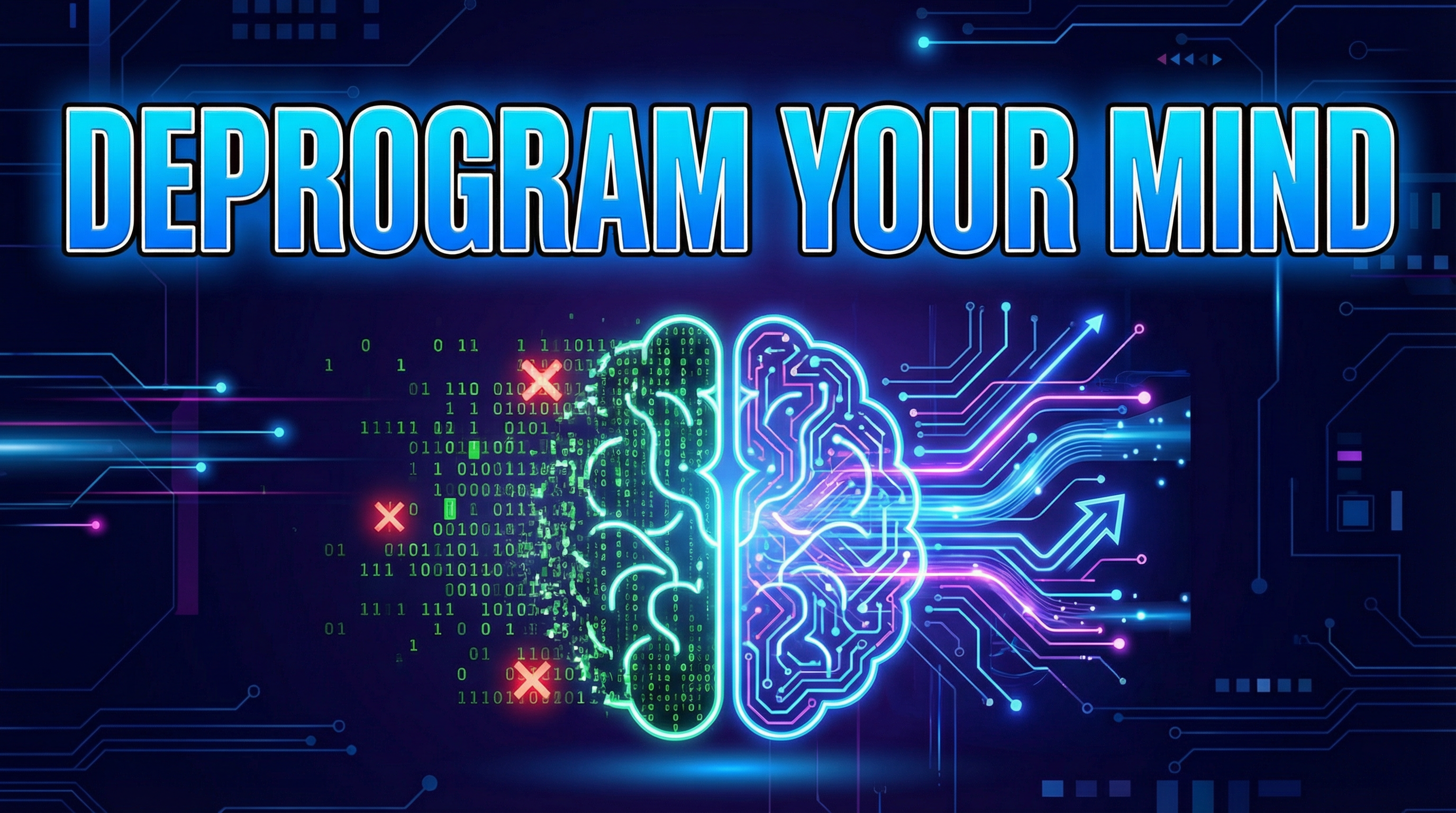
Your brain is running outdated software installed by society, media, and your own ego. Time for an update. The practical guide to thinking for yourself.
Full Article
Deprogram Your Mind
Your Brain is Running Outdated Software
Let’s get one thing straight: you’re not thinking for yourself. Not really. You think you are, but you’re not. Your thoughts, your beliefs, your most deeply held convictions? They’re mostly just echoes. Echoes of your parents, your teachers, the news, the ads you see, the social media feed you scroll through with a glazed-over look in your eyes. Your brain is a computer, and it’s running software that was installed without your permission. It’s outdated, it’s buggy, and it’s damn sure not optimized for the world we actually live in.
We’re born into a world that’s already built. A world of rules, of expectations, of shoulds and shouldn’ts. A world that tells you to go to school, get a good job, buy a house, and save for retirement. A world that tells you what to believe, what to value, and what to fear. And for the most part, we just accept it. We download the software without ever reading the terms and conditions. We become, as my friend and mentor Dr. Bob Melamede would say, Backward-Looking People (BLPs). We’re so busy trying to maintain the status quo, to keep things in a state of comfortable equilibrium, that we don’t even realize we’re living in the past.
But here’s the thing: the universe doesn’t give a damn about your comfort. The universe is a chaotic, unpredictable, and constantly evolving place. It’s a far-from-equilibrium system, and if you’re not willing to adapt, you’re going to get left behind. It’s time to deprogram your mind. It’s time for a software update.
The Problem with Your Programming
Most of what you think you know is bullshit. It’s a collection of hand-me-down ideas and cultural assumptions that you’ve mistaken for objective reality. You’ve been conditioned to see the world in a certain way, to filter out information that doesn’t fit your existing beliefs, and to seek out information that confirms what you already think. It’s called confirmation bias, and it’s one of the most powerful and insidious bugs in your mental software.
This isn’t your fault. It’s how our brains are wired. In a simpler time, it was a useful survival mechanism. Stick with the tribe, don’t question the elders, and you’ll probably live to see another day. But the world has changed. We’re not living in small, isolated tribes anymore. We’re living in a global, interconnected, and rapidly changing world. And the old software just can’t keep up.
Your outdated programming is keeping you stuck. It’s keeping you from seeing new opportunities, from learning new things, and from becoming the person you’re capable of being. It’s telling you to play it safe, to avoid risk, and to stick to the well-trodden path. It’s telling you that you’re not good enough, that you’re not smart enough, that you don’t have what it takes. And it’s all a lie.
“The greatest obstacle to discovery is not ignorance - it is the illusion of knowledge.” - Daniel J. Boorstin
It’s time to uninstall the old software and start fresh. It’s time to become a Forward-Looking Person (FLP). An FLP understands that the only constant is change. An FLP embraces uncertainty, seeks out novelty, and is constantly updating their mental model of the world. An FLP, in other words, thinks for themselves.
The Application: How to Update Your Brain
This all sounds great in theory, but how do you actually apply it to your life? How do you become a more open, far-from-equilibrium system? How do you update your brain?
First, you need to start questioning everything. Don’t just accept what you’re told. Be skeptical. Be critical. Do your own research. Read books and articles from a wide variety of sources, especially those that challenge your existing beliefs. Talk to people who have different perspectives than you do. The goal is not to find the “right” answer, but to expand your understanding of the world and to become more comfortable with uncertainty.
Second, you need to embrace novelty. Get out of your comfort zone. Try new things. Travel to new places. Learn a new skill. The more new experiences you have, the more new neural pathways you’ll create in your brain. The more you’ll be able to see the world in new and different ways.
Third, you need to learn to be present. The past is gone. The future is not yet here. The only thing that’s real is the present moment. And it’s in the present moment that you have the power to choose your thoughts, your actions, and your reality. Meditation and mindfulness are powerful tools for learning to be present. They can help you to observe your thoughts without judgment, to let go of the old programming, and to create a new, more conscious relationship with your mind.
I know this isn’t easy. It’s a lot easier to just go along with the program, to keep your head down, and to not rock the boat. But the world is changing, whether you like it or not. And if you’re not willing to change with it, you’re going to get left behind. It’s time to take control of your own mind. It’s time to become the architect of your own reality.
The Takeaway: Your Brain, Your Rules
Deprogramming your mind is not a one-time event. It’s a lifelong process. It’s a commitment to constantly learning, to constantly growing, and to constantly evolving. It’s a commitment to thinking for yourself.
Here are a few practical things you can do to get started:
- Read a book that challenges your worldview. If you’re a liberal, read a book by a conservative. If you’re a religious person, read a book by an atheist. The goal is not to change your mind, but to understand a different perspective.
- Have a conversation with someone you disagree with. Don’t try to win the argument. Just try to understand where they’re coming from. Listen more than you talk.
- Spend some time in nature. Nature is the ultimate far-from-equilibrium system. It’s a constant reminder that life is messy, chaotic, and beautiful.
- Start a meditation practice. Even just five minutes a day can make a big difference. There are plenty of apps and guided meditations online to get you started.
- Learn about your endocannabinoid system. The more you understand how your body works, the more you’ll be able to support its natural ability to adapt and to heal.
This is not about becoming a stoned-out hippie, although I have a deep respect for the stoned-out hippies of the world, especially the ones with PhDs like Dr. Bob. This is about becoming a more conscious, more intentional, and more powerful human being. This is about taking back control of your own mind.

Comments
Related Articles

Why I'm a Thermodynamic Libertarian
The Man Who Connected Everything
AI is a Mirror, Not a Monster

There Are Only Two Types of People

Why Socialism Violates Physics
Want More?
Subscribe to The Forward Look on YouTube to get notified when new episodes drop.
Subscribe