The Only Law That Matters
Forget the 48 Laws of Power. There's only one law: entropy always increases. Everything else is commentary. How to build your life around this truth.


Full Article
The Only Law That Matters: Why Everything Falls Apart
You’ve been lied to.
They sold you on hustle culture, on 10x-ing your life, on the 48 Laws of Power. They told you that if you just manifest hard enough, build the right habits, or follow their seven-step formula, you can conquer the world. You can achieve equilibrium, balance, and lasting success.
It’s all bullshit.
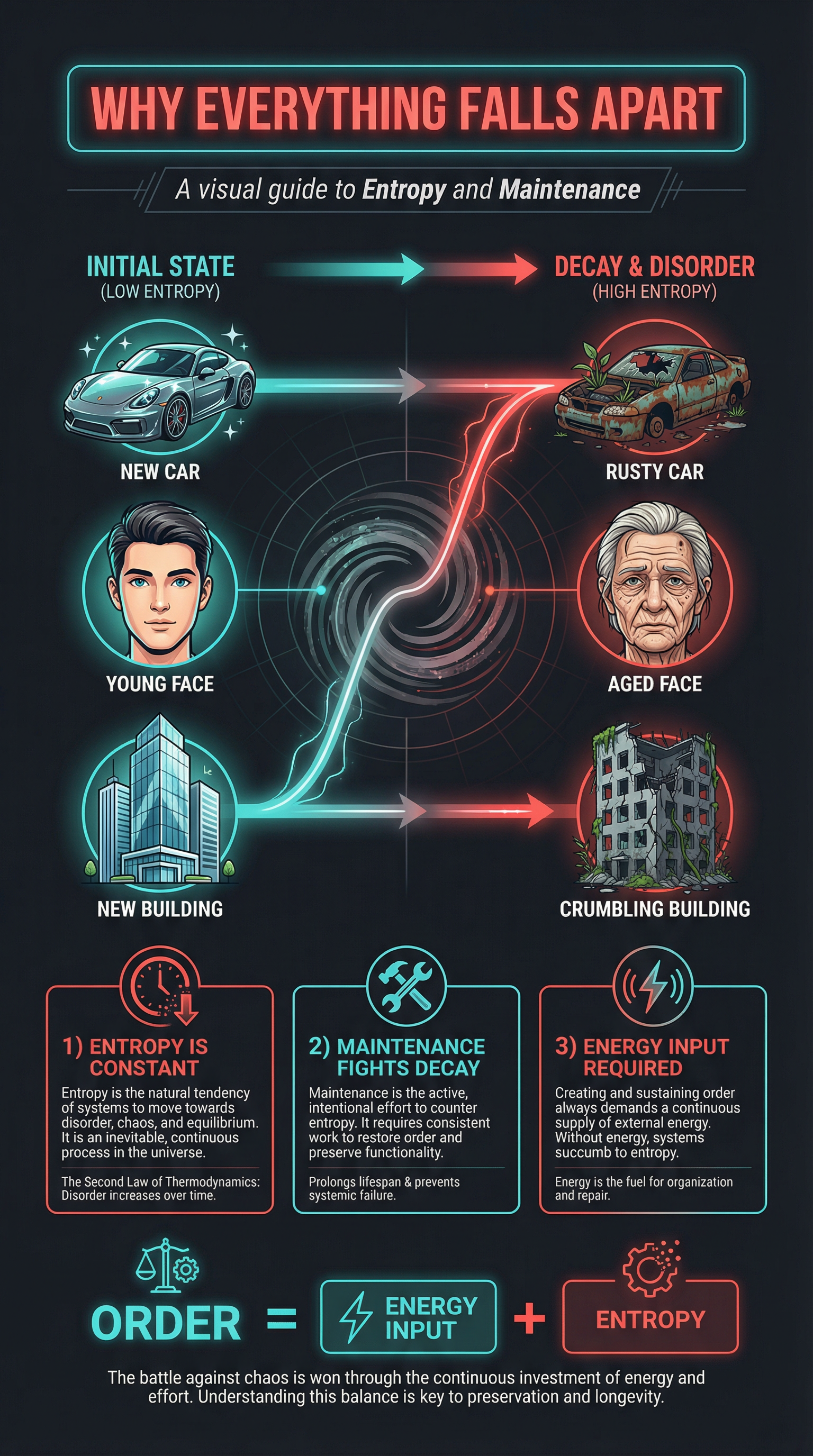
There is only one law that governs every single thing in this universe, from the formation of galaxies to the last breath you’ll ever take. It’s the Second Law of Thermodynamics. Entropy always increases. Disorder, chaos, and decay are the default settings of reality. Everything else is just commentary.
Forget balance. Forget equilibrium. The very essence of life is to exist in a state of rebellion against this cosmic tide. You are not a stagnant pond. You are a raging river, a dynamic, energy-burning, far-from-equilibrium system. The moment you stop fighting, the moment you seek the comfort of stasis, is the moment you start to die.
So, how do you build a life around this uncomfortable truth? How do you not just survive, but thrive, in a universe that’s actively trying to pull you apart? You lean into the chaos. You learn to surf the waves of entropy. You become a Forward-Looking Person (FLP) in a world full of Backward-Looking People (BLPs) clinging to a past that no longer exists.
This isn’t about another set of rules. This is about understanding the fundamental rule that underpins them all. This is the physics of life.
The Problem: Our Addiction to Equilibrium
Modern society is obsessed with the idea of balance. Work-life balance. A balanced diet. A balanced portfolio. We chase this mythical state of equilibrium, believing it’s the pinnacle of a well-lived life. We think of stress as the enemy, chaos as a problem to be solved, and stability as the ultimate prize.
This is a recipe for stagnation and misery.
Why? Because equilibrium is death. In physics, a system in perfect thermodynamic equilibrium is a system with no potential for work. It’s a closed box where the temperature is uniform, the energy is evenly distributed, and nothing is happening. It’s a state of maximum entropy. It’s cosmic dust.
When you chase equilibrium in your own life, you are chasing a state of non-existence. You are actively working against the very nature of what it means to be alive. Life isn’t about finding a comfortable plateau; it’s about constantly adapting, changing, and evolving. It’s a process, not a destination.
Think about the people you know who are miserable. They’re often the ones most resistant to change. They are the BLPs, the Backward-Looking People. They talk about the “good old days.” They complain about how things are changing too fast. They cling to jobs they hate, relationships that have soured, and beliefs that no longer serve them, all because they fear the uncertainty of the unknown. They are trying to create a state of personal equilibrium, a predictable and unchanging world, and in doing so, they are suffocating their own vitality.
They are fighting a losing battle against the arrow of time. Time only moves in one direction. The past is gone. It exists only as a memory, a ghost in your neural wiring. Resisting the forward march of time is like trying to hold back the ocean. It’s a damn fool’s errand.
The Maintenance Mindset: How to Stop Drowning and Start Surfing
So how does this cosmic truth apply to your shitty day-to-day problems? It’s simple. You have to shift your entire mindset from one of seeking stability to one of embracing maintenance.
BLPs are the ones who are constantly surprised when things break. They believe in a mythical “normal” state where everything works perfectly, and any deviation from that is a personal affront. They are fighting the arrow of time, and they are losing. Badly.
FLPs, on the other hand, understand the nature of reality. They expect things to fall apart. They know that maintenance isn’t a punishment; it’s the cost of admission to the game of life. They don’t ask “Why did my car break down?” They ask, “What’s my process for dealing with car trouble?” They don’t mourn the end of a relationship; they integrate the lessons and adapt. They see the decay not as a failure, but as an opportunity to rebuild, to reorganize, and to evolve.
This is where the body’s own master regulatory system, the endocannabinoid system (ECS), provides the perfect biological blueprint. The ECS is all about adaptation. It’s a complex signaling network that is constantly monitoring your internal and external environment, making adjustments to keep you in a state of dynamic homeostasis. It’s not about keeping things the same; it’s about managing the process of change.
Adopting a maintenance mindset means living like your endocannabinoid system. It means you stop trying to build a life that’s a static, finished product and start treating it like a garden that needs constant tending. You have to weed, you have to water, you have to prune. It’s a continuous process. It never ends. And that’s not depressing—it’s liberating. It means you’re alive.
The Application: How to Live a Far-From-Equilibrium Life
So what does this mean for you, right now, in your messy, complicated, beautiful life? It means you need to stop trying to find balance and start learning to embrace the process. You need to become a Forward-Looking Person.
Being an FLP isn’t about blind optimism. It’s about radical acceptance of reality. It’s about understanding that change is the only constant and that your ability to adapt is your greatest asset. Here’s how you start:
- Schedule Your Decay: Expect things to break. Your car, your body, your relationships. They all require maintenance. Don’t wait for the breakdown. Schedule the oil change. Schedule the doctor’s appointment. Schedule the date night. Make maintenance a proactive, non-negotiable part of your life. It’s not a failure when you have to do it; it’s a success that you’re still in the game.
- Embrace Stress (the Right Kind): We’re told all stress is bad. That’s a lie. The right kind of stress—what’s known as hormesis—is essential for growth. Lifting weights stresses your muscles, and they grow stronger. Learning a new skill stresses your brain, and you become smarter. Intermittent fasting stresses your cells, and they become more resilient. BLPs avoid all stress. FLPs actively seek out productive stressors. They get comfortable with being uncomfortable.
- Cultivate Adaptability: How adaptable are you? When was the last time you changed your mind about something important? When was the last time you learned a new skill, traveled to a new place, or had a conversation with someone you profoundly disagreed with? Your adaptability is a muscle. If you don’t use it, you lose it. An FLP is constantly updating their mental models of the world based on new information. They are intellectually humble and perpetually curious.
- Feed Your System Quality Energy: You are what you eat, and that includes what you feed your mind. Are you consuming a diet of junk food and junk information? Or are you fueling your body and brain with high-quality energy? This means whole foods that your body evolved to process. It means information that challenges you, that expands your understanding, that forces you to think. Garbage in, garbage out. It’s that simple.
- Let Go of the Past: The arrow of time is relentless. You cannot go back. Holding onto past grievances, past failures, or past glories is a waste of precious energy. It’s like trying to drive a car while staring in the rearview mirror. You’re going to crash. An FLP learns from the past but does not live in it. They are focused on the present moment and the future they are actively creating.
The Takeaway: Your Action Items for Surfing Entropy
This isn’t just a philosophical exercise. This is a practical guide to living a more vital and effective life. Here are your takeaways:
- Identify one area of your life where you are clinging to equilibrium. Is it a dead-end job? A stale relationship? An outdated belief? Acknowledge it. See it for the energy sink that it is.
- Introduce a hormetic stressor this week. Lift something heavy. Take a cold shower. Sign up for a class on a topic you know nothing about. Do something that makes you productively uncomfortable.
- Do an information diet audit. Look at the last 24 hours of your media consumption. How much of it was noise, and how much was signal? How much was designed to make you outraged, and how much was designed to make you smarter? Cut out one source of noise.
- Practice letting go. Is there a grudge you’re holding onto? A mistake you keep replaying in your mind? Write it down on a piece of paper. Acknowledge the lesson. Then burn the paper. Let it dissipate.
This is not easy. It requires courage. It requires a willingness to be vulnerable, to admit when you’re wrong, and to constantly reinvent yourself. But the alternative is to slowly fade into the background noise of the universe. The alternative is equilibrium.
Comments
Related Articles
What Dr. Bob Taught Me

The Same Physics Runs Both
The Consciousness Question Nobody's Asking
The Great Rewiring
Want More?
Subscribe to The Forward Look on YouTube to get notified when new episodes drop.
Subscribe