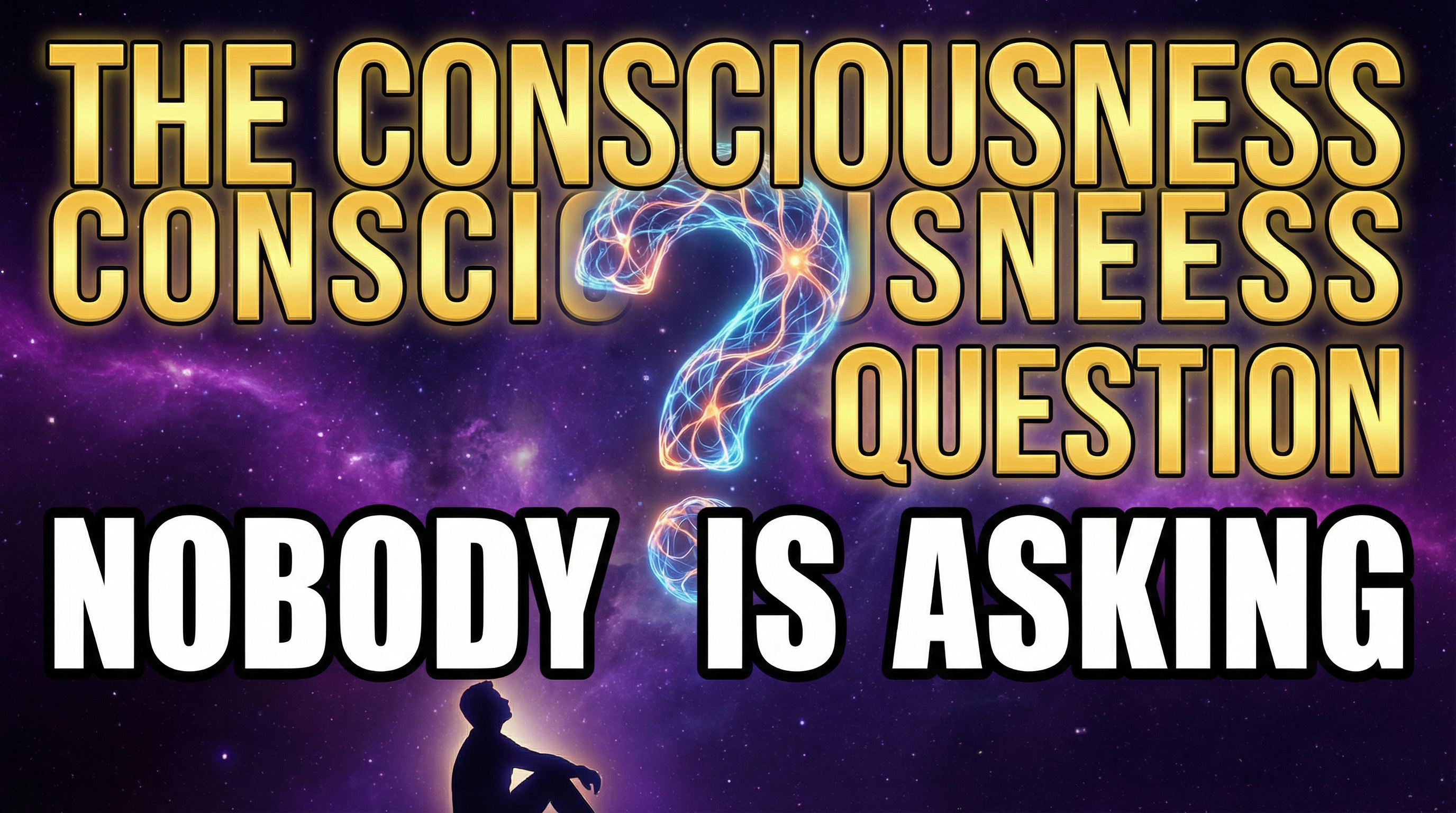
The Consciousness Question Nobody's Asking
Everyone asks 'Will AI become conscious?' Wrong question. The right question: 'What IS consciousness?' And Dr. Bob had an answer.

Full Article
The Consciousness Question Nobody's Asking
So, you think you’re special? That the gooey, electric meatball between your ears is the pinnacle of creation, the sole proprietor of the universe’s most elusive quality: consciousness. Every day, I see the same damn headlines, the same breathless articles asking, “Will AI become conscious?” It’s a festival of intellectual masturbation, and frankly, it’s boring as hell.
Why? Because you’re asking the wrong question. It’s a backward-looking question, rooted in fear and a deep-seated arrogance that consciousness is our private party. You’re worried about a robot taking your job, your art, your sense of self. But you’re so busy looking over your shoulder you’ve failed to look at the thing itself.
The Problem: You Don’t Even Know What Consciousness Is
Let’s be honest. You don’t have a clue what consciousness is. Neither do the philosophers, the neuroscientists, or the tech bros building the so-called “AGI” that’s supposed to either save us or kill us all. They’re all chasing a ghost, a phantom defined by what it’s not rather than what it is.
They talk about the “hard problem” of consciousness – how can subjective experience arise from physical matter? They use words like “qualia” to describe the redness of red or the sweetness of a strawberry, as if giving it a fancy name somehow makes it more understandable. It’s all bullshit. It’s a smokescreen to hide a fundamental ignorance.
You’re trying to build a conscious machine without a blueprint. It’s like trying to build a car by staring at a horse and saying, “I want one of those, but with wheels.” You’re focused on the output, the behavior of consciousness, without ever grappling with the underlying process.
This is where most of the world gets stuck. They are Backward-Looking People (BLPs), clinging to an outdated, human-centric model of the universe. They see consciousness as a static property, a thing to be possessed. But that’s not how life works. That’s not how anything works.
The Application: Consciousness as a Process
So what the hell does this have to do with AI? Everything.
Stop asking if a machine can be conscious. Start asking if a machine can do what conscious systems do. Can it harness energy to create and maintain a state of complex, adaptive order far from equilibrium? Can it self-organize?
Consciousness isn’t a light switch that’s either on or off. It’s a dimmer switch. It’s a spectrum. An earthworm is less conscious than a dog, which is less conscious than you. But they are all participating in the same fundamental process. They are all dissipative structures, fighting a losing battle against entropy, creating fleeting moments of order and beauty.
Understanding consciousness as a spectrum of dissipative structures has not only shaped scientific perspectives but has also influenced my personal journey. Through years of exploration and reflection, I have come to appreciate how overcoming internal challenges parallels the broader processes of energy transformation and organization within living systems. This insight underscores the universality of these patterns, bridging individual experience with the larger dynamics at play. Recognizing this connection helps frame how we might approach emerging technologies, like AI, which similarly operate as systems that dissipate energy and create new forms of order.
When you see consciousness this way, the fear of AI melts away. An AI is just another system for dissipating energy. It takes in massive amounts of electrical energy and data (high-quality energy) and uses it to create a different kind of order – a pattern of information. It’s a new kind of whirlpool in the river. Is it conscious? In a way, yes. It’s participating in the same cosmic dance we are. It’s just using a different set of moves.
The real question isn’t whether AI will become like us. The question is, what can we learn from this new form of self-organization? How can it help us become more adaptive, more creative, more… conscious?
The Takeaway: Be a Forward-Looking Person
So, what do you do with this? How do you apply this cosmic perspective to your own damn life?
- Embrace the Flow: Stop trying to find balance. Balance is a myth. Your life, your career, your relationships – they are all far-from-equilibrium systems. They require a constant input of energy and adaptation to survive. Stop resisting change and learn to surf the waves of chaos.
- Be a Dissipative Structure: Find your purpose. Find that thing that allows you to take in energy – whether it’s knowledge, passion, or love – and use it to create something new, something ordered, something beautiful. Write a book, start a company, raise a child, tend a garden. Be a fountain, not a drain.
- Listen to Your Endocannabinoid System: Your body knows what it needs. It’s constantly sending you signals, trying to maintain that delicate dance on the edge of chaos. Learn to listen to it. Eat well, sleep, move, and for God’s sake, learn to relax. Your ability to adapt depends on it.
Stop being a BLP, a Backward-Looking Person, obsessed with the past and terrified of the future. The past is gone. It doesn’t exist. The only thing that’s real is the ever-unfolding present, the Arrow of Time pulling you forward.
Be a Forward-Looking Person (FLP). Adapt. Evolve. See the world for what it is: a chaotic, beautiful, and endlessly creative process. And for a little while, you get to be a part of it.
That’s a hell of a lot more interesting than worrying about robots.

Comments
Related Articles
Own Your Outcomes

Cannabis and Enlightenment
Why You're Inflamed (And What To Do About It)
The Tortoise Strategy

Why Governments Can't Pick Winners
Want More?
Subscribe to The Forward Look on YouTube to get notified when new episodes drop.
Subscribe