New Here? Start With The TLDR
Everything I've learned from Dr. Bob Melamede distilled into one article. The physics of life, the endocannabinoid system, why some people embrace the future while others cling to the past, and what it all means for you.

Look, I get it. You landed here and you're staring at 150+ articles about thermodynamics, cannabis, consciousness, and some guy named Dr. Bob. You're wondering what the hell this is all about and whether it's worth your time.
Let me save you some scrolling. This is the TLDR—the distilled essence of everything I've learned from Dr. Bob Melamede, a brilliant and unconventional scientist who changed how I see literally everything. If this resonates, dive deeper. If not, no hard feelings.
The Foundation: You Are a Flow of Energy
Here's the first mind-fuck: traditional physics says life is statistically impossible. The universe tends toward disorder—that's the second law of thermodynamics. So how the hell are you sitting there, reading this, with trillions of cells working in perfect coordination?
Enter Ilya Prigogine, who won the Nobel Prize in 1977 for proving that when energy flows through a system, it doesn't just create chaos—it creates order. Life doesn't exist despite physics. Life exists because of physics.
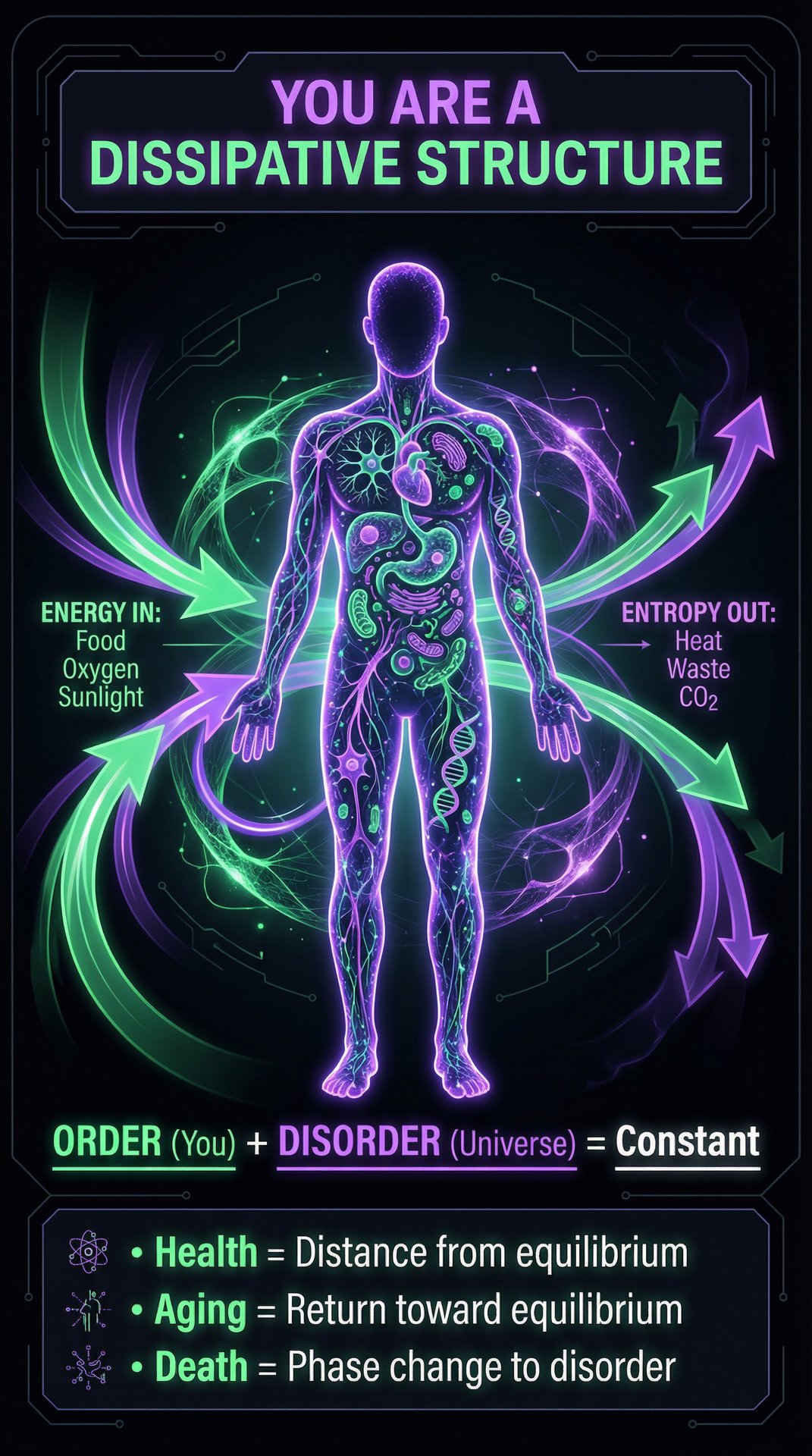
You are what Prigogine called a "dissipative structure." You take in energy and matter, you organize it into something complex and beautiful, and you expel waste. You maintain your organization by making the universe around you more disordered. As Dr. Bob puts it: "Collections of molecules get smarter as long as they make the universe stupider quicker."
This isn't philosophy. This is physics. And it changes everything about how you should think about health, aging, and death:
- Health = distance from equilibrium (how far you are from disorder)
- Aging = returning toward equilibrium (losing the fight against entropy)
- Death = phase change back to disorder (game over)
Here's the practical implication Dr. Bob always emphasized: There are only two ways for a human being to decrease entropy and complicate ourselves in a flow-dependent way—gaining muscle or gaining knowledge.
Think about it. When you lift weights, you're literally building more organized structure. When you learn something new, you're creating more complex neural networks. Both require energy flow. Both create order from chaos. Both push you further from equilibrium—which is exactly where you want to be.
This is why exercise and learning feel good. This is why stagnation feels like death. Your body knows at a thermodynamic level that growth equals life and decay equals death. The couch potato watching reruns isn't just wasting time—they're literally moving closer to equilibrium, closer to disorder, closer to death.
The Problem: Free Radicals Are Killing You
Here's the catch. The same process that keeps you alive—metabolism, burning fuel for energy—produces byproducts called free radicals. These are molecular wrecking balls. One free radical molecule could theoretically kill you by damaging critical DNA.
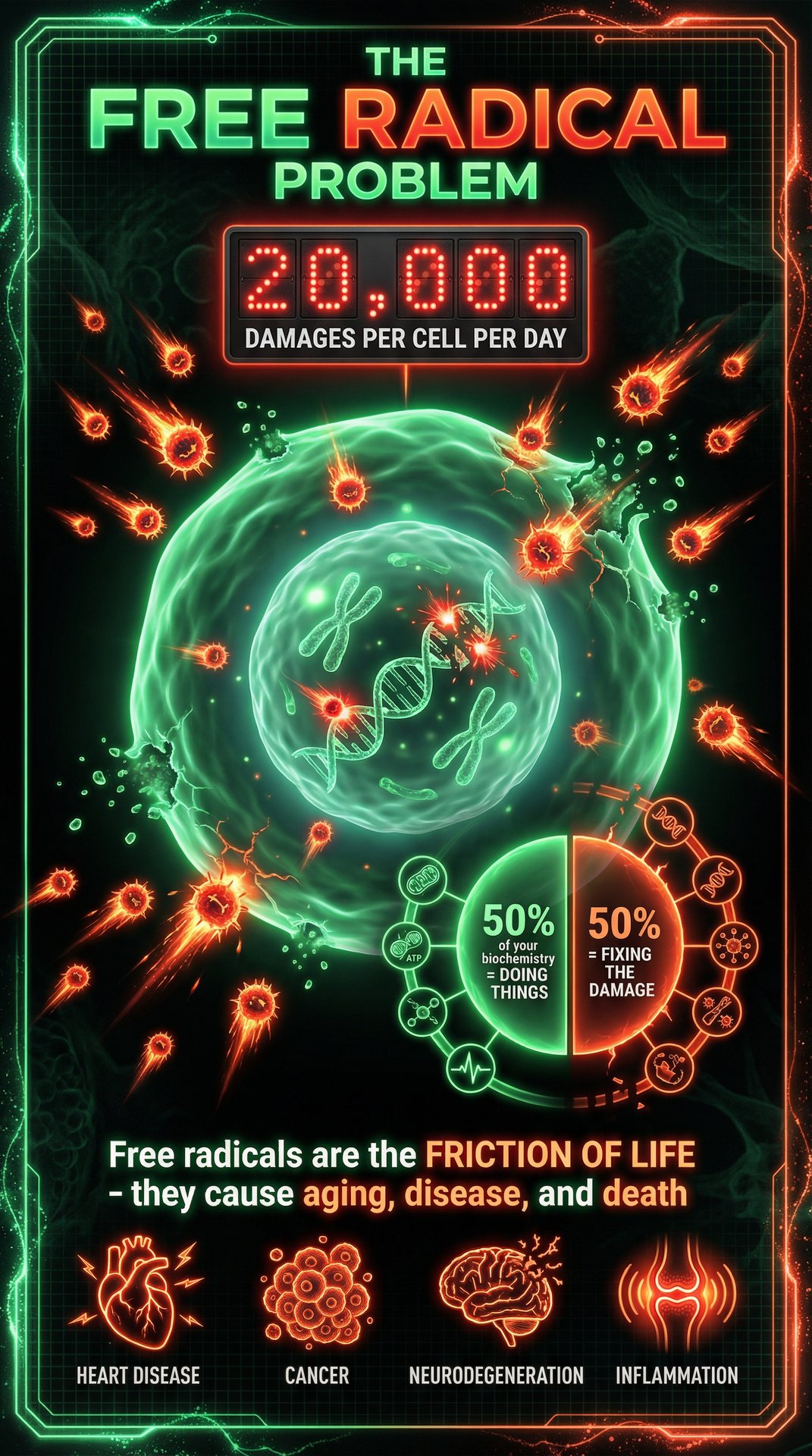
Every single cell in your body sustains about 20,000 free radical damages per day. Let that sink in. Half of your biochemistry is devoted to doing things; the other half is devoted to fixing the damage from doing things.
Free radicals are the friction of life. They're why you age. They're why you get sick. They're why everything eventually falls apart.
The Solution: The Endocannabinoid System
Now here's where it gets interesting. Evolution didn't leave us defenseless. About 600 million years ago, when vertebrates first appeared, something remarkable evolved: the endocannabinoid system (ECS).
Dr. Bob calls endocannabinoids "the oil of life"—they lubricate your biochemistry against free radical friction. The ECS is the most abundant neurotransmitter system in your brain, and it regulates everything: immune function, nervous system, cardiovascular system, digestion, reproduction, bone health. From conception to death.
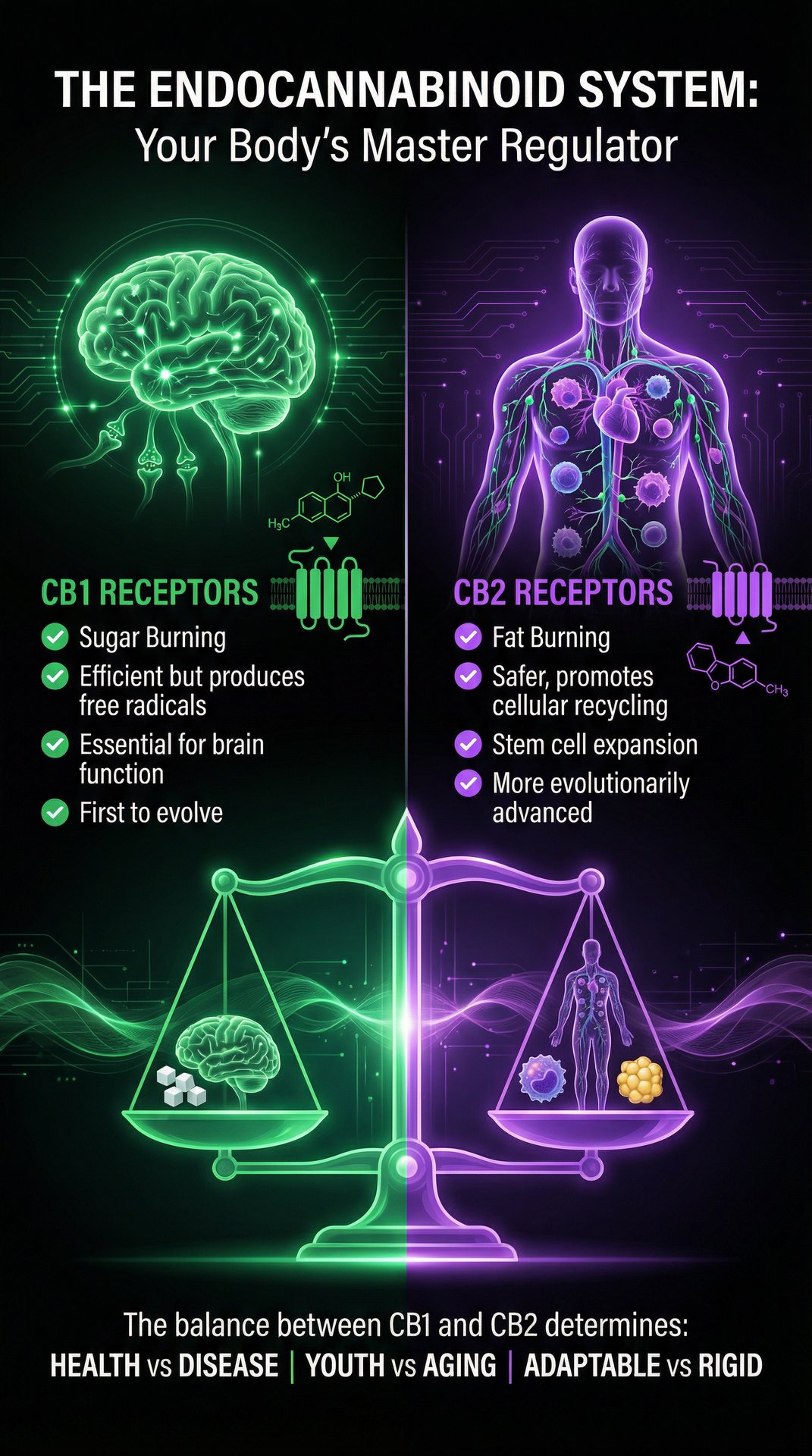
The system has two main receptors:
| CB1 Receptor | CB2 Receptor |
|---|---|
| Regulates sugar burning (carbs) | Turns on fat burning |
| Efficient but dangerous (free radicals) | Safer, promotes cellular recycling |
| Essential for brain function | Promotes stem cell expansion |
| First to evolve | Evolved later (more advanced) |
The balance between these receptors determines whether you're healthy or sick, young or old, adaptable or rigid.
The Plant: Cannabis as Anti-Aging Medicine
Here's where most people's brains short-circuit. Cannabis isn't just a recreational drug. It's a plant that produces compounds (cannabinoids) that interact directly with your endocannabinoid system.
Think about that. A plant evolved to produce molecules that fit perfectly into receptors in your brain and body. Psychoactive cannabinoids are even found in mother's milk—nature designed us to have cannabinoid activity from birth.
Cannabinoids counteract free radical damage. They protect against age-related illnesses: cardiovascular disease, cancer, neurological disorders, autoimmune diseases. Throughout evolution, cannabinoid receptor density has continuously increased in more advanced brain regions. The most evolutionarily advanced areas of the human brain have the highest CB1 concentration.
Dr. Bob's conclusion: Cannabis isn't a drug—it's an essential nutrient for modern humans.
The Division: FLPs vs. BLPs
Now here's Dr. Bob's most provocative idea, and the one that made everything click for me.
Humanity is divided into two types of people:
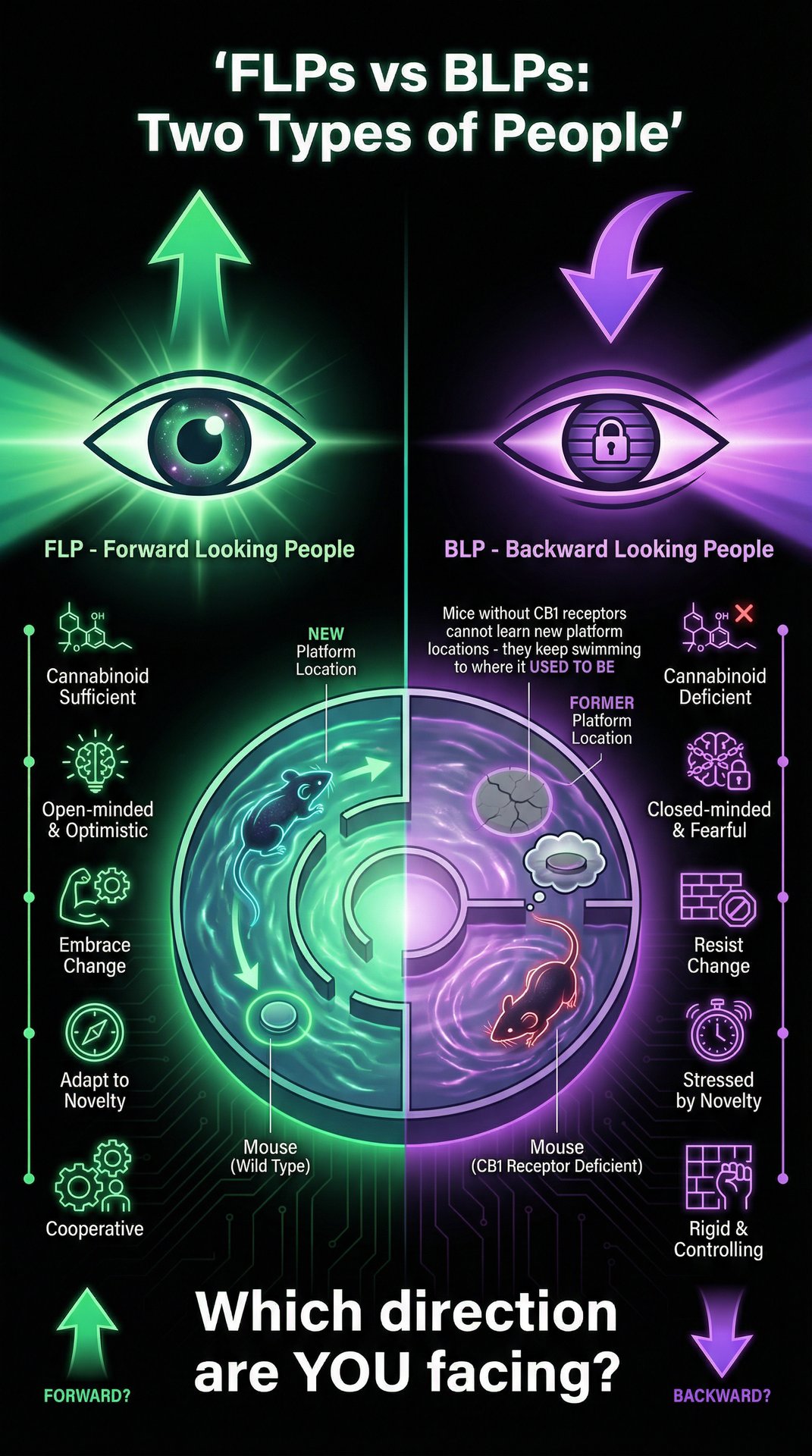
| FLPs (Forward-Looking People) | BLPs (Backward-Looking People) |
|---|---|
| Cannabinoid sufficient | Cannabinoid deficient |
| Open-minded, optimistic, adaptable | Closed-minded, fearful, rigid |
| Embrace change, creative | Cannot "relearn" (stuck in old patterns) |
| Adapt to novelty | Stressed by novelty |
| Cooperative, peaceful | Run governments, militaries, churches |
This isn't about intelligence or success. It's about orientation. Are you pointed toward the future, or are you trapped in the past?
Dr. Bob tested this with mice. Normal mice, when you move the platform in a water maze, quickly learn the new location. Mice without CB1 receptors? They keep swimming to where the platform used to be. They literally cannot update their mental model of reality.
Sound like anyone you know?
The Stakes: A Global Phase Change
Here's why this matters beyond your personal health.
The planet is undergoing a far-from-equilibrium phase change. Look around: wild fluctuations in weather, politics, economics, finance. This is pre-phase-change behavior. The system is unstable and about to reorganize into something new.
Two possible outcomes:
- Rise of fascism/tyranny (BLP dominance) — fear wins, walls go up, humanity contracts
- True liberation of humanity (FLP emergence) — adaptation wins, cooperation expands, humanity evolves
Current world leadership is dominated by BLPs. That's a problem. Because BLPs, by definition, cannot adapt to new realities. They keep swimming to where the platform used to be.
What You Can Do
So what's the practical takeaway? How do you become more FLP and less BLP?
- Fix your diet: Eat in a calorie-deficient most of the time and increase your healthy fats with plenty of avocados, nuts and salmon. Shift your metabolism toward fat burning (CB2 activation). Your endocannabinoids are made from omega-3 and omega-6 fatty acids—eat real food.
- Move your body: Exercise activates AMPK, which promotes fat burning and cellular recycling. It's not optional.
- Consider cannabis: Not as a way to get high, but as a way to supplement your endocannabinoid system. Do your research. Be intentional. Start low, go slow.
- Embrace novelty: Actively seek out new experiences, new information, new challenges. This is how you stay far from equilibrium. Comfort is death.
- Let go of the past: Stop swimming to where the platform used to be. The past is a story you tell yourself. The only thing that's real is now, and the only direction is forward.
The Bottom Line
Dr. Bob's core message, and the reason I built this entire site:
"The survival of mankind may depend on increasing cannabinoid activity in the human population. We need to replace BLPs with FLPs—and cannabis is the tool to do it. This isn't about getting high; it's about aligning with the creative force of evolution itself."
That's the TLDR. Physics says life must exist. Your endocannabinoid system is what keeps you alive and adaptable. Cannabis is an essential nutrient, not a drug. The future belongs to those who can adapt.
Now you have a choice. Keep swimming to where the platform used to be, or turn around and flow with it.
I know which one I'm choosing.
— Justin
Where to Go Next
- → Episode 1: The Universe Doesn't Care About Your Feelings — Start the journey from the beginning
- → The Endocannabinoid System Deep Dive — Learn about the wizard behind the curtain
- → Who is Dr. Bob Melamede? — Meet the scientist who changed my worldview
- → The Framework — The six pillars of this philosophy
Comments
Essential Reading

Comments
Frequently Asked Questions
A dissipative structure is a system that maintains its organization by continuously taking in energy and matter, organizing it into something complex, and expelling waste. You are a dissipative structure—you maintain your order by making the universe around you more disordered. This concept was developed by Nobel Prize winner Ilya Prigogine.
The endocannabinoid system (ECS) is a biological system found in all vertebrates that regulates homeostasis throughout your body. It controls inflammation, mood, appetite, sleep, pain, and more. It's called the 'master regulator' because it helps maintain balance in virtually every other system in your body.
Free radicals are unstable molecules produced as byproducts of metabolism. They cause oxidative damage to cells, proteins, and DNA. This damage accumulates over time and is a primary driver of aging and disease. Your body produces antioxidants to neutralize them, but the balance shifts as you age.
FLPs (Forward-Looking People) embrace change, adapt to new information, and thrive in uncertainty. BLPs (Backward-Looking People) resist change, cling to tradition, and fear the unknown. This isn't about intelligence—it's about how your biology responds to novelty and stress.