Free Will is an Illusion (And That's OK)
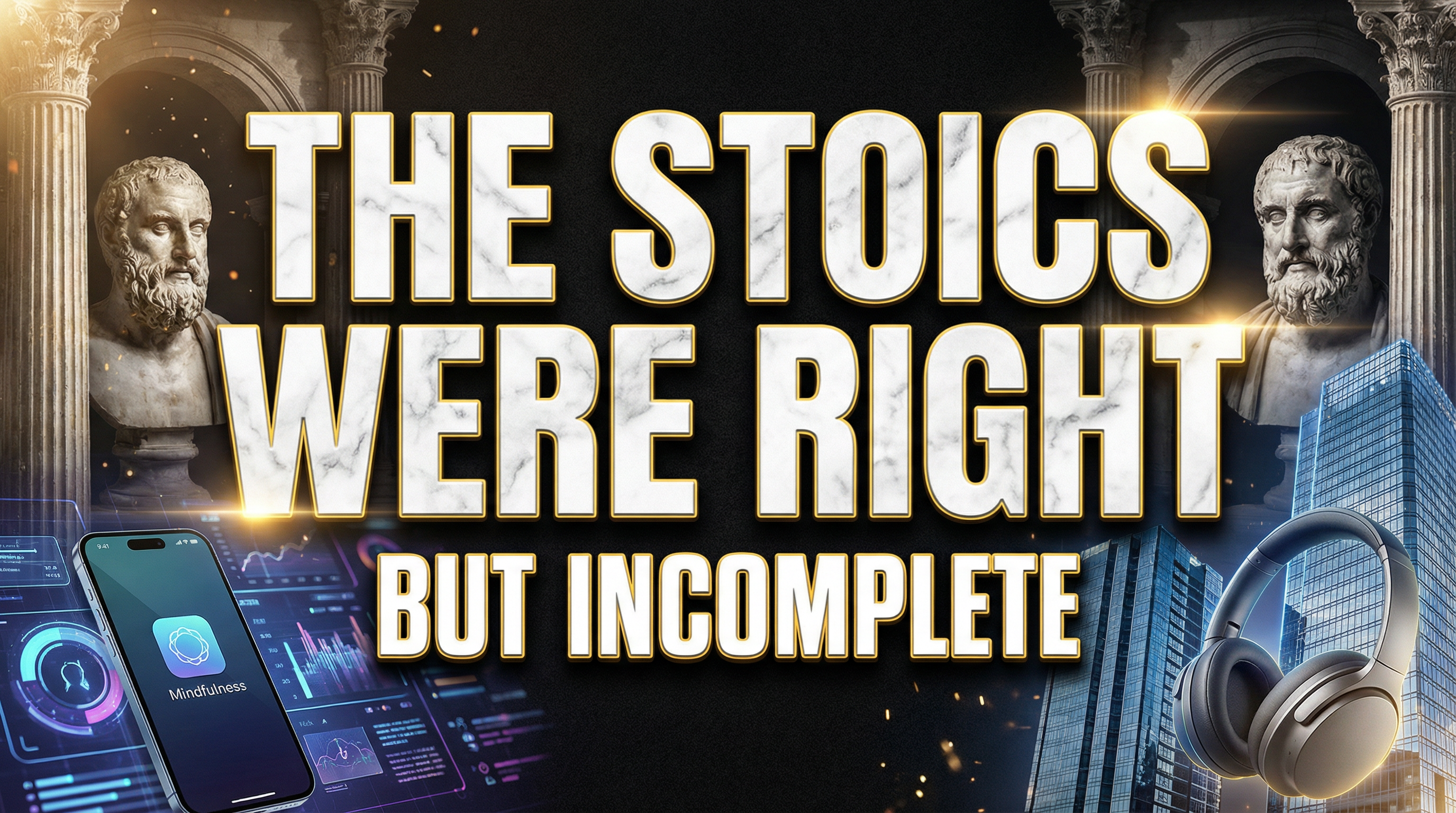
Ancient wisdom meets modern science. What the Stoics understood about acceptance—and what they missed about adaptation.
Full Article
You think you’re in control. You think you chose to read this. You think you decided what to have for breakfast, who to marry, and what career to pursue. You believe you are the captain of your ship, the master of your fate. I’m here to tell you that’s bullshit. Every decision you’ve ever made was baked into the universe from the moment of the Big Bang. You have no more free will than a rock rolling down a hill. And the sooner you accept that, the sooner you can actually start living.
The Problem: Our Collective Delusion
We’re obsessed with the idea of free will. It’s the bedrock of our legal system, our religions, and our personal sense of identity. We tell ourselves stories about pulling ourselves up by our bootstraps, making our own luck, and choosing our destiny. It’s a comforting narrative, but it’s a fantasy. A damn convenient one, I’ll admit. It lets us take all the credit when things go right and assign all the blame when they go wrong.
But this obsession with control is a trap. It fuels our anxiety, our guilt, and our judgment. We beat ourselves up for past “mistakes” and agonize over future “choices.” We judge others for their “bad decisions,” assuming they could have simply chosen differently. This backward-looking perspective keeps us stuck, fighting a battle we can never win. You can’t change the past, and you can’t control the future. The arrow of time only moves in one direction.
The Stoic Half-Step: Great for Endurance, Bad for Evolution
The ancient Stoics—Marcus Aurelius, Seneca, Epictetus—got it half right. They understood the deterministic nature of the universe. They preached Amor Fati, a love of fate. They knew that railing against what you cannot control is a recipe for misery. The "Philosopher King" Marcus Aurelius himself wrote constantly about accepting the natural order of things, understanding that we are but small parts of a greater whole.
But according to Dr. Bob and my own observations, their thinking was incomplete. The Stoics mastered the art of endurance. They could take a punch from the universe and keep standing. They built a philosophy of steel to withstand the chaos. But life isn't just about withstanding chaos; it's about using it.
The Stoic approach often leads to a state of equilibrium—a static acceptance that borders on resignation. But as Dr. Bob taught, life is a Far-From-Equilibrium process. We are not rocks designed to weather the storm; we are flames designed to dance with the wind. We don't just endure entropy; we generate complexity.
The missing piece of the puzzle that the Stoics lacked was the biological mechanism of adaptation: the Endocannabinoid System (ECS). While the Stoics had the "software" of acceptance down pat, they didn't understand the "hardware" of evolutionary adaptation. They strove to suppress their internal state to match a chaotic world, whereas the goal of a Far-From-Equilibrium system is to dynamically adjust its internal state to thrive in a chaotic world.
The Application: So, What the Hell Are We Supposed to Do?
If our choices are an illusion, why not just lie on the couch and do nothing? Because the illusion of free will is a necessary one. You are a forward-looking person (FLP), not a backward-looking person (BLP). You are a system designed to adapt and evolve. Even though your path is determined, you still have to walk it. The universe requires you to act as if you have free will. You are a self-organizing system. Your job is to respond to the feedback from your environment and adjust your trajectory.
This is where the endocannabinoid system (ECS) comes in. Dr. Bob called it the body’s master regulatory system. The ECS is what helps us adapt to stress and maintain homeostasis. It’s the biological mechanism that allows us to be forward-looking, to process information from our environment, and to adjust our behavior accordingly. It’s the hardware that runs the software of adaptation.
When your ECS is functioning optimally, you are more resilient, more adaptable, and more present. You are better able to navigate the currents of life without getting swept away by them. But when your ECS is out of balance, you become a BLP. You get stuck in rigid patterns of thought and behavior. You become more susceptible to stress, anxiety, and depression. You lose your ability to flow.
Accepting determinism doesn’t mean becoming a passive blob. It means letting go of the baggage. It means forgiving yourself for your past “mistakes” because you couldn’t have done anything differently. It means letting go of the anxiety about the future because you can’t control it anyway. It means having more compassion for others, because they are just as much a product of their circumstances as you are.
Your life is not about making the “right” choices. It’s about being present for the ride. It’s about embracing the chaos and finding the order within it. It’s about recognizing that you are a part of a much larger system, a complex and beautiful dance of cause and effect. You don’t have to steer the river; you just have to learn how to navigate the current.
I struggled with this for a long time. I’d get angry at myself for not living up to my own expectations. I’d beat myself up for not being more disciplined, more focused, more… whatever. But then I realized I was being a BLP. I was looking backward, trying to change a past that was already written. The moment I started to see myself as an FLP, as a system in constant motion, everything changed. I started to focus on the process, not the outcome. I started to see every moment as an opportunity to adapt and evolve.
The Takeaway: How to Live Without Free Will
So how do you put this into practice? How do you live a determined life in a world that screams about choice?
- Practice Radical Forgiveness: Forgive yourself. Forgive others. Let go of the blame and the guilt. You are all just playing out your programming. Holding onto resentment is like drinking poison and expecting the other person to die. It’s a backward-looking waste of energy.
- Focus on the Process, Not the Outcome: You can’t control the outcome. You can only control your response to the present moment. Show up. Do the work. Be present. The results will be what they will be. Your job is to be an active participant in your own determined path.
- Cultivate Your Garden: You may not be able to choose the seeds, but you can tend the soil. You can control your inputs. You can choose what you read, who you spend time with, and what you put into your body. You can create an environment that promotes growth and adaptation. You can tune your endocannabinoid system to be more resilient and responsive. This means eating well, sleeping enough, moving your body, and managing your stress. It means feeding your brain with new ideas and experiences. It means being mindful of the information you consume and the people you surround yourself with.
- Embrace the Absurdity: There’s a dark humor to it all, isn’t there? We are conscious beings who are aware of our own powerlessness. That’s a cosmic joke. Learn to laugh at it. Don’t take yourself so damn seriously. You’re a puppet, but you’re a puppet that can appreciate the show.
Closing
Letting go of the illusion of free will is not a cause for despair. It’s a cause for liberation. It’s the key to unlocking a more compassionate, present, and fulfilling life. It’s about trading the burden of control for the freedom of acceptance. Stop fighting the current. Stop trying to swim upstream. Let the river carry you.
Comments
Related Articles
Stop Trying to Convince BLPs
What Dr. Bob Taught Me
The Science Dr. Bob Left Behind

The Kahuna Were Scientists
Order From Chaos: The Secret of Life
Want More?
Subscribe to The Forward Look on YouTube to get notified when new episodes drop.
Subscribe