What are the munchies, why does food taste better when you're high, why do you get hungry even right after a meal, does weed raise ghrelin, the hunger hormone, does CBD give you the munchies, and why did I stop getting the munchies? From the smell bulb to the cells that should tell you you're full, with the mouse and human studies behind each one.
The full answer
Why does weed make you hungry?
Why does weed make you hungry? THC switches on a lock in your brain called CB1, which your body already uses to run hunger, and in mice, switching that lock on makes food smell stronger and even flips the cells that normally tell you you're full. I'm Justin Hartfield, I've spent twenty-five years in cannabis, and the munchies are the clearest look at the system the plant borrows.
What are the munchies?
What are the munchies? It's the hunger that comes on when you're high, and it's real enough to measure. In 1988, six men lived in a Johns Hopkins lab for thirteen days, and on the days they smoked marijuana they ate about forty percent more calories than on placebo days, and almost all of the extra came from snacks, especially sweet ones like candy bars.
Why does food taste better when high?
Why does food taste better when you're high? To see why, start with the places in your brain where these locks are packed most tightly.
They're densest in the deep structures that start and stop your movements. In the cerebellum, which keeps your timing. In the hippocampus, where today becomes memory. And in the olfactory bulb that reads smells. We'll come back to that one.
Many people feel more in touch with the world around them. Music, food and touch feel more intense. In mice, CB1 even makes sweet taste stronger.
And the munchies? Remember the olfactory bulb that reads smells? In hungry mice, CB1 receptors there make food smell stronger, so they eat more. Cannabis turns up the same switch.
Why do you get hungry when high?
So why do you get hungry when you're high, even right after a meal? In 2015, a lab at Yale switched on CB1 in mice that had just eaten, and the hypothalamus neurons that normally tell you you're full fired harder, but what they released was beta-endorphin, one of your body's own opioids, and the mice ate.
When the researchers blocked opioids with naloxone, the extra eating stopped, so the very cells that should have ended the meal were keeping it going.
Ghrelin, the hunger hormone
What about ghrelin, the hunger hormone your stomach makes? In 2012, in a small study of seven men smoking cannabis for nerve pain, ghrelin rose about forty percent over the day, while on placebo it dipped. But in a 2020 NIH study of twenty cannabis users, cannabis didn't clearly push ghrelin above placebo.
That second study did find GLP-1, a gut hormone that turns appetite down, running lower with cannabis than with placebo.
Does weed increase appetite?
So does weed increase appetite? It does, and the reason goes back to the very first job this system ever did for you.
The first dose comes with your first meal. Breast milk carries 2-AG, one of your keys. Newborn mice that couldn't use it barely fed, stopped growing, and some even died.
Does CBD give you the munchies?
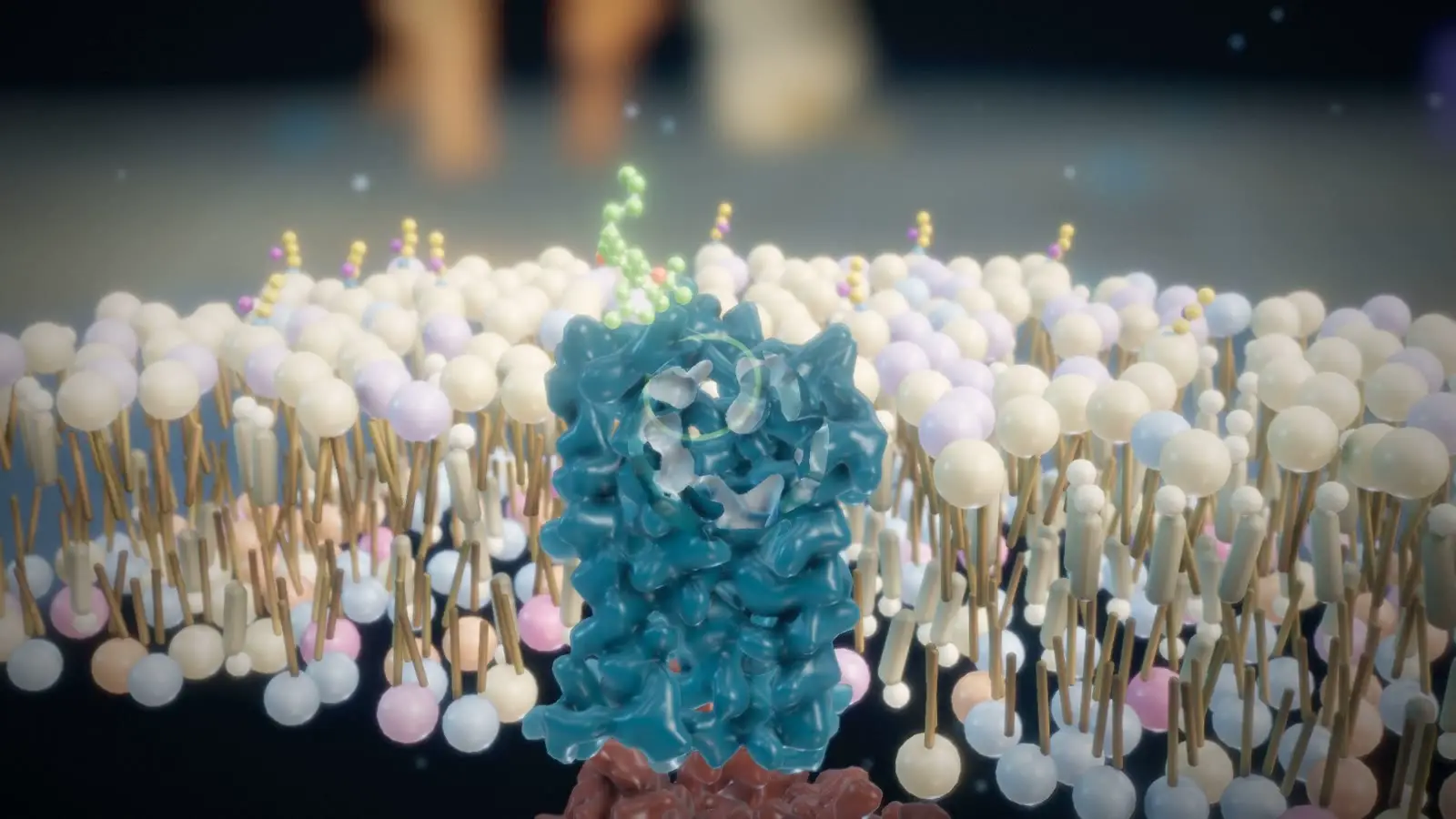
Does CBD give you the munchies? It doesn't look that way, and you can see why when you watch what it does at the lock.
CBD, the other famous cannabis molecule. Surprise. It barely touches this lock.
And in a 2018 trial of two hundred twenty-five people with a severe epilepsy that starts in childhood, who took CBD every day at the doses used for seizures, a smaller appetite was one of the most common side effects, and more so at the higher dose.
Why did I stop getting the munchies?
Why did I stop getting the munchies? Daily smokers have about fifteen percent fewer CB1 locks, and they come back within days of stopping, so weaker munchies may just mean fewer locks for THC to turn, though that link is my own inference from the scans.
So the munchies are THC borrowing a job this system has done for you since your very first meal. The whole film is on my site, linked below, and next, why do I want another bite, even when I'm already full?
What the studies show
Every claim in this answer, the study behind it, who was studied, and who paid for the research. “None listed” means the paper names no funder.