What is Bryan Johnson's Don't Die, and is his Blueprint protocol worth it? This covers who he is and what Blueprint measures, why he stopped the plasma infusions from his son, whether you can beat entropy or reverse your biological age, the hydra that doesn't seem to age, whether an algorithm can keep you young, and why we age and die, with my teacher, the biologist Dr. Bob Melamede, in his own voice from a 2017 talk.
The full answer
What is Bryan Johnson's Don't Die?
What is Bryan Johnson's Don't Die? It's his rule for living: measure everything in your body, and do whatever it takes not to die. I'm Justin Hartfield, and I've been selling cannabis for twenty-five years. And I think Don't Die misunderstands what life is.
Who is Bryan Johnson?
Bryan Johnson sold his payments company, Braintree, for 800 million dollars. Now he spends about two million dollars a year on one goal. His protocol is called Blueprint. A team measures his organs, he eats the same carefully chosen food on a fixed schedule, and he goes to bed at the same early hour every night. He has said his mind no longer decides. The protocol does. His stated target has been the organs of an eighteen-year-old. In 2023 he had plasma from his seventeen-year-old son infused into his own blood. And in 2025 he announced that Don't Die is a religion.
Is Bryan Johnson's Blueprint worth it?
A lot of it is good advice. Sleep, exercise, real food, no smoking. And to his credit, when the plasma infusions from his son showed no signs of improvement in him, he publicly stopped. I think he is an honest and sincere person. So my problem is definitely not his super broccoli salads or his antioxidant cocoa desserts. It's the idea underneath it. I think Don't Die gets life and death backwards. In fact, I even made a whole film on what I think life is on my website JustinHartfield.com.
Can you beat entropy?
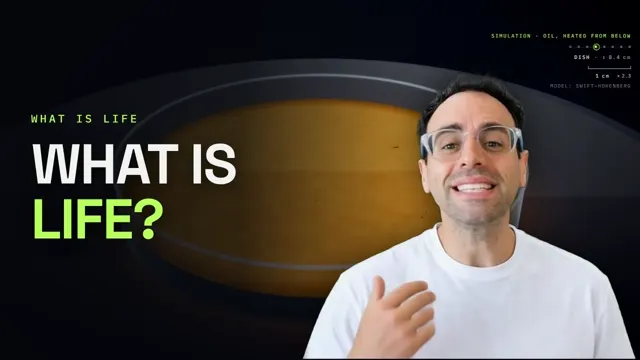
He has said that once super-intelligent AI arrives, your only enemy is entropy. But life has never beaten entropy. Picture a thin layer of oil in a dish, heated from below. It sorts itself into little cells, because cells carry the heat away faster. As the biologist Bob Melamede put it, molecules get smarter by making the universe stupider, quicker.
Dr. Bob Melamede, in his own words
The flow dependent structure goes away. That's what death is. It's a far from equilibrium phase change back to a state of lower organization.
Can you reverse your biological age?
Bryan Johnson's scoreboard measures biological age and organs, and he wants his to be what they were like if he were eighteen years old. It's a race back toward a body he no longer has or will ever be able to relive. Time only travels in one direction, and over time, nothing is immune to the effects of entropy. Bob kept a different scoreboard.
Dr. Bob Melamede, in his own words
Your chronological age is not what matters. The fact that I'm 70 is not what matters. How far am I from equilibrium is what matters. And, you know, you could be 6 years old and dying because you're closer to equilibrium, or you could be a hundred years old riding a horse, running around, because you're further from equilibrium.
Do any animals not age?
Interestingly enough, physics doesn't say every living thing has to age. Researchers followed hydra, tiny freshwater animals, for more than three million animal-days in the lab, and their risk of dying did not rise with age. How? Well, they never hold on. Every cell in a hydra is replaced in about four weeks. They don't escape entropy either. They just never stop paying it. The animal that doesn't seem to age is actually the one that lets go of itself the fastest.
Can an algorithm keep you young?
Bryan Johnson's Blueprint system is, in a phrase, measure every number, hold each one where you want it, and hand all bodily choices to the Blueprint protocol. To be fair, Blueprint changes when his numbers do. But it always steers back to the same fixed picture: the body of an eighteen-year-old. And a protocol can only tune what it measures. What keeps a living thing going is how well it adapts when the world changes, and you can't measure that in advance. You can capture the static measure of the efficiency of your organs, and they can operate in peak conditions, say, of an eighteen-year-old, but your body is much more complex than that, and the forces of entropy are too dynamic to attempt to control algorithmically. There are just too many variables.
Dr. Bob Melamede, in his own words
Every one of your 15 trillion cells every day sustains 20,000 of the damages where one, in one cell, one time, could kill you. What does that suggest to you? To me it says we must have an incredible amount of biochemical complexity devoted to preventing us from dying.
Why do we age and die?
This is what Dr. Bob taught me many years ago. Your endocannabinoid system, the one THC works through, doesn't hold you still. It helps you let go and update. Evolution doesn't spare individuals. It keeps lineages. A species adapts because each generation is new, a fresh spawn from the one before. Bob pictured life as a whirlpool: it only keeps its shape while the water flows through it. No whirlpool lasts forever. The flow goes on. To be fair, Bob wanted more life too. He called cannabis an anti-aging drug and used it almost every day for more than fifty years. But what he tried to stretch wasn't agelessness or a return to youth. It was the flow.
What should you aim for instead of Don't Die?
Here's where I land. Don't Die is a goal about keeping a thing: a body, a number, a self. It's also a system that offloads thinking about your body to a lower, deterministic algorithm, separate from the realities of the moment. Your body, your mind and, I'd say, your soul are one swirling mass of chemical reactions. You were never a thing. You're a pattern that keeps rebuilding itself while the flow lasts. And the flow goes on after you.
If I had to put it in two words, mine wouldn't be don't die. They'd be keep flowing. The whole film is on my site, linked below. Next: why do we age?
What the studies show
Every claim in this answer, the study behind it, who was studied, and who paid for the research. “None listed” means the paper names no funder.