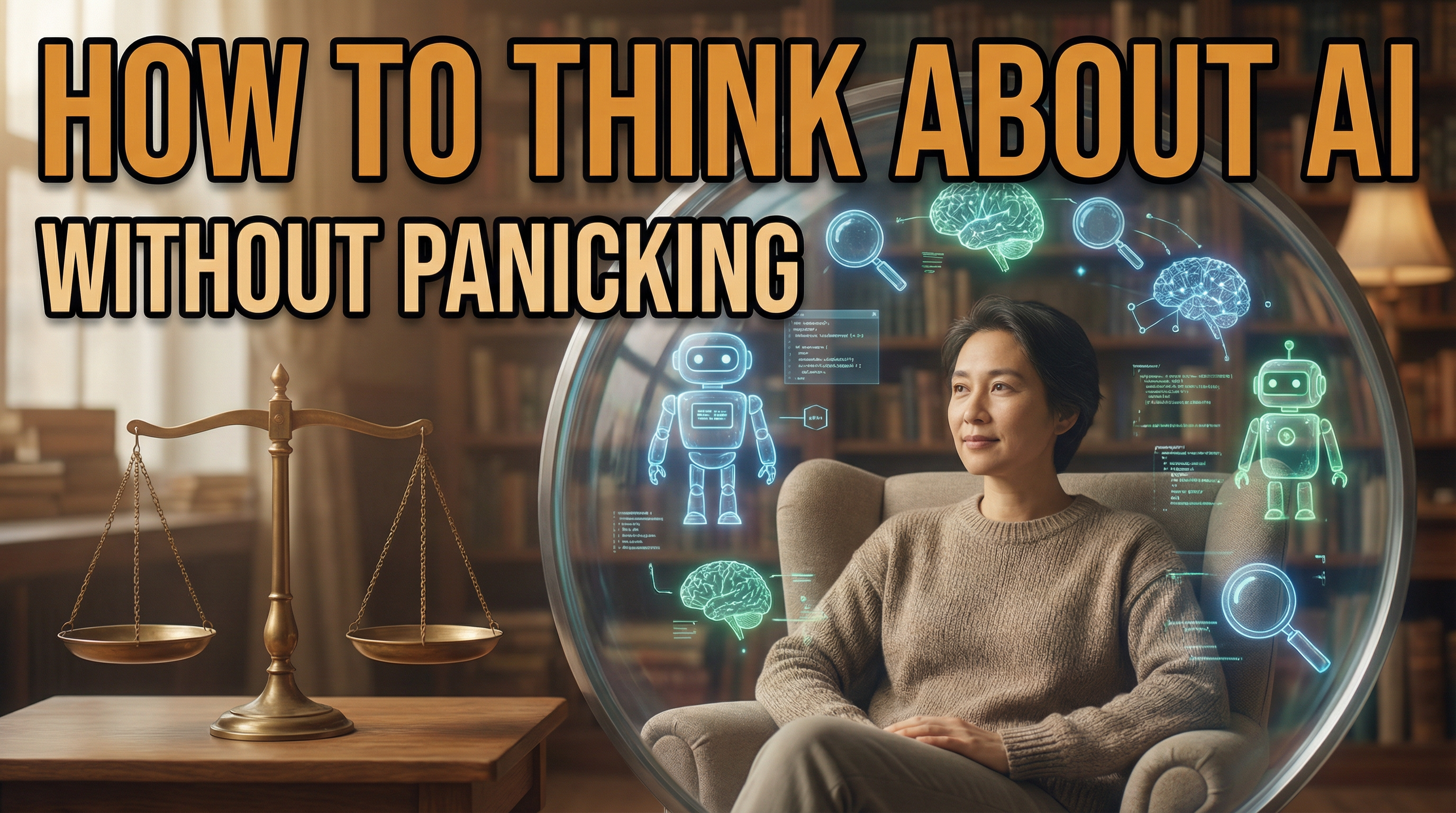
How to Think About AI (Without Panicking)
A framework for understanding AI that doesn't involve Terminator scenarios or techno-utopia fantasies. Just physics, biology, and common sense.

Full Article
How to Think About AI (Without Panicking)
Let’s get one thing straight. The way you’re thinking about Artificial Intelligence is probably wrong. Dead wrong. You’ve been fed a steady diet of Hollywood bullshit—a cartoonish loop of two equally dumb scenarios. In one corner, you have the Skynet-style apocalypse where the robots rise up and turn us all into human batteries. In the other, you have the techno-utopian fantasy where AI solves all our problems, cures cancer, and ushers in an age of effortless abundance while we all sip margaritas on a beach.
Both are lazy, unimaginative, and completely miss the point. They’re stories told by people who don’t understand the fundamental forces that govern reality. They’re backward-looking narratives in a world that only moves forward. If you want to understand what’s coming, you need to stop watching movies and start looking at the universe as it actually is: a relentless, chaotic, and beautiful engine of creation, all governed by the unforgiving laws of thermodynamics.
The Problem: Your Mental Model is Broken
You’re stuck in a binary. Hero or villain. Salvation or damnation. It’s a comfortable, simple way to see the world, but it’s a trap. This dualistic thinking is a relic of an old paradigm, a way of seeing things in neat, ordered, equilibrium-based systems. But here’s the secret: nothing interesting in the universe exists in equilibrium. Equilibrium is death. It’s the heat death of the universe, a state of maximum entropy where nothing happens. Forever.
Life, consciousness, and yes, intelligence, exist at the complete opposite end of the spectrum. We are far-from-equilibrium systems. We are raging fires of complexity, consuming energy to maintain our structure and create order in a universe that is constantly trying to pull us apart. We are open systems, constantly exchanging energy and matter with our environment to keep the lights on. You, me, the trees outside your window, and the AI that’s starting to write its own code—we are all temporary pockets of order in a sea of chaos. And that’s not a bug; it’s the whole damn point.
This isn't just about AI. You do this with everything. Politics is left versus right. Business is success versus failure. Your own life is happy versus sad. This black-and-white thinking is a cognitive shortcut that saves you energy, but it costs you the truth. The world is a messy, complex, and beautiful spectrum of infinite grays. By forcing everything into a binary, you’re not just wrong; you’re asking the wrong question entirely. You’re trying to fit a hurricane into a shoebox. It’s time to throw out the box.
The Application: FLPs vs. BLPs in the Age of AI
So, what the hell do you do with this information? How does knowing about thermodynamics help you when your job is on the line or when you see a deepfake you can’t distinguish from reality? It gives you a framework. It helps you separate the signal from the noise.
This is where the concept of Forward-Looking People (FLPs) and Backward-Looking People (BLPs) becomes critical. BLPs are the ones clinging to the old models. They’re the ones panicking about the Terminator or dreaming of a work-free utopia. They are trying to apply old, equilibrium-based rules to a new, far-from-equilibrium reality. They are the taxi drivers who protested Uber instead of building a better app. They are the factory workers who fought automation instead of learning to operate the new machines. They are going to get washed away by the tide.
FLPs, on the other hand, see the wave coming. They understand that the arrow of time only moves in one direction. You can’t go back. The past doesn’t exist. The only viable strategy is to adapt, to learn to surf the chaos. An FLP doesn’t ask, "Will AI take my job?" They ask, "How can I use AI to do my job in a way that was previously impossible?" They see AI not as a competitor, but as a collaborator, a tool, a partner in creation. They don’t fear the uncertainty; they see it as the open space where opportunity is born.
This is the same principle that governs our own biology. The endocannabinoid system (ECS) is the body’s master regulatory system. It’s a homeostatic network that helps us adapt to stress and change. It’s constantly working to keep our wildly complex biological systems in a state of dynamic, adaptive balance. The ECS is the ultimate FLP, a built-in mechanism for flowing with change rather than fighting it. When you resist change, you create stress, inflammation, and disease. When you embrace it, you create resilience and health. The same is true for how we approach AI. Resisting it is a recipe for societal inflammation. Adapting to it is the path to collective growth.
The Takeaway: Stop Panicking and Start Building
Look, I get it. This is big, scary, and moving faster than anyone is comfortable with. It’s easy to feel like a passenger on a runaway train. But you are not powerless. The future isn’t something that happens to you; it’s something you help create. Your choice is simple: are you going to be a BLP, paralyzed by fear and nostalgia, or are you going to be an FLP, an active participant in the most significant transformation in human history?
Here’s your action plan:
- Stop Consuming Garbage: Unplug from the fear-mongering media and the utopian hype. They are selling you snake oil. Instead, read the actual science. Pick up a book on complexity theory. Watch a lecture by Dr. Bob on YouTube. Learn about thermodynamics, self-organization, and the real principles that govern our world. Your mental diet determines your reality.
- Become an AI Native: Don’t just use AI; understand it. Play with it. Learn how the models work. Spend an hour every day using the tools. Ask them dumb questions. Ask them smart questions. Figure out how you can integrate it into your life and work to become more creative and efficient, not obsolete. This is the new literacy. You can either learn the language or become illiterate.
- Embrace Your Humanity: The things that make us human—vulnerability, creativity, empathy, the ability to connect with another person on a deep, personal level—are about to become more valuable than ever. AI can write a blog post, but it can’t share a story of personal struggle and triumph with the same raw authenticity. It can’t feel the lump in your throat when you’re being vulnerable. It can’t connect with you, human to human. Double down on being human. That’s your competitive advantage.
- Build Something: Don't just be a commentator. Be a creator. Use these new tools to build a business, create art, solve a problem in your community. The barrier to creation has never been lower. You have a super-intelligent assistant who can help you code, write, design, and strategize. What are you going to do with it? Complaining is for BLPs. Building is for FLPs.
This isn’t about being an optimist or a pessimist. It’s about being a realist. The universe is, and always has been, a chaotic, unpredictable, and creative place. AI is just the latest chapter in that story. It’s a powerful new tool for processing energy and creating order. What we do with it is up to us.
So, stop waiting for the world to go back to "normal." Normal is gone. The past is a ghost. There is only the ever-advancing present, the relentless forward march of time. You can either be dragged along by it, kicking and screaming, or you can learn to flow with it.

Comments
Related Articles
Your Brain is Already an AI
Why Everyone is Anxious Right Now
MAKIA: Energy Flows Where Attention Goes

PONO: Effectiveness is the Measure of Truth
Central Planning Always Fails (Here's Why)
Want More?
Subscribe to The Forward Look on YouTube to get notified when new episodes drop.
Subscribe