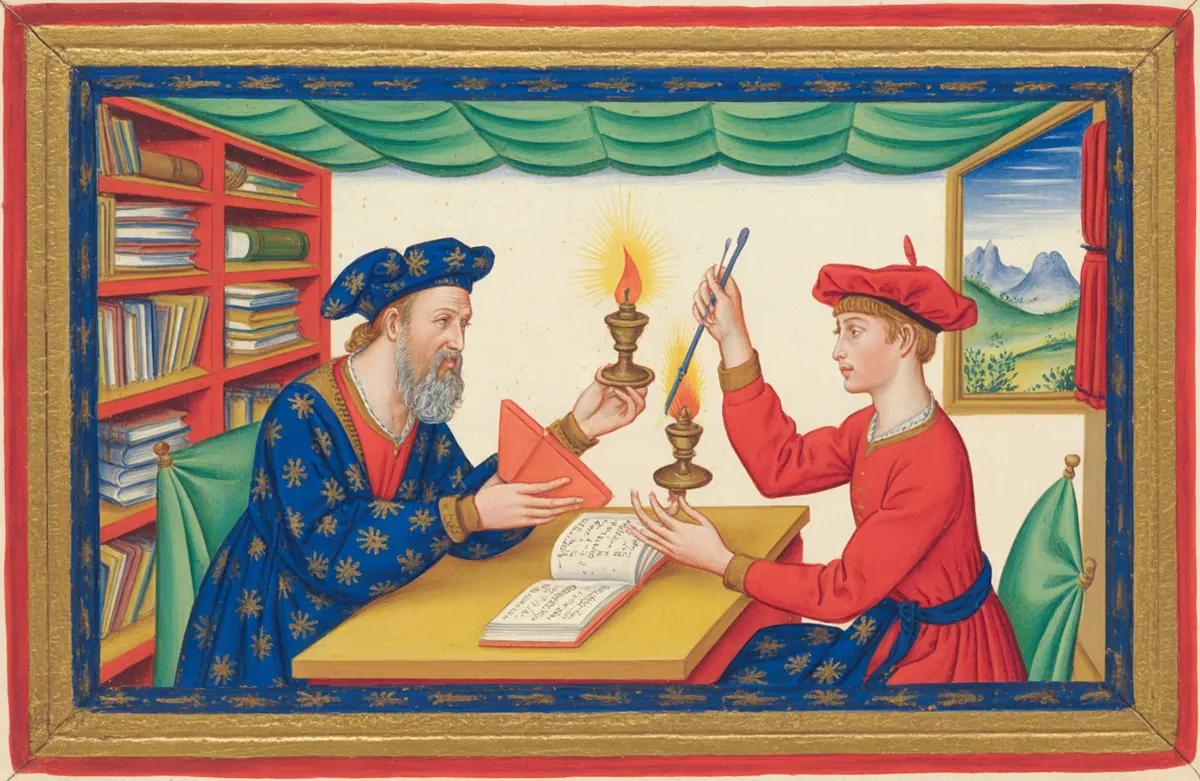
The Man Who Taught Me All This
Who Dr. Bob was, what he taught me, and why I keep telling his story.
If you’re lucky, you’ll meet one teacher who changes the way you see. Not a teacher from school, maybe. Just a person who hands you a new pair of eyes. And if you’re lucky that way, then one day you’ll lose them. When that day comes, you’ll find you’re carrying some of what they knew. You’ll have to decide what to do with it.
Mine was a man named Bob Melamede. Everyone called him Dr. Bob. He wore wire-rim glasses and a big bushy mustache, as if it were still 1975. He was blunt, he swore freely, and he laughed a lot.
Here is who he was, as best I can tell it.
He grew up in New York City and earned a PhD in how genes and cells work. Then he spent years in labs on one question: how a cell fixes its own DNA when it gets hurt. Some of that harm comes from the sparks a cell throws off as it burns its fuel. “The friction of life,” he called it. Along the way he read Ilya Prigogine, the chemist whose work sits under rule one. He built his own ideas on top of it. In 2001 he moved to Colorado to head the biology department at a state school there. The next year he began a class on the cannabis-like part of the body. He said it was the first college class on it anywhere. He also ran for the Senate twice and for Congress once, in Vermont, for a tiny third party. He never got more than a few thousand votes.
He was my teacher, and he was my friend.
Most of the letters you’ve read so far about the body are his ideas in my words. Rule one is his. He taught me that a living thing is a flow, kept going far from rest. A thing that stops flowing isn’t resting. It’s done. The thermostat in letter two is his picture. So is the split between forward-looking people and backward-looking people. Some meet change by leaning in. Some spend their lives trying to get back to how things were.
Now rule five, and he gets no free pass. Some of his big claims went past what anyone could show. He said cannabis could cure cancer. The proof for that isn’t there, and saying it cost him. In his own words, it made him an outcast in his field. I don’t ask you to take those claims on faith, and I don’t take them that way either. The world gets the last word, even over my teacher. What I kept is what held up when I tried it in my own life.
And now rule four. Dr. Bob had a stroke in 2022 and died in April of 2023. He was seventy-five. Time runs one way. I can’t go back and ask him one more question. The only push left to me is forward, so I push it here. I carry what held up, and I say where I got it.
That’s why I keep telling his story. Ideas don’t outlive people on their own. They need someone to carry them, and they need someone to say whose they were. A whirlpool keeps its shape because new water keeps coming. A teacher’s ideas work the same way.
Try this this week.
Think of the one person who most changed the way you see. Write down one thing they taught you, in your own words, in a few lines. Then teach it to one person who has never heard it, and tell them where it came from. If your teacher is still alive, call them and tell them you did it. Notice how much more of it you understand once you’ve had to say it out loud.
One line to remember
Carry what held up, and say whose it was.