Key takeaways
- Open chemical systems fed by an energy gradient can organize themselves into repeating cycles without DNA, as shown in Ilya Prigogine’s dissipative structure physics and the Belousov and Zhabotinsky oscillator.12
- Inside living cells, nutrient metabolism directly feeds nuclear acetyl coenzyme A into histone acetylation, physically opening DNA wound around nucleosomes (PDB 1AOI) so specific genes can be read.34
- Dr. Bob Melamede extended that biochemistry into an evolutionary framework placing metabolism before genetics, linking open chromatin, reactive oxygen species mutagenesis and vertebrate mitochondrial CB1 signaling. Parts of that cascade are established cell biology; the broader evolutionary claims remain conceptual hypotheses rather than settled textbook consensus.56789
Follow sunlight and hydrothermal vents into prebiotic chemistry, watch acetyl coenzyme A unspool nucleosomes around DNA, and trace how vertebrate mitochondrial CB1 receptors help manage metabolic stress. Each chapter separates established biochemistry from Dr. Bob’s broader evolutionary synthesis.
Established science and Dr. Bob’s evolutionary synthesis
| Step in the arc | What cited experiments and physics show | How Dr. Bob framed it |
|---|---|---|
| Prebiotic organization | Energy gradients across open systems drive dissipative structures and chemical waves without genes.12 | Sunlight and hydrothermal vents ran planetary metabolism long before genetic code existed.9 |
| Metabolism to chromatin | ATP citrate lyase turns cellular glucose flux into nuclear acetyl coenzyme A that acetylates histones on nucleosomes.34 | What the cell eats holds the keys to the genetic library, inverting the textbook Central Dogma.8 |
| Transcription and mutation | Open, actively transcribed DNA is physically exposed to oxidative stress and replication fork stalls.58 | Metabolism focuses mutations onto the exact genes an organism uses to adapt to a new stress.8 |
| Vertebrate CB1 evolution | Canonical CB1 receptors appeared in chordates and vertebrates and regulate neuronal mitochondrial respiration.67 | CB1 acted as a circuit breaker for mitochondrial free radical friction, unlocking large vertebrate brains.9 |
The full answer
The Blueprint Illusion
Biology textbooks start with the Central Dogma: DNA makes RNA, RNA makes protein, and protein builds the cell. Dr. Bob Melamede asked the question that picture leaves unanswered: what built the blueprint in the first place?89
Before he became known for teaching cannabinoid biology, Dr. Robert Melamede chaired the biology department at the University of Colorado Colorado Springs and published laboratory research on DNA damage and recombinational repair in bacteriophage T4.5 His skepticism of a passive blueprint view came straight out of spending decades at the bench watching molecules fail, break and repair.
An architectural drawing dropped onto an empty lot cannot dig a foundation or wire a wall because paper carries no energy flow. The chapters below trace Dr. Bob’s alternative order of events: energy gradient first, continuous chemical metabolism second, epigenetic chromatin control third, and DNA as an evolving archival record rather than an uncaused ruler.
Transcript of this chapter 00:00
My name is Justin Hartfield. I’ve spent over twenty-five years building companies in the cannabis space, starting with Weedmaps back in 2008.
Over those decades, I’ve met countless thinkers, but nobody rewired my understanding of reality like my mentor, the late Dr. Bob Melamede.
Bob was former chairman of the biology department at the University of Colorado Colorado Springs and held a PhD in molecular biology and biochemistry, specializing in DNA repair. He was an elite laboratory scientist who spent decades doing DNA research, while also being an unapologetic, self-described "stoned-out hippie."
If you open any high school or college biology textbook today, they teach you what’s known as the Central Dogma: DNA makes RNA, RNA makes protein, and protein makes you. They tell you that DNA is the "master blueprint of life," and that life began when a magic strand of genetic code accidentally assembled itself in the primordial mud.
Bob called that complete nonsense.
Bob asked a simple question that conventional biology couldn't answer: Where did the blueprint come from?
If you drop a roll of architectural blueprints onto a vacant lot, a house doesn't build itself. A blueprint has no energy. It has no engine. It can’t dig a foundation, nail a board, or turn on the electricity.
Today, we are going deep into Dr. Bob’s most profound scientific legacy: The Metabolic Origins of the Universe.
You are going to see why DNA didn't create life. Life created DNA. And you are going to see the exact thermodynamic pathway showing how flowing energy organizes metabolism, how metabolism directs epigenetics, and how epigenetics writes the genetic code.
Test Tube Earth
Under equilibrium thermodynamics, the odds of a functional DNA strand assembling by random atomic collisions look vanishingly small. Earth, however, was never a closed box at equilibrium.1
Dr. Bob Melamede, in his own words
And we have been part of a chemical reaction, a chemical reaction that has gone on since the planet formed. We'll, we'll start
Dr. Bob Melamede, in his own words
You know, if we took me and dissolved me down to my molecular components and put me in a big die tumbler and went... what's the probability of me coming out? Zero. But I'm here talking to you, so how did I get here? Obviously not through the die tumbler approach, which is intrinsic to equilibrium thermodynamics. In contrast, what you'll see is that organization must happen when you have flowing energy.
Dr. Bob Melamede, in his own words
Here we saw evolution of a chemical system in a test tube. Well, imagine evolution on the planet driven by sunlight and thermal vents and volcanoes occurring over billions of years.
Nobel laureate Ilya Prigogine showed that open systems crossed by a steady energy gradient behave completely differently from sealed containers cooling toward death.1 Solar radiation pours into Earth’s surface, geothermal heat rises through deep ocean hydrothermal vents, and waste heat radiates out into cold space. Matter sitting inside that river of energy spontaneously organizes into dissipative structures that move energy faster than disordered soup can.
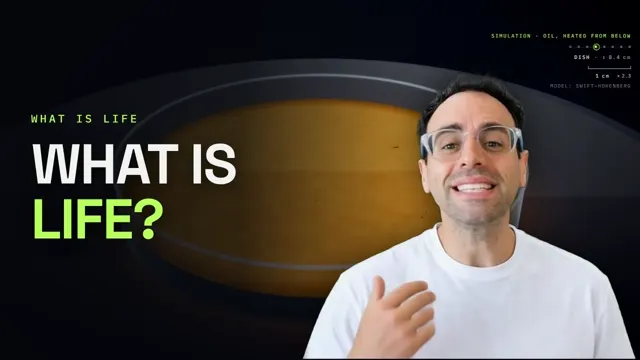
Even simple lifeless laboratory mixtures demonstrate the principle. In the Belousov and Zhabotinsky reaction, ordinary chemicals pulse in coordinated waves and rotating spirals with no genes, no membranes and no enzymes involved.2 To Dr. Bob, Earth’s early oceans acted as a planetary test tube running those energetic chemical cycles for hundreds of millions of years before biology stabilized a genetic code.9
Transcript of this chapter 01:46
Dr. Bob Melamede, in his own words
And we have been part of a chemical reaction, a chemical reaction that has gone on since the planet formed. We'll, we'll start
Dr. Bob Melamede, in his own words
You know, if we took me and dissolved me down to my molecular components and put me in a big die tumbler and went... what's the probability of me coming out? Zero. But I'm here talking to you, so how did I get here? Obviously not through the die tumbler approach, which is intrinsic to equilibrium thermodynamics. In contrast, what you'll see is that organization must happen when you have flowing energy.
Dr. Bob Melamede, in his own words
Here we saw evolution of a chemical system in a test tube. Well, imagine evolution on the planet driven by sunlight and thermal vents and volcanoes occurring over billions of years.
Look at what Bob is pointing out.
If you take a traditional physics view, life is statistically impossible. The odds of a string of DNA spontaneously forming out of random collisions of atoms are worse than a hurricane blowing through a junkyard and assembling a Boeing 747.
That paradox only exists because scientists were using equilibrium thermodynamics—the physics of closed, dead systems.
In the 1970s, Ilya Prigogine showed that the Earth was never a closed box. The Earth is an open engine. Enormous streams of energy pour in from the sun and heat from hydrothermal vents, and escape back into the freezing vacuum of space.
Whenever energy flows across a gradient, matter organizes into what Prigogine called dissipative structures.
Just like water pulling into a whirlpool to drain out of a bathtub faster, prebiotic chemistry organized into continuous chemical cycles to burn through that energy gradient.
Long before there were genes, long before there were cells, the metabolism was already running.
The First “Cells” Had No Genes
In metabolic origin models, the earliest protocells were fatty acid membranes trapping continuous chemical flow, with no DNA or RNA blueprint inside them yet.9
Dr. Bob Melamede, in his own words
And that eventually created in the primordial soup this whole diversity of chemical reactions that eventually were talking to one another and created such a level of complexity that you basically had cells, but without genetics. You had flow-dependent structures that were the successful, essentially, metabolism. You know, they formed membranes, so you had a cell-like structure, but you didn't have that relationship between the metabolism that generated the organization and some kind of a record that would let you start again and work with what you've had. In other words, build over time biological evolution.
Think of a jazz band improvising live in a club for hours before anyone buys a tape recorder. The music is metabolism: active, responsive, and dependent on energy moving through the room. DNA is the cassette tape added later so the band does not have to relearn the tune from scratch every night.
- Active chemistry first: lipid bubbles take in molecules, transfer electrons across chemical gradients and expel waste while energy flows.
- Fragile memory: without a copying archive, whenever a prebiotic membrane ruptures, its working network disappears.
- Genetics as storage: nucleic acids lock successful metabolic pathways into a durable record that lets biological evolution accumulate over time.
Transcript of this chapter 03:40
Dr. Bob Melamede, in his own words
And that eventually created in the primordial soup this whole diversity of chemical reactions that eventually were talking to one another and created such a level of complexity that you basically had cells, but without genetics. You had flow-dependent structures that were the successful, essentially, metabolism. You know, they formed membranes, so you had a cell-like structure, but you didn't have that relationship between the metabolism that generated the organization and some kind of a record that would let you start again and work with what you've had. In other words, build over time biological evolution.
Think of it like this:
Imagine a legendary live jazz band improvising in a club. The music is flowing, dynamic, complex, and alive.
After hours of playing, the band decides: "This music is incredible. We need to buy a tape recorder so we can write this down and remember how to play it tomorrow."
The music is metabolism. The cassette tape is DNA.
Mainstream biology acts like the cassette recorder walked into the empty club and invented jazz.
It didn't.
The original "cells" were purely metabolic bubbles. They had fatty acid walls, they took in food molecules from the water, they pushed electrons down chemical chains, and they excreted waste. They were alive because energy was flowing through them.
The problem was, when a prebiotic metabolic bubble popped, all that accumulated operational wisdom was lost.
To survive long-term, the flowing chemistry needed a way to stabilize itself. It needed an archival hard drive.
The Holy Trinity Inverted
DNA inside a human cell is not an open page waiting to be read. Roughly 146 base pairs at a time wrap tightly around histone protein spools called nucleosomes, keeping closed genes physically silent.4
Dr. Bob Melamede, in his own words
there's a continuity that occurs between flowing energy organizing matter and creating life, and how we respond to things via free radical production,
Dr. Bob Melamede, in his own words
What I'm trying to say is that metabolism gets turned into epigenetic control, and that that epigenetic control winds up actually, um, providing for a targeted source of mutagenesis and change, such that the metabolism that becomes institutionalized in the epigenetics subsequently gets further institutionalized in genetics.
What opens those spools is direct metabolic chemistry. In a landmark 2009 Science study, Kathryn Wellen and colleagues showed that when mammalian cells metabolize glucose, the enzyme ATP citrate lyase converts citrate into nuclear acetyl coenzyme A, which attaches acetyl groups directly onto histone tails.3 Histone acetylation loosens the grip on DNA and exposes specific genes for transcription.
Shift the cell’s fuel state toward fat oxidation and fasting, and deacetylase enzymes tighten those spools back down while other maintenance and repair programs open up. In that concrete biochemical sense, metabolism does not wait passively on genetic orders; the cell’s energetic state directly gates which chapters of its DNA library stay open.348
Transcript of this chapter 05:30
Dr. Bob Melamede, in his own words
there's a continuity that occurs between flowing energy organizing matter and creating life, and how we respond to things via free radical production,
Dr. Bob Melamede, in his own words
What I'm trying to say is that metabolism gets turned into epigenetic control, and that that epigenetic control winds up actually, um, providing for a targeted source of mutagenesis and change, such that the metabolism that becomes institutionalized in the epigenetics subsequently gets further institutionalized in genetics.
Here is the mechanism that Bob unlocked, and it is brilliant.
Your DNA is not an open book sitting on a library table. It is coiled tightly around spool-like proteins called histones. When DNA is spooled up tight, it is completely hidden from the cell; it's unreadable.
What decides which genes get unspooled and read? Metabolism.
When your cell is burning sugar, it produces a specific chemical byproduct called Acetyl-CoA. That Acetyl-CoA directly attaches to the histones—a process called histone acetylation.
It physically forces the spools open.
When you burn sugar (differentiated action), one set of genes opens up.
When you burn fat and trigger autophagy (cellular repair and fasting), your cells deacetylate those histones, slamming the sugar genes shut and opening the repair and stem-cell genes.
Your DNA doesn't tell the cell what to eat. What the cell eats tells the DNA how to open.
Metabolism holds the keys to the genetic library.
The Targeted Mutagenesis Engine
Textbook evolution usually treats mutations as blind typos scattered randomly across the genome. Dr. Bob argued that epigenetic opening creates a physical bias in where damage and change actually land.8
Dr. Bob Melamede, in his own words
the genes that are turned on in particular, um, are exposed to free radicals simply by the fact, for example, that they're being, um, they're being transcribed, that they're genetically active. A stalled replication fork that would occur, for example, uh, with a appropriate type of damage would then in turn lead to strand breaks, which are of course highly mutagenic and pro-recombinant.
When an organism hits a new environmental stress, its metabolism shifts to keep energy flowing, and epigenetic tags unspool the specific genes needed to cope. While those regions are unwrapped and actively transcribed, exposed single strands of DNA and replication forks sit far more vulnerable to reactive oxygen species generated by cellular respiration than tightly packed, silent chromatin does.
Drawing on his laboratory background in DNA damage and recombinational repair in bacteriophage T4, Bob noted that stalled replication forks and strand breaks both drive mutation and favor recombination.58 If a resulting change helps metabolism run cleaner under the new stress, selection preserves it, turning a temporary epigenetic response into a lasting genetic inscription.
Transcript of this chapter 07:20
Dr. Bob Melamede, in his own words
the genes that are turned on in particular, um, are exposed to free radicals simply by the fact, for example, that they're being, um, they're being transcribed, that they're genetically active. A stalled replication fork that would occur, for example, uh, with a appropriate type of damage would then in turn lead to strand breaks, which are of course highly mutagenic and pro-recombinant.
Traditional evolutionary theory tells you that mutations in DNA are completely random accidents—like blind typos in a million-page book.
Dr. Bob showed that evolution is far smarter than that.
When an organism faces a new environmental stress, its metabolism shifts to survive. That metabolic shift uses epigenetics to open up the exact genes required to deal with that stress.
And because those specific genes are now physically open and being read constantly, they are the exact genes exposed to the cellular exhaust: the free radicals.
The open genes take the mutational hits. The closed, protected genes stay untouched.
In other words: metabolism focuses mutations right where the cell is trying to adapt.
When a mutation helps the metabolic flow run cleaner, the cell survives. That metabolic success becomes locked into the epigenetics, and over evolutionary time, it gets permanently etched into the DNA.
DNA is not an isolated dictator sitting in an ivory tower. DNA is an evolving ledger written by the metabolic furnace of life.
Life as a Dynamic Fractal
Evolution does not repeat a fixed formula against a frozen backdrop. Every successful metabolic adaptation rewrites the environment, forcing the next round of organisms to adapt to the world they just altered.9
Dr. Bob Melamede, in his own words
A dynamic fractal. And what, what a dynamic fractal in my version of reality is, is that every time you reiterate that algorithm, you change it. And what do you change it based on? You change it based on your first algorithm changed the environment, the environment changed you. If you want to adapt, you now have to change back to the environment that you've changed. So there's this constant process of unfolding, and that's what evolution is.
Earth’s Great Oxidation Event around two and a half billion years ago illustrates that feedback loop at planetary scale. Early photosynthetic cyanobacteria tapped sunlight so effectively that they flooded the oceans and atmosphere with corrosive free oxygen, triggering an ecological crisis for anaerobic life.
Instead of halting evolution, that steep oxygen gradient drove a far from equilibrium phase change. Cells evolved aerobic respiration, harnessing oxygen to extract far more energy from organic molecules and powering the rise of complex multicellular life. Dr. Bob called that recursive feedback between organism and environment a dynamic fractal: every iteration updates the rules for the next one.19
Transcript of this chapter 09:01
Dr. Bob Melamede, in his own words
A dynamic fractal. And what, what a dynamic fractal in my version of reality is, is that every time you reiterate that algorithm, you change it. And what do you change it based on? You change it based on your first algorithm changed the environment, the environment changed you. If you want to adapt, you now have to change back to the environment that you've changed. So there's this constant process of unfolding, and that's what evolution is.
Look at how this dynamic fractal played out on Earth:
Two and a half billion years ago, primitive photosynthetic bacteria learned how to eat sunlight. They were so successful that they flooded the entire planet with a toxic, corrosive gas: oxygen.
They fundamentally altered the atmosphere of the planet. And in doing so, they created an environmental crisis that nearly wiped them out.
Did the universe stop? No.
That massive oxygen gradient created a far-from-equilibrium phase change. Life adapted by inventing respiration—learning how to take that oxygen and burn hydrocarbons with unprecedented efficiency.
The organism changes the environment. The new environment forces the organism to evolve. The cycle reiterates, pushing complexity higher and higher.
The universe isn't a static loop. The universe is an evolving dynamic fractal driven by metabolic flow.
The Vertebrate Leap
Metabolically demanding brains burn enormous amounts of energy and generate heavy oxidative friction inside mitochondria. Comparative genomics shows that canonical CB1 cannabinoid receptors emerged specifically with chordates and vertebrates.6
Dr. Bob Melamede, in his own words
And that's, in my mind, what powered the evolution of humanity. It was the CB1 receptor, which first appeared with the vertebrates. Not invertebrates, vertebrates, okay? Once we got our brains in the vertebrates, we had the CB1 receptor.
Dr. Bob Melamede, in his own words
Feeding behavior driven by the endocannabinoid system drives the evolution of deuterostomes and man.
Dr. Bob Melamede, in his own words
And the mitochondria being this nuclear reactor that can be good or bad depending on whether it's leaking radiation, in this case, in the form of free radicals. Um, by a- by being able to fine-tune that nuclear reactor, you can keep it from spitting out too many free radicals. And that's what the CB1 receptor is doing.
In 2012, Giovanni Bénard and colleagues demonstrated in Nature Neuroscience that CB1 receptors sit not only on outer neuronal membranes but also on mitochondrial membranes, where they directly regulate cellular respiration and energy output.7 Later structural crystallography and cryogenic electron microscopy resolved the human CB1 receptor and its signaling complex at atomic resolution (PDB 5TGZ and 6N4B).7
Dr. Bob combined those findings into his signature evolutionary claim: by giving vertebrates a finely tuned circuit breaker over mitochondrial free radical output and linking appetite and energy balance to changing environments, the endocannabinoid system lifted the metabolic speed limit on brain size, learning and human adaptability.679
Transcript of this chapter 10:26
Dr. Bob Melamede, in his own words
And that's, in my mind, what powered the evolution of humanity. It was the CB1 receptor, which first appeared with the vertebrates. Not invertebrates, vertebrates, okay? Once we got our brains in the vertebrates, we had the CB1 receptor.
Dr. Bob Melamede, in his own words
Feeding behavior driven by the endocannabinoid system drives the evolution of deuterostomes and man.
Dr. Bob Melamede, in his own words
And the mitochondria being this nuclear reactor that can be good or bad depending on whether it's leaking radiation, in this case, in the form of free radicals. Um, by a- by being able to fine-tune that nuclear reactor, you can keep it from spitting out too many free radicals. And that's what the CB1 receptor is doing.
This is where cannabis and the endocannabinoid system re-enter the story.
Invertebrates—like insects and mollusks—hit an evolutionary speed limit. They couldn't run high-octane metabolic brains without frying their cells in free-radical friction.
Four hundred million years ago, vertebrates broke through that barrier by evolving the endocannabinoid circuit breaker.
The CB1 receptor allowed our ancestors to throttle the mitochondrial nuclear reactor, buffering the friction of high-speed thinking.
And the endocannabinoid system drove our appetite and feeding behavior, allowing us to hunt, eat, store energy, and survive in wildly shifting climates.
Consciousness, curiosity, and human intelligence are the direct descendants of that four-billion-year-old metabolic stream.
Epilogue
Seen through thermodynamic biology, a living body is not a static sculpture reading orders off a rigid script. It is a continuous four billion year energy flow using DNA as its working library.139
Your daily habits change the real chemical signals bathing your chromatin: nutrition alters nuclear acetyl coenzyme A availability, movement and sleep reshape mitochondrial turnover, and chronic stress shifts oxidative load. None of that rewrites your sequence overnight, and this video is science education rather than medical advice, yet the physical lesson is clear: metabolism sets the operating conditions for every gene you carry.
To follow the rest of Dr. Bob’s thermodynamic trilogy, pair this episode with Answer 38 on generalized open system dynamics and Answer 40 on his seven philosophical questions of existence.
Transcript of this chapter 12:08
You are not an isolated spectator watching a dead universe.
You are an active participant in an unbroken metabolic flame that has been burning on this planet for over four billion years.
DNA is not your master. It is your library.
Your daily metabolism—how you eat, how you move, how you breathe, how you handle stress, and how you adapt—is the living music that decides which chapters of that library get read.
Understand your engine. Respect the flow. And stay far from equilibrium.
What the studies show
Every claim in this answer, the study behind it, who was studied, and who paid for the research. “None listed” means the paper names no funder.